English
 Español
 Français
 Deutsch
 Italiano
 Português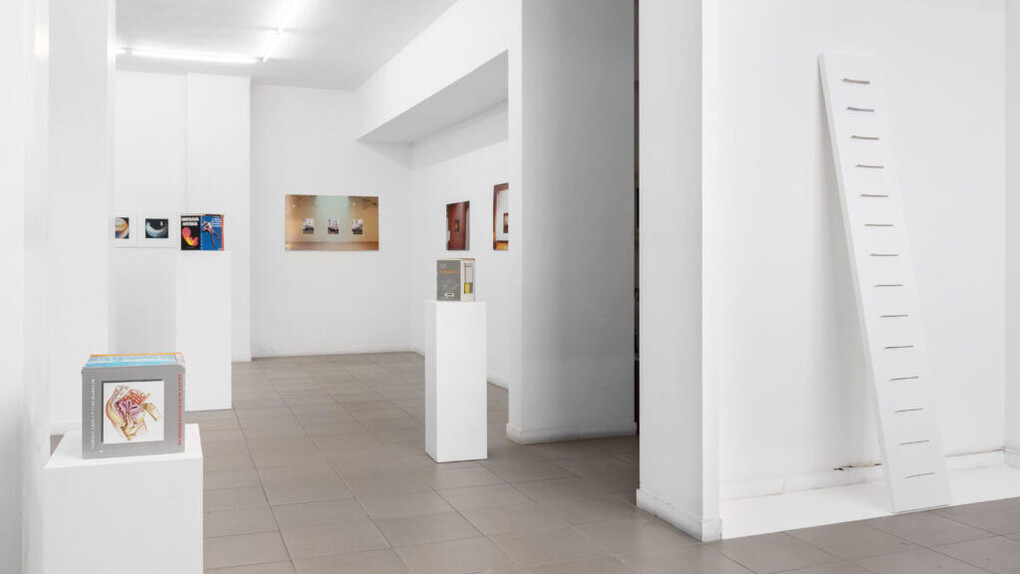
The Gallery Apart is proud to announce Materia paterna, the second solo exhibition of Cesare Pietroiusti in the gallery spaces.
Grounded on the previous exhibition Valori, which partially focused on the complexity of the father/son relationship filtered through his father’s stamp collection, Pietroiusti investigates his relationship with his parents even more deeply, blatantly with respect to the father figure, but with a significant reference to his mother, ironically evoked through the term materia. Nothing can serve as an introduction to the exhibition better than the text written for the occasion by the artist.
The decision to devote an exhibition to the father figure –- not to the father in general, but to one’s own father – demands a chance, after deducting all of probable unconscious determinants.
In this case, it was the fact that I had to empty out, after selling it, the apartment on Via Novara, in the “posh” Trieste neighborhood of Rome, a short walk from the Macro Museum, where my maternal grandparents and, from my birth onward, my parents had lived. In that house my grandfather died in 1963, my grandmother in 1986, my father in 2011, and my mother four years ago. All the rooms were filled with objects whose stories, functions, appearances, spanned three generations – from the early to the last years of the 20th century. I threw out much, but much I kept, hoping to find interesting or surprising documents, perhaps able to shed light on aspects unknown to me about some family member. Thus, in the basement, in a couple of voluminous boxes covered with black soot, I found hundreds of documents about the scientific publications (1960-1966) of my father, Guido Pietroiusti.
Guido was a physician, a successful gynecologist (but he preferred to call himself “obstetrician”), long chief physician, in the happiest years of his professional life, of the Velletri Hospital. He was not a great speaker, nor a refined intellectual, but he was certainly an excellent doctor, highly respected and loved by his patients. I remember, in particular, his ability to reassure the parturients in the decisive moments of labor. He was convinced that I would also be an obstetrician, and when – I think I was in my second year of university and, incidentally, very late in my sexual maturation – he took me to his department and tried to teach me how to do a gynecological examination, I was overwhelmed with embarrassment, a sense of inadequacy and an unbridgeable distance between me (my fingers) and the possibility of making any kind of sense of what I was doing. Indeed, that distance has never been bridged, and perhaps the fact that I have been an artist and not a doctor is also due to that trauma.
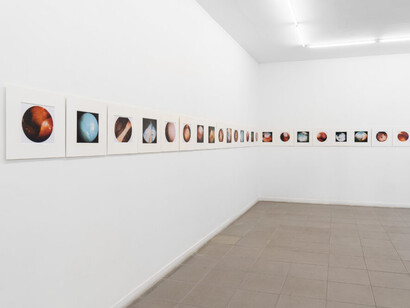
Some of my father’s publications tell of a new technique learned in France, the celioscopy: a way, later to become very common, of exploring the female genital apparatus by “endoscopic means” by drilling a hole in the abdomen and passing a small lens through it connected to a photo- or video-camera. In the publication The importance of celioscopy in gynecologic diagnostics, the technique is illustrated both with color images of the internal organs and with some black-and-white photos of the surgical setting, in one of which my father is seen with his eye glued to a camera precariously connected to a tube that penetrates the abdomen of a person under general anesthesia, whose body is, otherwise, covered. This image, and the series of “celiophotos” reproduced in this and other files, reminded me that, between 1989 and the mid-1990s, I had exhibited, on various occasions in galleries and museums, photographic reproductions of what was on the other side of the walls of exhibition spaces.
The project of this Materia paterna exhibition thus emerges from the idea of a comparison, and perhaps an attempt to shape an affinity that, given the obvious distance with respect to professional choices and values, is -– at least for me – unexpected and surprising.
Materia paterna thus becomes a project that lies between homage and the critical underlining of a substantial difference, between nostalgia and the irony of retracing a story punctuated by shreds of memory, through the reuse, manipulation, and re-configuration of objects otherwise meant to be thrown away in a dump. As if art could, with a freedom that not even scientific research possesses, make sense of otherwise incomprehensible or unwieldy, unserviceable or untouchable matter.
The exhibition presents a large body of works, some historical but mostly new production. As if to certify the trait d’union with the previous gallery exhibition, the artist has created a large-scale work consisting of two collages placed against each other, like two sides of a huge envelope, and containing respectively dozens of postal wrappers from auction houses or stamp dealers and dozens of letters and invoices attesting to his father’s acquisitions for his collection.
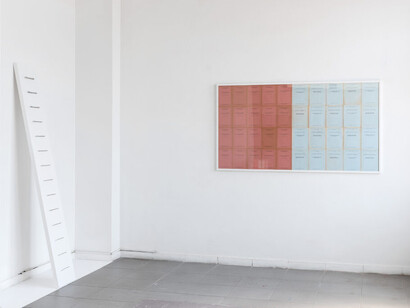
Much of the exhibition focuses on his father’s medical activities. Having found a substantial number of his father’s publications and books from his library, Pietroiusti used the scientific publications to create a large collage in which repetition and bichromy give rise to a work somewhere between conceptual and abstract-geometric, while the books have taken on new life in a series of volumetrically regular sculptures.
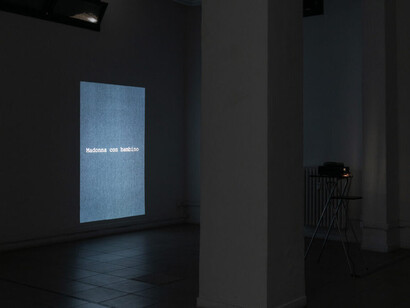
A photographic series, on the other hand, is based on the reproduction of images found by the artist and made by his father using the technique of celioscopy. Internal organs are revealed as the scene of enigmatic beauty, giving rise to images that evoke sidereal space. Directly connected, the sculptural work obtained by lining up, according to a dimensional progression from small to large, a series of steel uterine dilators, positioned to compose a sort of ascending staircase. And again through the use of objects found in his father’s studio, here is a work consisting of a sequential projection of 80 slides all titled Gynecology presumably used for educational purposes.
This body of work that reuses residual objects from his father’s long professional activity offers Pietroiusti an opportunity for an analysis of himself and his (failed) relationship with medicine, but it also prompts reflection on the female body, its centrality to the known universe and the miracle of life (think of Courbet’s L’origine du monde) but also on the dialectic between the traditional and patriarchal view of femininity as a mystery and the internalized awareness of the principle of women’s self-determination of their own bodies.
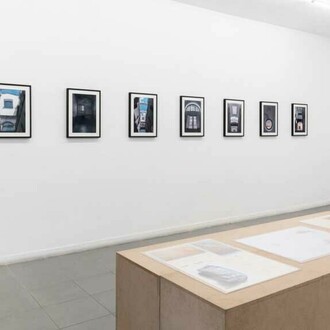
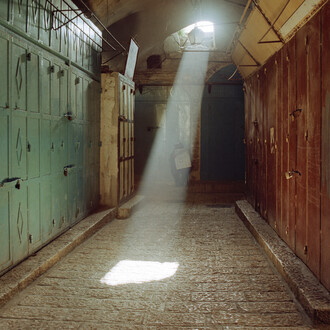
Perhaps, in the end, the dialectic is, once again, between interiority (of the body but also of the self, of a place but also of an institution) and exteriority. Precisely in relation to this latter aspect, Pietroiusti reproposes in the exhibition some historical photographic works belonging to the series Finestre vivita from 1989/90. Just as the human body can be investigated and seen in its internal structures through some of the medical techniques evoked in the exhibition, buildings and spaces can also be transfixed by the artist’s gaze and reveal otherwise invisible realities.
(A special thanks to Alex Paniz)