English
 Español
 Français
 Deutsch
 Italiano
 Português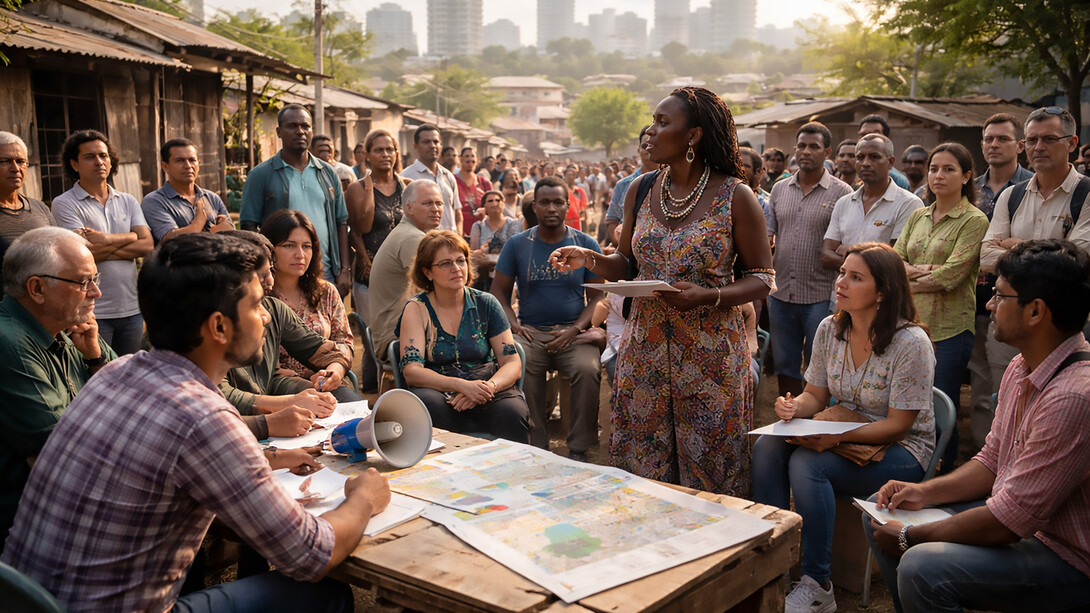
Analyses of success factors in development projects worldwide are repeatedly showing that the proactive participation of public-interest civil society in such projects plays a make-or-break role in their ultimate sustainable impact. Currently, the main obstacle to such a proactive participation is political. It is thus not far-fetched to say that the ruling development paradigm has gotten to a dead end, primarily because it has ignored turning on civil society's potential. Giving a greater protagonist role to civil society in sustainable development is thus one of the main challenges we all face.
At least two key questions are raised when talking about civil society: First, where do these organized (community) groups draw their mandates from (and how do they claim to get these mandates)? And second, what kind of capacity building, advocacy, social mobilization, and empowerment of their constituencies do they get engaged in? Unfortunately, much of the response to these questions is in the eye of the beholder. There certainly are many kinds of these groups with different purposes and serving different constituencies (or claiming to do so); many of them are 'single issue' (AIDS, pro-abortion, pro-environment, etc.); others have wider development scopes of action.
To start with, a minimum consensus needed in civil society to build upon when engaging in development work is to agree on the following:
A given science (which tells us what can be done).
A given ethics (that tells us what ought to be done).
A given political stance (that tells us what must—or must not—be done, how, with whom, and against whom it could best be done, followed by actually getting involved in doing it).
Science, ethics, and politics actually come together in conceptual frameworks that depict the different levels of causes of underdevelopment (from immediate to underlying to structural). Such conceptual frameworks need to be shared in order for development practitioners to be able to agree on what can, ought to, and must be done in a given historical context. (“No common understanding, no agreement on action”).
Agreeing on the science in development work is less frequently a problem. Agreeing on the ethics has come a long way in the short history of sustainable development. But agreeing on the politics—beyond ethical pronouncements—is the real challenge if what ought to be done is to get done the way development rights holders see it most fit.
Finding such a unifying core for these civil society organizations in the political realm is what this paper is mostly about.
The background
The issue of power (mostly the lack of it to enact sustainable development changes) is still very much at the center of the development challenge. The issue remains largely unresolved—or, looking at it from the opposite perspective, it is actually very much resolved, but against the very objectives of sustainable development.
The remaining challenge is to come up with what needs to be done during the transition to a new sustainable development paradigm based on the new emerging development ethics. Promoting and encouraging the growth of budding public interest civil society organizations with a genuine popular mandate and leadership and encouraging them to network and coalesce into movements with growing social and political power are at the center of this challenge (and seem to be the only way out).
Ethics is no longer to be seen as ancillary to development: 'Development owes it to itself to be inherently ethical.' The new ethics calls for working with those rendered poor as protagonists and not merely as recipients of goods and services. It calls for safeguarding their rights for people planning with autonomy and, in doing so, for politicizing people's actions towards development.
What commitments are then needed beyond ethics?
A climate of change is something we help create, not something that is found out there; we have to create the times rather than be in step with time.
Imposing a new, more sustainable development paradigm is a political, not an ethical task. To work on a common set of new ethical values and to actually impose them is indeed a political act.
Politics involves the true practice of ethics and ideology. Politics is the translation of all our scientific, ethical, and historical knowledge into the management of society.
In the case of struggling for sustainable development, among other things, this calls for the following:
Challenging the current 'failed development practice'; considering equity as a precondition for sustainability; direct citizens' engagement so as to regain local control(s), i.e., 'anchoring power in the community'; more systematically reflecting on the deeper causes of injustice (a political awakening) as a precondition to embark on collective citizens' actions; for people to commit themselves to the most fundamental changes needed; for coalescing local initiatives into a coherent force for change, including fostering solidarity across national boundaries.
Moreover, this brings up the crucial issue of how we, development workers, so often 'presume to talk for the people,' embracing the rhetoric of empowerment, but how we also too often really serve primarily as intermediaries between donors and dependent client populations.
As development workers, we are thus doubly challenged; not only should we oppose the old paradigm but also help set out the needed counterconcept. We have to help set the parameters of such a new emerging paradigm: its ethics and its praxis. Being radical in this effort is just a commitment to a line of analysis trying to change things that are clearly not working.
The challenge is to convince, persuade, and mobilize potential actors at different levels, including specific calls to step-by-step action. In other words, together with rights holders, we also have to build the needed capacities to intervene. This requires getting involved in bottom-centered consciousness-raising, social mobilization, advocacy, networking, coalition building, consolidation of movements, and solidarity work.
The latter emphasizes the fact that social mobilization of the local civil society per se is necessary but not sufficient. This mobilization has to come up with a way of breaking the global inertia and building more effective coalitions and networks across sectoral and geographic boundaries. Networking is thus about developing a sense of a common cause against the global embarrassment that the persistence of extreme poverty (in its different expressions) has become across the globe.
There are at least two operational ways of steering the transition process to a more sustainable development paradigm:
The primarily ethics-led process to sustainable development
As is true for slavery, there are ethical limits to tolerating extreme poverty.
The growing new development ethics that call for working with those rendered poor as protagonists and not merely as recipients has, so far, itself unfortunately remained mostly a top-down approach. It represents mostly the view of academicians, of intellectuals, of church leaders, of international bureaucrats, and of only very few politicians (mostly in the opposition). Beneficiaries have remained mostly passive in this approach, being counted rather as the 'object' of the process. This ethics-led process is mostly ethically motivated and assigns a key role to 'moral advocates' who are to advance the transition process:
The inherent weakness of this process is that to have rights ultimately respected, someone other than those rendered poor takes the responsibility at each step to steer the process from a vague entitlement to enforcement.
The primarily politically led process to sustainable development
This more bottom-up political approach (in which commitments are needed beyond ethics) better accommodates and represents the perceptions and development actions as seen from the civil society's perspective. In this approach, beneficiaries are clearly the protagonists of the process; the process is mostly politically motivated and assigns a key role to 'social activists and political advocates' who are to advance the transition process.
Although the ethically and politically led approaches represent different paths, both can contribute—through their own merits-- to a sustainable development path. They do complement each other.
Some closing remarks on the action-oriented challenges of networking and of leadership are fitting here:
Networking
Social mobilization is not window dressing just to show some degree of civil society's active involvement. As said, it is to be directed at consciousness raising to legitimize and focus the attention on the plight of those rendered poor, which ultimately seeks to control the resources they need for a genuine 'people-led sustainable development path.' But social mobilization is also to foster networking with others so as to build coalitions that can sustain the attention on the rights holders' demands and claims. And finally, social mobilization is about solidarity with other groups embarked on the same or similar endeavors elsewhere (strategic allies). It is only this concerted solidarity that has the potential to reach the threshold of empowerment needed for imposing the new development paradigm, thus overruling the current pro-status-quo power holders.
In order to create and sustain the needed attention and support, health, nutrition, education, the environment, and the many other problems of society have to ultimately be made global social and political issues (going beyond ethics but certainly departing from it). Using their de facto power base, people have to first call for action by creating the aforementioned 'global embarrassment' in their leaders for condoning the persistence of preventable ill-health, hunger and malnutrition, illiteracy and so many other social ills among the poor, given the pervasive environmental degradation we are witnessing daily. If this does not elicit the needed remedial actions, other mechanisms of social pressure will have to be considered.
Leadership
As said earlier, the new approaches called for by the new sustainable development paradigm require new types of civil society and new types of development workers/actors/activists. We are thus faced with the challenge of convincing and persuading others so as to build these growing constituencies, and for that to happen, a new breed of leadership is needed, one that plans new strategies and leads the people to launch some bold new interventions.
In short, in separate or the same individuals, there is a role for:
Moral advocates who will influence perceptions and values by giving guidance on what is permissible and fair.
Mobilizing agents or social activists who will influence action by giving guidance on what is possible and doable, on how it can be done, by whom and by when.
Political advocates who will raise political consciousness by giving guidance on what people's empirical and de facto entitlements and rights are.
Such new leaders will have to be found and nurtured—most probably in the thousands-- before we see sustainable development prevail some time in the next decades.
The transition to the new sustainable development paradigm will have to start by painting a new reality for people in social movements, because the reality they have been 'given' is not their own; it has been socially and politically constructed outside their own reality and, so far, it has been mostly controlled and manipulated to the poor of the world's detriment and disadvantage.