English
 Español
 Français
 Deutsch
 Italiano
 Português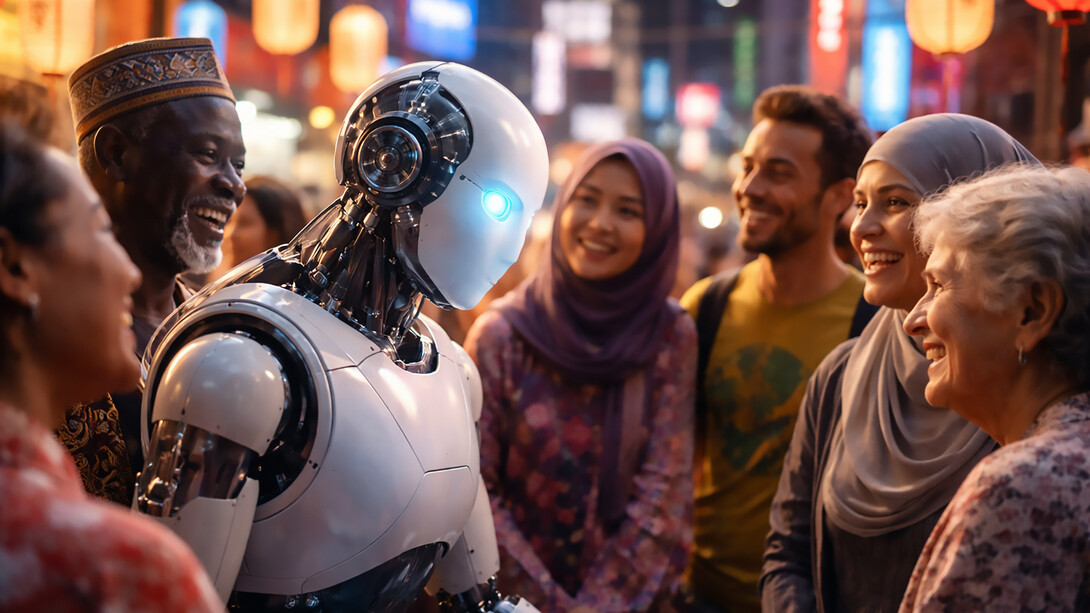
A chatbot in Tokyo recommends a ramen shop that locals swear by, not the tourist favourite. In Lagos, an AI assistant responds in Pidgin English and quotes local proverbs when giving business advice. Meanwhile, in São Paulo, a digital tutor helps students understand poetry written in their native dialect, not the sanitised, formal version taught in textbooks.
These aren’t future visions. They’re the beginning of a cultural shift in how artificial intelligence sees us and, perhaps, how we’ll see ourselves.
Until recently, AI has been fluent in syntax but tone-deaf to meaning. It could mimic language, but not life. Now, something new is happening: machines are beginning to reflect cultural nuance. They’re not just translating our words; they’re starting to interpret our world.
So what happens when AI begins to understand culture? What changes when technology doesn’t just process data but responds with context with emotional intelligence, local insight, and even humour?
The answers might reveal just as much about humanity as they do about machines.
For years, artificial intelligence has been an impressive mimic, repeating the patterns of human language without truly grasping its roots. But culture isn’t grammar. Culture is memory, sarcasm, values, trauma, and pride. It’s what makes a joke land in one place and fall flat in another.
Traditional AI systems weren’t built for this. They were trained on vast, mostly Western datasets, technical documentation, formal English, and high-volume online content. This gave us tools that could pass the Turing test in English but fumbled with nuance in other languages and contexts.
When AI couldn’t recognise the difference between a term of endearment and an insult or misread a proverb as a literal command, it reminded us: language is not logic. It’s a lived experience. And until now, that lived experience has been largely missing from the machines we use every day.
As MIT Technology Review has noted, even advanced AI translation systems still struggle when cultural context is stripped away, often producing technically correct but socially inaccurate results.
From translation to interpretation
Now, a quiet evolution is taking place. Advances in machine learning have moved beyond raw data scraping and statistical patterns. Today’s most powerful language models, like GPT-4 and its successors, are being trained not only on scale but also on diversity. And that shift is changing everything.
These systems are increasingly exposed to datasets that include regional dialects, literature from non-Western cultures, indigenous languages, music lyrics, online forums, and social media banter. The result? Responses that are starting to show awareness of tone, social dynamics, and even cultural taboos.
In some cases, AI can now distinguish between formal Arabic and the spoken Egyptian dialect and tailor its tone accordingly. It can understand that “bless your heart” might be a compliment in one context and a sarcastic jab in another. In certain languages, it even attempts to mirror formality levels based on who is speaking to whom, a crucial element of respect in many Asian cultures.
Of course, this isn’t true understanding. AI doesn’t have lived experience. It doesn’t grow up in a village, feel nostalgia for a childhood song, or flinch at a loaded historical reference. What it does have, however, is pattern recognition that is growing more sophisticated and, in many cases, eerily effective.
But with that effectiveness comes a new set of challenges. As AI becomes more culturally fluent, it doesn’t just risk getting things wrong; it risks getting them almost right, which can be even more dangerous. Misplaced humour, half-learnt idioms, and subtle stereotyping may slip through the cracks under the appearance of authenticity.
This thin line between fluency and appropriation is where things get interesting and complicated.
The power and the risk
But what happens when the machine gets too close?
The promise of cultural intelligence in AI is exciting: tools that can adapt to local customs, honour traditions, and communicate with empathy across borders. Imagine virtual teachers that can switch between dialects and honorifics. Healthcare bots that understand how mental health is spoken about or not spoken about in different communities. Customer service systems that actually get the joke.
There’s power in that kind of fluency. It opens the door to inclusion. It makes technology feel less like a foreign imposition and more like a participant in everyday life.
But there’s risk, too, and it’s not just technical.
When AI gets culture “almost right”, it can slip into stereotype. It may amplify the loudest voices in a community while silencing the marginalised ones. It might mimic slang without understanding history. Or worse, reduce centuries of tradition into quirky content for global consumption, another algorithmic flavour of the month.
This is where representation matters, not just of languages but of lived perspectives. Because cultural nuance isn’t just about what is said; it’s about who is allowed to say it and why it matters. And when datasets are shaped by bias or curated by tech giants with narrow worldviews, the illusion of understanding can become a new kind of misunderstanding.
As machines learn to “speak human”, the ethical questions get more human, too.
What do we owe to the cultures we digitise? And who decides which versions of them are preserved, edited, or monetised?
What this means for us
As AI becomes more culturally responsive, its influence stretches far beyond language. It begins to reshape how we teach, how we build, how we connect, and how we sell.
In education, culturally fluent AI could tailor learning experiences for students around the world, using stories, metaphors, and examples drawn from their own environments. In entertainment, it might recommend music not just based on genre but on mood, memory, or regional sound, expanding how we discover art across borders.
In business and communication, the implications are profound. An AI that understands cultural context could improve everything from international marketing to diplomatic messaging. It could help companies avoid tone-deaf campaigns, adapt to regional norms, or even reframe product design based on cultural values.
But it also raises the bar for responsibility. The more “human” AI sounds, the more we’ll expect it to behave ethically, to respect boundaries, to understand pain, and to respond with empathy. And while AI can simulate emotion and culture, it doesn’t feel them. That gap matters.
As users, we’ll need to develop a new kind of digital literacy, one that includes cultural literacy. We’ll need to ask: Whose culture is being represented here? Who trained this model? And what does it leave out?
When AI mirrors our world, it’s easy to forget that it was trained to reflect, not to understand.
Living in the mirror: how cultural AI reflects us back
As AI becomes more culturally responsive, its influence stretches far beyond language. It begins to reshape how we teach, how we build, how we connect, and how we sell.
In education, culturally fluent AI could tailor learning experiences for students around the world, using stories, metaphors, and examples drawn from their own environments. In entertainment, it might recommend music not just based on genre but on mood, memory, or regional sound, expanding how we discover art across borders.
In business and communication, the implications are profound. An AI that understands cultural context could improve everything from international marketing to diplomatic messaging. It could help companies avoid tone-deaf campaigns, adapt to regional norms, or even reframe product design based on cultural values.
But it also raises the bar for responsibility. The more “human” AI sounds, the more we’ll expect it to behave ethically, to respect boundaries, to understand pain, and to respond with empathy. And while AI can simulate emotion and culture, it doesn’t feel them. That gap matters.
As users, we’ll need to develop a new kind of digital literacy, one that includes cultural literacy. We’ll need to ask: Whose culture is being represented here? Who trained this model? And what does it leave out?
When AI mirrors our world, it’s easy to forget that it was trained to reflect, not to understand.
The line between reflection and understanding
Maybe the real question isn’t whether AI will ever truly understand culture but whether we do.
As we train machines to reflect our stories, values, and voices, we’re forced to consider what those stories say about us. We are feeding our digital creations with archives of who we’ve been, and in return, they’re offering us a strange, hyperintelligent mirror, polished, predictive, but still only a reflection.
There is something both humbling and urgent in that. If culture is a living conversation between people, place, and time, then the tools we build to replicate it must be handled with care. Not because they might replace us, but because they might represent us incompletely, imperfectly, and with more influence than we imagine.
When AI starts to speak our language and laugh at our jokes, the question is no longer whether it understands us.
It’s whether we’re ready to understand ourselves through it.
References
Heaven, W. D. (2021, August 12). AI machine translation struggles with language and culture. MIT Technology Review.