English
 Español
 Français
 Deutsch
 Italiano
 Português
A few years ago, in a quiet suburb outside Dublin, something unusual happened. A new data center came online. Then another. Then another. Within months, the local electricity grid operator announced that no further data center connections could be approved. Not because of protests. Not because of political resistance. Simply because the grid had no spare capacity left. The servers had consumed the margin. What looked like a local planning decision was, in reality, an early symptom of a global shift.
The digital world feels weightless. We say “the cloud” as if data floats in some frictionless ether. Yet behind every streamed film, every financial transaction, and every AI-generated paragraph sits a physical machine. That machine draws electricity, produces heat, demands cooling, occupies land, and requires regulatory permission to exist. The more digital civilization expands, the more it collides with geography, infrastructure, and energy systems designed for a slower era.
That collision is now visible worldwide. Water scarcity in the American Southwest is restricting cooling permits. Grid congestion in Northern Europe is delaying hyperscale expansion. Data-sovereignty laws in Asia and the EU are fracturing global cloud architectures into national compartments. At the same time, AI workloads are accelerating compute demand far beyond what most energy planners forecast even five years ago. The bottleneck for digital growth is no longer software innovation. It is physical capacity.
When technology encounters a physical ceiling, engineers rarely accept limits. They relocate the problem.
That is why orbital data centers have returned to serious discussion. Not as science fiction. Not as a billionaire spectacle. But as a pragmatic response to terrestrial constraints.
In orbit, sunlight is nearly continuous. No night, no clouds, no storms. Solar arrays operate without atmospheric losses. Cooling does not require air or water; heat is radiated directly into a vacuum. There are no zoning disputes, no seismic risk maps, no flooding concerns, and no political boundary conflicts. There are hazards—radiation, micrometeoroids, thermal cycling—but they are predictable hazards. Predictability is gold in infrastructure design. You can engineer for known risks. You cannot engineer for political volatility or water rights litigation.
For decades, launch costs made this idea irrational. Sending mass to orbit costs tens of thousands per kilogram. But launch economics are undergoing their own industrial transition. Reusable heavy-lift vehicles now fly repeatedly. Refurbishment cycles improve. Production lines scale. Marginal launch cost drops steadily. When cost crosses certain thresholds, orbital infrastructure stops being fantasy and becomes a spreadsheet exercise.
Inside the orbital platform, the technology is not exotic. Radiation-hardened processors already operate reliably aboard satellites. Error-correcting memory architectures are standard. Distributed computing frameworks already assume hardware faults and self-heal automatically. Optical inter-satellite laser links now move data at multi-gigabit speeds. Autonomous rendezvous and robotic servicing are commercially operational. The missing piece is not invention, but integration.
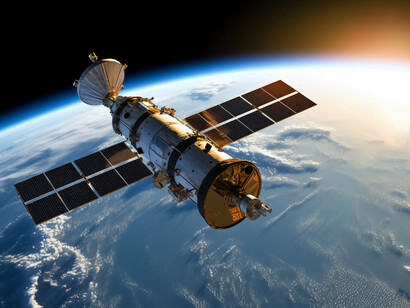
The first orbital data centers will look more like industrial modules than cinematic space cities. Pressurized compute containers. Fold-out radiator wings. Solar trusses tracking the sun. Docking ports for servicing spacecraft. AI controllers balance thermal loads, migrate workloads during eclipse periods, and detect component degradation before failure. Ground stations managing encryption, access control, compliance, and customer interfaces. Humans supervising objectives and governance. Machines handling continuous operations.
Latency shapes early markets. A signal to low Earth orbit takes tens of milliseconds round trip. Too slow for real-time gaming or high-frequency trading. Perfectly acceptable for AI model training, scientific simulation, encrypted archival storage, climate modeling, national backup vaults, and sovereign cloud hosting. Hybrid scheduling will distribute workloads dynamically between terrestrial and orbital nodes depending on latency sensitivity, jurisdictional requirements, and power availability.
Sovereignty may become the decisive driver. Governments increasingly require sensitive data to remain under jurisdictional control. An orbital data center registered under a national space authority is physically outside foreign territory yet legally domestic infrastructure. It cannot be seized by border disputes, flooded by storms, or disconnected by terrestrial sabotage. For defense, intelligence, diplomatic archives, and critical infrastructure continuity, orbital hosting becomes strategic insurance rather than a luxury.
There are real risks. Radiation degrades electronics over time. Orbital debris collision probability must be actively managed. End-of-life deorbit compliance is mandatory. Capital expenditure is heavy and patient. Regulatory frameworks for space-based data jurisdiction remain under development. None of these challenges are trivial. But none violate physical law. They are engineering and governance problems—precisely the kinds of problems modern infrastructure societies know how to solve when necessity demands.
The development path is already emerging. This decade will see experimental compute payloads on commercial space stations. The 2030s will bring pilot orbital clusters serving defense, research, and sovereign cloud markets. By the 2040s, portions of the global digital backbone may quietly operate in orbit, integrated with space-based power generation and logistics networks.
At that point, the metaphor of “the cloud” becomes literal. Some of humanity’s digital memory, computation, and intelligence will exist above the atmosphere, powered by constant sunlight and cooled by the vacuum of space.
The irony is elegant: the most physical layer of the digital world may end up beyond Earth, precisely because Earth became too crowded to contain it.
The question is no longer whether orbital data centers are technically conceivable, but when nations and industries will decide they are strategically necessary. As digital infrastructure collides with terrestrial energy limits, land constraints, and sovereignty regulation, orbit becomes the next logical zone of expansion. Early adopters will gain more than compute capacity; they will gain jurisdictional resilience, strategic autonomy, and first-mover advantage in a new layer of global infrastructure. The cloud began as a metaphor. In the coming decades, part of it will become a literal orbital asset class—and those who plan for that transition now will define the digital geography of the future.