English
 Español
 Français
 Deutsch
 Italiano
 Português
What if poetry were, above all, a gesture of recognition, an act of listening that transcends time and restores a voice to what has been silenced? This article stems from an unexpected and fruitful encounter, which took place in the fluid space of social media, yet is rooted in a shared commitment to the poetic word as a place of truth and resistance. From the intellectual friendship between two distinct paths—one still taking shape, the other already firmly established in a mature literary awareness—HoleniaPoesia takes shape: not a publishing house in the strict sense, but rather a cultural laboratory, an affectionate and critical community that chooses to swim against the tide.
The project aims to reopen the ‘drawers’ of early 20th-century literary memory, bringing to light forgotten poets, rare works, and voices marginalized by official publishing history. Futurism, Florentine journals, Ligurian lyricism, and isolated or precocious authors, alongside female figures culpably overlooked: HoleniaPoesia works with rigor, humility, and passion to restore complexity and depth to an often-simplified canon.
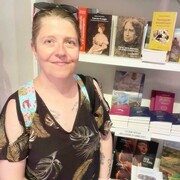
At the center, always, is poetry: understood as a sacred and necessary space, capable of speaking of the elsewhere, of holding together fragility and wonder, shipwreck and innocence. A project that does not seek the approval of trends but rather connection, even with a single reader capable of listening. Monia Moroni, one of the driving forces behind the publishing project, tells us about it.
I met an extremely talented poet a few years ago; the most remarkable thing was that I had not the faintest idea who was on the other side of the screen on Instagram. That is how our acquaintance began: I had recently plunged into this parallel world, unaware of anything, and had published two collections—attempts at writing, or exercises, as I would call them today.
Whereas he already knew his stuff; I could see straight away that he was top-class in the way he wrote verse.
HoleniaPoesia was born from his mind, that of the poet Luca Quattrini, a project named after the great Austrian writer, poet, translator, and playwright Alexander Lernet Holenia, a name that sounds grand and harmonious to the ear.
It is Luca himself who is the driving force behind this creative literary project. The aim is to bring forgotten and unknown poets back into the spotlight, with the involvement of a few prose writers and the inclusion of essays that are also stimulating from a historical perspective.
The period under consideration is the first half of the 20th century, giving a voice to movements rarely heard of today, such as the Futurists or the authors of the great Florentine magazines, La Voce di Prezzolini and Lacerba by Soffici and Papini, not forgetting the ‘Ligurians’ of Mario Novaro and his Riviera Ligure. “Words set free count as works of the utmost importance." With this powerful statement by Filippo Tommaso Marinetti in “Gli Indomabili," we define ourselves within the landscape of literary publications.
HoleniaPoesia is not a publishing house in the strict sense but a small group of cultural agitators:
“Not as a paradise lost forever, but as a source of new strength”—the words of the sculptor Antonio Canova on the theme of Ugo Foscolo’s Sepolcri, which describe us, and which we have reproduced at the foot of every issue of the literary magazine Poesia Morta, a further addition to HoleniaPoesia.
One thing that perhaps sets us apart is that we affectionately regard all Holenia authors, living or dead, as part of a large and united family.
We have since been joined by two more dynamic figures: Ettore Pollacci (translator) and Eleonora Levi Giordani (a very young poet).
Those who work behind the scenes on the books do so with humility, commitment, dedication, research, and study.
We strive to transcend the confines of provincial publishing that panders to fads and trends; ours is a painstaking endeavor to rediscover authors left in the shadows, unjustly omitted from anthologies of contemporary Italian literature, such as Nicola Moscardelli, whose complete works we are republishing—the only ones in Italy to do so.
One wonders why such excellence was locked away in a drawer: HoleniaPoesia wanted to reopen that drawer.
To give a brief overview, my literary journey began as a self-taught writer on a day when I decided to
Take the path of poetry seriously. So an independent publisher in Turin, whom I had contacted via email and who generously gave me disinterested advice regarding the poems I submitted to him, told me that in his opinion I was publishable. For Luca Quattrini, the interest and serious
Engagement with literature was immediate, I think, right from his teenage years, and his first work, Cortometrico, already demonstrated a maturity of language, highly refined metrical research, and a depth almost carved in stone. Currently, two of my poetry collections have been published by HoleniaPoesia (Dell’Amore e della Carne and Stella Binaria), whilst Luca Quattrini has six to his name (Cortometrico, Diasporo, Q. Poema Imago Vorticista, Vándor, Paràclito, and Dagherrotipia), plus two historical essays (Mussolini e le leggi razziali and Shintō).
In HoleniaPoesia, poetry itself takes center stage, embodying the breath of a sacred world that untangles the knots of existence; in just a few verses, it speaks to us of the beyond—a life woven from words and sounds that, in turn, transform into images, filling our eyes and hearts, that interweaving of personal subtleties from a bygone innocence with shards of shipwreck, where feelings become grand and central once more, and small things are clothed in the right kind of wonder.
The aim of our literary project is to reach even a single person who possesses the sensitivity and a free mind to notice one of the many authors we have featured and will feature.
I would say that, in some way, we are succeeding in small steps; we have even sold a few copies abroad.
We also have a website1 and two Instagram profiles (one for literature, @holeniapoesia, and the other for nonfiction, @holeniastoria), and all our books are available on Amazon.
HoleniaPoesia represents the voice of poets who have remained behind closed doors, yet who deserve to be heard and read for their own merit.
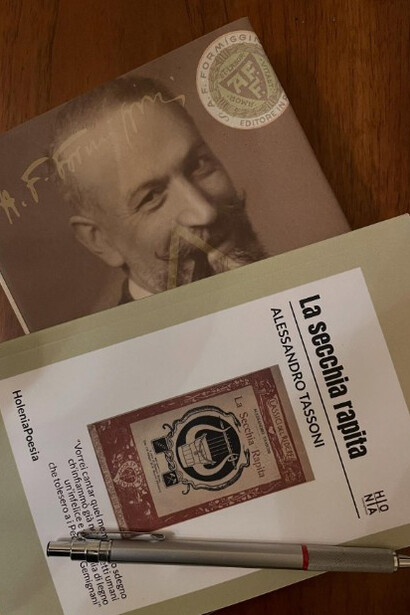
In the early months of its operation, Holenia republished several authors who had long since faded from the Italian publishing scene. To date, the Holenia catalogue boasts genuine publishing rarities: the first two volumes of Arturo Onofri’s lyrical cycle “Terrestrità del sole” in a single edition (to be followed by the remaining four); the first four poetry collections by Nicola Moscardelli, which have not been published for decades; two poetic works by F.T. Marinetti no longer in print, “L’Aeropoema del Golfo della Spezia” and “L’Aeropoema di Gesù”; “Occhilucenti” by Saturno Montanari, an author from Romagna who died very young in the war and was highly regarded by Ezra Pound; two collections of poetry by a virtually forgotten author (one of the precursors of Futurism and free verse) who has not been published for over half a century, Federico De Maria; “Cavalcando il sole” by Enrico Cavacchioli and the poems of Federigo Tozzi; as well as “Sillabe ed ombre” by Ceccardo Roccatagliata Ceccardi; and many other authors of great historical and literary significance such as Lucini, Novaro, and Michelstaedter, or influential female voices no longer in print such as those of Guglielminetti, Ginanni, Lisa Arianna Jenna, or the shepherdess-poet Dina Ferri.
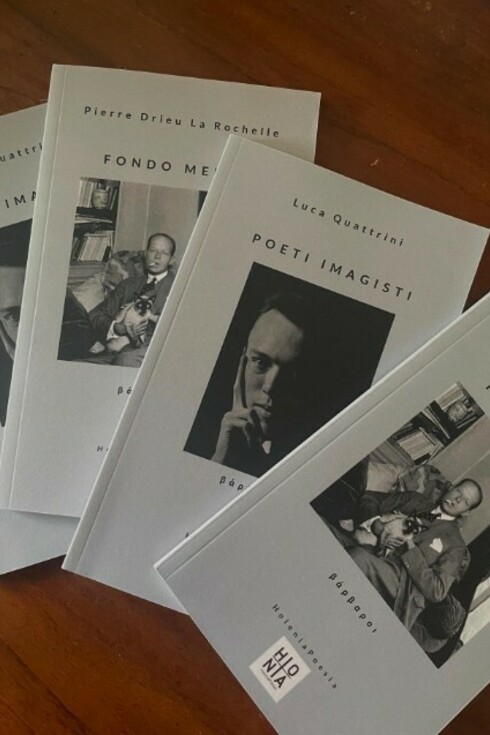
For several months now, Holenia has also had a new series, “I Barbaroi," in which translations of foreign authors are published: of particular note is an unpublished work by Yvan Goll, "Ditirambi," and a short anthology of Imagist poets.
HoleniaPoesia represents the voice of poets who have remained behind half-closed doors, yet who deserve to be heard and read for their own merit.
In the near future, I believe we hope for a continuity of work that trembles, sings, and refreshes, in which HoleniaPoesia’s commitment may be recognized by readers, in a corner worthy of literature.
After all, we are here above all to give a voice to poetry, the magnificent art that enriches the soul and the mind.
HoleniaPoesia: Luca Quattrini, Monia Moroni, Ettore Pollaci, and Eleonora Levi Giordani.