English
 Español
 Français
 Deutsch
 Italiano
 Português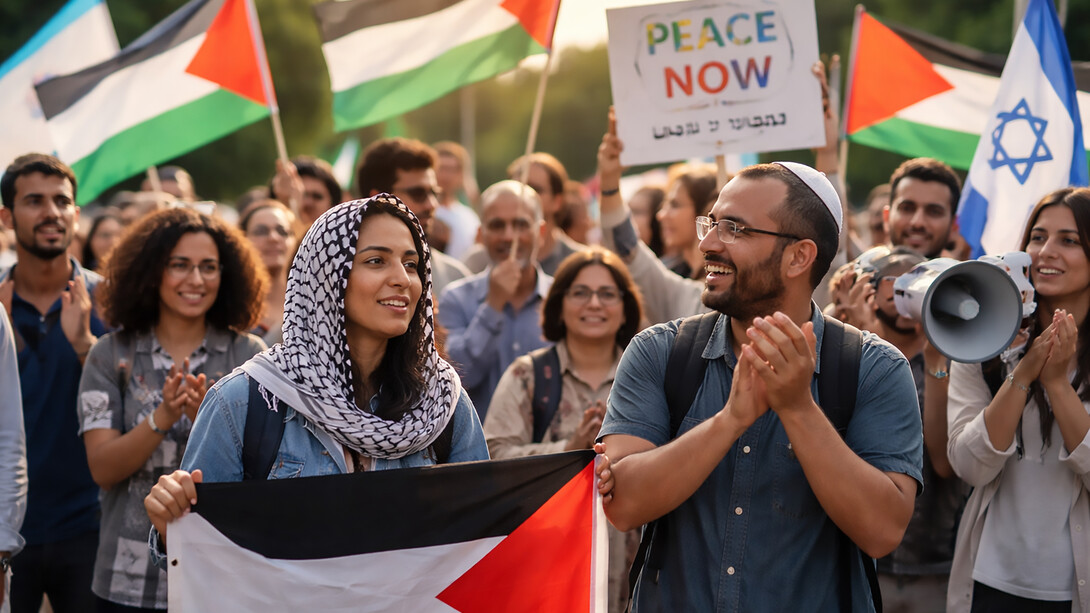
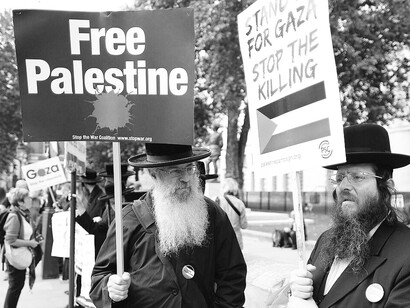
The current conflict in Gaza is reopening old wounds that are still scabbing over. Opposing sides fight in the media, their firm arguments supported by the determination to remain rooted in the belief in what defines their homeland.
The expression of every perspective is pivotal. The mobilization of community members, whose voices would otherwise be neglected, has been, and will always be, the catalyst of upward, tangible progress. Reconciliatory partnerships have redirected the course of the humanitarian movement surrounding the conflict in Gaza, uniting to develop new messaging and strategies that connect broadly and inspire meaningful change.
Revolutions are not born from crowds, but rather from the few who are courageous enough to let their voice be heard.
Creating a new majority
In February, I attended a political talk at a community space just down the road from my apartment. The keynote speakers, Amal Ghawi and Itamar Avneri, are activists and spokespersons for the largest Jewish-Arab grassroots movement in Israel, Standing Together. The social mobilization network advocates for coexistence, resolution, and an end to the occupation in Gaza and the West Bank.
Their advocacy is rooted in the idea that peace and compromise can be achieved through the joint effort of both Jewish and Palestinian citizens of Israel. They choose to form a new majority, made up of people who have a genuine interest in creating a sustainable, just society within the Israeli State. Through this coalition of diverse communities, change is attainable.
The two primary goals of Standing Together have remained constant. First, to secure a full ceasefire that will put a permanent end to the destruction of infrastructure and preventable loss of lives. Secondly, to attain a peace agreement that establishes an independent Palestinian state alongside Israel, which the organization believes is a necessary next step towards a different future that nurtures a peaceful future and opposes violence, fear, and hatred between Jewish-Israelis and Palestinians.
Their outreach operates in three languages: Arabic, Hebrew, and English. Chapters of Standing Together include eight local chapters throughout Israel, a nationwide climate chapter, and multiple student chapters, primarily on college campuses.
This approach is effective because it generates awareness and legitimacy, which gradually builds support and loyalty through the honest, open dialogue between domestic partners and an international audience. However, their grassroots pressure remains domestic, reinforcing the importance of locally driven change and the principle that this is truly about their people and their community.
Outreach through storytelling
The title of the discussion I attended can be translated to: What happens after the ceasefire? I went into the political talk blind; I had limited knowledge regarding their approach to mobilization and the structure of the organization. The title of the talk led me to expect that this would be an informative 90-minute lecture-style talk discussing political agendas supported by statistical evidence. Once Ghawi and Avernti began to speak, the tone shifted, and their stories began to unfold.
Amal Ghawi, a Palestinian-born activist and journalist raised in Israel, reflected on moments during the war that deepened her commitment to activism. On October 9th, the start of the conflict that reshaped the modern Arab world, she was working at a local news station. From a journalistic standpoint, she confronted whether to focus solely on Palestinian suffering or acknowledge all those affected—and immediately chose universal empathy. This stance often left her isolated among communities opposed to her humanitarian approach.
Ghawi also distinguished between Israel’s government and its people, highlighting how the media struggles to maintain a balanced perspective. Coverage of the conflict remains polarized, especially when faith, history, or human lives are at stake, making a middle ground rare when politics comes into play.
Itamar Avneri is a Jewish-Israeli activist whose story began during the Arab Spring protests of 2011, four years before Standing Together was founded. Though no one cared to know his name and he jeopardized his safety with every protest he attended, he continued to show up week after week.
He attributed the ultimate failure of these protests to enact feasible change due to their large scale and the uneven distribution of perspectives in leadership, alluding to the fact that Palestinian-Israeli voices were concealed.
With an academic background in philosophy, sociology, and politics, he volunteered in the Israeli Parliament in Tel Aviv, where he connected with his colleagues and shared visions on how they can effectively mobilize voices to make a direct impact on their society.
He shared the following quote during the discussion, which embodies the vision of Standing Together:
My safety depends on Palestinian safety. My prosperity depends on Palestinian prosperity.
Avnerii now serves on the Tel Aviv-Jaffa city council and has spent years advocating for cross-community political cooperation, ensuring that Palestinian voices are heard equally as loud as Jewish-Israeli voices. Even if thousands of people show up, it is not just enough to collectively gather. It is also a principle of connection, sharing stories, exchanging, or challenging beliefs.
Reflections on the discussion
The discussion was separated into two sections: what is happening now and what lies ahead. Ghawi and Avneri consistently reiterated that global attention must be directed towards the people, instead of to the governments. The obsession with war in the media is overwhelming, and it is important to redirect focus on the human toll that has always been at the heart of the conflict.
The closing Q&A portion furthered dialogue as listeners hung on Ghawi and Avneri's every word. The audience was made up of longtime Berliners, migrants, retirees, refugees, college students, and families, all of whom agree that the value of political engagement is that it is shaped by lived experience and conversation.
The way Standing Together approaches education and outreach shows that it is thriving as a grassroots movement. Though I have remained informed about what is happening in Gaza, I left the discussion with a deeper understanding of how those who are directly impacted are responding. Even from a distance, I remain politically engaged and committed to following global events, and the conversation reminded me that awareness from afar still carries responsibility.
Choosing to support the right organization (and also finding comfort in the fact that the organization exists) is how you can help from afar while absorbing the right kind of media.