English
 Español
 Français
 Deutsch
 Italiano
 Português
In what is perhaps the best book on Hitler, Allan Bullock wrote in Hitler: A Study in Tyranny that Hitler’s philosophy is the natural philosophy of the doss-house, the philosophy of homeless shelters – a philosophy he learned while living in those shelters in Vienna for some time. Of course, Bullock forgot to apologize to the homeless because among them there is more than one philosophy, and above all there are philosophies contrary to the one he identifies. But the one he identifies is no less true for that. As evident in Mein Kampf and Hitler’s subsequent speeches and practices, the main elements of this philosophy are as follows:
The idea of struggle is as old as life itself, for life is preserved only because other living beings perish through struggle. In this struggle, the strongest and most capable prevail, while the least capable and the weak lose.
In this struggle, any trick or ruse, however unscrupulous, and the use of any weapon or opportunity, however treacherous, are permitted.
Any goal humans have achieved is due to their originality combined with their brutality.
Astuteness is crucial: the ability to lie, distort, deceive, and flatter.
The elimination of sentimentality or loyalty in favor of cruelty. These were the qualities that allowed humans to rise. And, above all, willpower.
Never trust anyone, never commit to anyone, never admit any loyalty.
A lack of scruples must surprise even those who pride themselves on their lack of scruples.
Lie with conviction and dissemble with candor.
Distrust must be accompanied by contempt.
People are driven by fear, greed, the thirst for power, envy – often for petty and insignificant reasons. Politics is the art of knowing how to use these weaknesses for one’s own ends.
Despise the masses: the masses exist to be manipulated by the capable politician.
Democrats, particularly social democrats, poison the popular mind and cynically exploit the suffering of the masses for their own ends. The agents of this poisoning are the Jews.
History does not repeat itself, and Hitler is dead. But his philosophy is present in two politicians who dominate current international politics. These politicians are Benjamin Netanyahu and Donald Trump. It is present in different ways, and that is why today’s Hitler has two heads. Netanyahu is the head of the horror of war, while Trump is the head of the horror of peace. One might say it makes no sense to speak of equivalence to Hitler because the core of his philosophy was anti-Semitism, and today’s “Hitlers” – one is a Zionist Jew and the other stands unconditionally by his side. The relationship between Zionism and Judaism is very complex. Given the prevailing misinformation in public discourse on this topic and the severe silencing of dissenting voices, it is not easy to address this issue. That is why addressing it is so important for the survival of critical thought, to which, incidentally, European Judaism is closely linked and to which critical intellectuals owe so much.
Zionism and Judaism
Historian Yakov Rabkin would summarize the contradictions between Zionism and Judaism as follows:
Zionism was, at its inception, a marginal movement. Opposition to the Zionist idea was articulated on the spiritual and religious as well as the social and political levels. Most practicing Jews, both Orthodox and Reform, rejected Zionism, referring to it as a project and an ideology that conflicted with the values of Judaism. Jews who joined various socialist and revolutionary movements saw Zionism as an attack on equality and as an attempt to distract Jewish masses from pursuing social change. Finally, those who, thanks to the Emancipation, had integrated into the broader society and become dedicated liberals were convinced that Zionism was, no less seriously than anti-Semitism, a threat to their future. Jewish nationalism was thus rejected because it was seen to imperil not only Judaism but also the social status and political values of the emancipated Jews. (What is Modern Israel? London: Pluto Press, 2016, p.122).
Here are some of the reasons that have led Jews and non-Jews alike to oppose Zionism1. Zionism is a form of nationalism that runs counter to the idea of the diaspora. The founder of Zionism, Theodor Herzl, believed that, by seeking the expulsion or emigration of Jews, anti-Semites were Zionism’s most faithful friends and allies. Zionism has its roots in the experience of Eastern European Jews, especially following the 1881 pogroms in Russia that led to Jewish emigration to the West, creating tensions between Eastern and Western Jews. Zionism reinforces the idea of separation of the Jewish people, when they have always fought for integration into the societies where they lived with autonomy to freely practice their religion, since Judaism is a religion and nothing more.
The Austrian Jewish writer and publicist Karl Kraus considered that the essence of Zionism was anti-Semitism. Zionism served the interests of European (British) imperialism to control access to the natural resources of the Middle East. The State of Israel was conceived as a European settlement colony that would guarantee access to natural resources and freedom of trade with the East. In his book published in 1896, Der Judenstaat (The Jewish State), Theodor Herzl states:
Supposing His Majesty the Sultan were to give us Palestine, we could in return undertake to regulate the whole finances of Turkey. We should there form a portion of the rampart of Europe against Asia, an outpost of civilization as opposed to barbarism. We should as a neutral state remain in contact with all Europe, which would have to guarantee our existence (The Jewish State, London, 1946: 30).
Zionism was promoted by anti-Semites, such as Arthur Balfour, who wanted to rid Europe of the Jews. In 1850, there were no more than 9,700 Jews in Palestine. Jewish Zionism is now combined with Christian Zionism, which is based on ideas of racial supremacy and the far right, ideas against which Jews have fought with great tenacity and sacrifice over the past hundred years. Christian Zionism is a disguised form of anti-Semitism. The fundamentalist Zionism that dominates Israeli politics today is largely responsible for the rise of anti-Semitism worldwide, including through the way it criticizes anti-Zionist Jews. All these arguments reinforce the position that Zionism, far from serving the cause of the Jewish religion in the world, may ultimately deal it a severe blow against it.
Benjamin Netanyahu, the horror of war
The logic of extermination governs Israel’s security-driven and expansionist philosophy. The war against Islam is religious and, as such, can only end with the extinction or unconditional surrender of the weaker party. The enemy to be vanquished must be ceaselessly invented, from Palestine to Syria, from Iran to Lebanon. Above all, the enemy must not rise from the ashes, which is why it is crucial to murder women and children. Peace is anathema. Expansionism is rooted in a messianic element whose origins can be found in Moses Hess’s work, Rome and Jerusalem (1862). The victory of the Jewish idea is imminent, the “Sabbath of history", as he calls it. Today it has at its service a new messianic instrument, artificial intelligence, the new deity as irresponsible as the gods, precisely when it commits the scandalous error of mistaking a school for a military barracks, as happened recently in Iran.
Like Hitler, Netanyahu is in a hurry and unable to stop. Like Hitler, he invents or exaggerates acts of aggression to justify continuing the war and making it increasingly violent. A bit of history helps clarify this.
It was Hitler’s haste that dictated the start of World War II with the invasion of Poland. Military leaders and diplomats spoke out against this haste. Göring warned that the economy was already being affected by the effort required for war preparations. Not to mention Chamberlain’s British, who had no strategy other than peace negotiations, Mussolini, an Axis partner, sent Hitler a secret memorandum on May 30, 1939, requesting the postponement of the war’s start (if that were the decision) until the end of 1942. Hitler did not respond, and his silence was interpreted by Mussolini as agreement. But while pretending to favor negotiations, Hitler urged his commanders on August 22: “Close your hearts to pity. Act brutally.”
He proposed a peace treaty with Poland that amounted to nothing less than Poland’s total capitulation. He signed a non-aggression pact with his declared “irreconcilable enemy,” the Soviet Union, merely to buy time, since his goal was to conquer Lebensraum (living space) in the East and, therefore, a pact to be violated as soon as convenient, that is, a year later. He defined the invasion of Poland as a blitzkrieg, a war intended to last only a short time, and justified it by fabricating an alleged Polish aggression. In a false-flag operation, the SS attacked the radio station in the small German town of Gleiwitz, near the Polish border, dressed German criminals in Polish military uniforms, and then killed them. Yet another fatal Polish aggression had been staged. On September 1, Hitler invaded Poland. This was followed by six years of carnage that began against enemy combatants and ended against the millions of innocent civilians who were victims of the Holocaust.
Donald Trump: the horror of peace
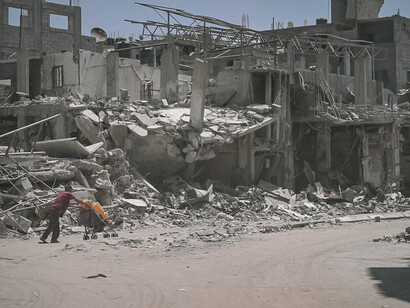
Donald Trump is simultaneously Netanyahu’s unconditional ally and a self-proclaimed angel of peace. In his second term alone, Trump boasts of having brokered 10 peace treaties or ceasefires: between Israel and Lebanon, between Israel and Hamas, between Armenia and Azerbaijan, between the Democratic Republic of the Congo and Rwanda, between India and Pakistan, between Israel and Iran, between Cambodia and Thailand, between Serbia and Kosovo, between Egypt and Ethiopia. Reality tells us that all this activity in the name of peace has been nothing but political theater. It has achieved no lasting results and, at best, has allowed only temporary truces. Western Asia is either burning or in ruins.
But what is most serious is that when one of two objectives is at stake—access to natural resources or the interests of his unconditional ally, Israel – Trump’s peace proposals mean, just like Hitler’s, the capitulation of the “other side,” the euphemism for the “irreconcilable enemy.” Instead of a peace proposal, there is an ultimatum. Iran is faced with the choice between being expropriated or being destroyed. The expropriation includes not only oil, but also the 440 kg of 60% enriched uranium, while the destruction entails the disappearance of a 6,000-year-old civilization.
This is not a peace proposal; it is a provocation or a demand for surrender. We know that the U.S. has a historical track record of destroying civilizations, for that is how it came into being. But since history does not repeat itself—and sometimes has a cruel cunning—it is possible to imagine that those who are born by destroying civilizations may also die by destroying civilizations. In any case, the peace being proposed is the “strong peace” Netanyahu speaks of in his writings2, which is nothing more than the peace of the strongest, the peace of the fait accompli. It is, therefore, a violent peace. A horrific peace in the service of a horrific war.
Why the two heads of Hitler?
If we carefully analyze the speeches and political practices of Netanyahu and Trump, we see that the twelve points of Hitler’s ideology are very much present. But they are present in different ways and, above all, with different styles, and this difference is not accidental. It aims to strengthen the effectiveness of both. While Hitler took it upon himself (along with Ribbentrop, Göring, and others) to propose peace negotiations and to boycott them when convenient, always with the aim of intensifying the war, today there is a division of labor between two Hitlers: the one who proposes negotiations and peace plans (Trump) and the one who boycotts them and intensifies the war (Netanyahu).
Only naivety would lead one to believe that they are not in cahoots or that, at the very least, there is no pact between them to accept whatever the other does, provided it serves the common goal of destroying the Islamic peoples of the Middle East to control natural resources and neutralize China. The tragedy (and comedy) of our time is that it takes two Hitlers to make one Hitler. A two-headed Hitler, the monster of our time.
References
1 The bibliography on this subject is vast and can be consulted in texts such as: Mazin B. Qumsiyeh, Sharing the Land of Canaan. London: Pluto Press, 2004: 67–84 (with recommended further reading); Robert Wistrich “Anti-Zionism and Anti-Semitism” Jewish Political Studies Review, 2004, vol. 16, 27–31; Walid Sharif “Soviet Marxism and Zionism,” Journal of Palestine Studies, 1977, Vol. 6, No. 3, 77–97; Mim Kemal Oke “The Ottoman Empire, Zionism, and the Question of Palestine (1880–1908)” International Journal of Middle East Studies, 1982, Vol. 14, No. 3: 329–341; Sara Roy, Mark Braverman, Ilan Pappe et al., Prophetic Voices on Middle East Peace (Claremont Studies in Contemporary Issues, Book 1), Claremont Press, 2016; Abdul-Wahab Kayyali, “Zionism and Imperialism: The Historical Origins,” Journal of Palestine Studies, 1977, Vol. 6, No. 3: 98–112.
2 Laura Drake “A Netanyahu Primer” Journal of Palestine Studies, Vol. 26, No. 1 (Autumn, 1996), pp. 58-69; Shalom Lipner, “The Chosen People vs. Their Chosen People: Israelis Are the Victims of the Political Shenanigans of Their Elected Leaders,” Atlantic Council (2020); Anthony H. Cordesman, “Israel and the Palestinians: From the Two-State Solution to Five Failed ‘States,’” Center for Strategic and International Studies (CSIS) (2021).