English
 Español
 Français
 Deutsch
 Italiano
 Português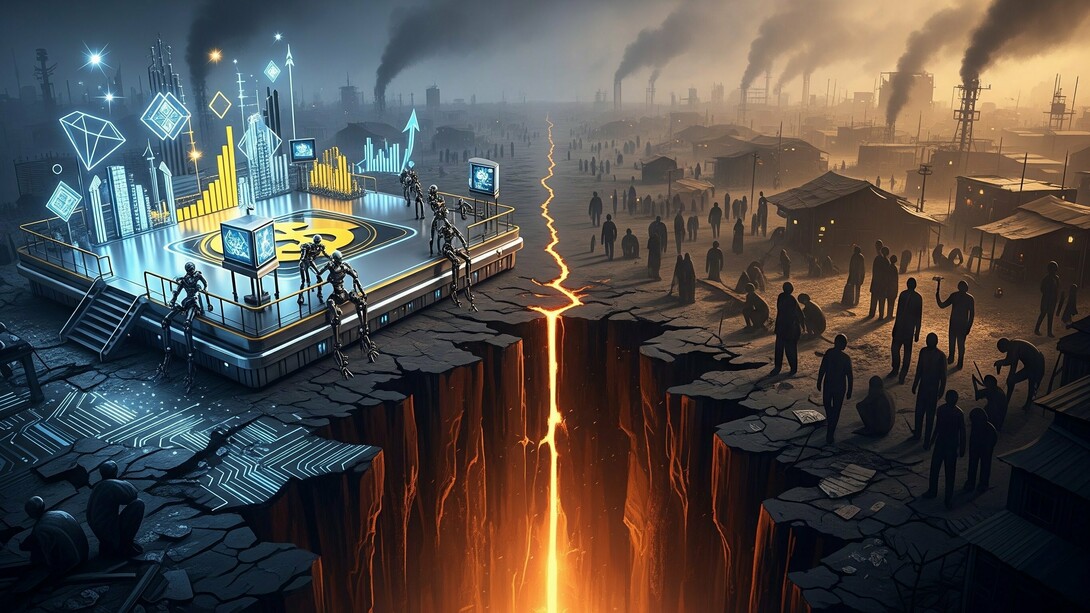
Does social policy also have something to do with geopolitical relations? It is not an obvious question and certainly cannot be answered in a nutshell. Moreover, social justice is a topic that is rarely discussed in geopolitical debates.
What is it about?
What is social justice? Does it go beyond social policy itself? Does it go beyond poverty reduction? How far can the fight against inequality go? When does a society become 'just'? These are philosophical and political questions that have been pondered for centuries. In our time, the answer fluctuates between poverty reduction and an eco-social welfare state with a focus on production relations and fair taxation. In all cases, it is about people's real lives, their needs, their health, their work, their well-being. It is precisely the latter that breaks with geopolitics, which is about international relations between the political entities in which those people live.
What is a 'world order' and when do we say it is 'new'? At the World Economic Forum in Davos last January, it was clear that geopolitical relations are shifting. The 'Western' alliance is no more, and whether NATO and/or the European Union will survive is the question. This did not come out of the blue; it became clear during Trump's first term and from the beginning of his second term. One explanatory factor is the threatened hegemony of the United States, the rapid rise of China, and the threat from the BRICS countries to replace the dollar in international payments. These are economic factors with potential political consequences that could ultimately lead to a multipolar world.
What is the relationship between 'social justice' and 'geopolitics'? Are changes in social policy the result of geopolitical shifts, or is it the other way around? Or are they the result of a changing cultural hegemony? Which, in turn, is a consequence of new economic relations? Is there a difference between national and global social policy in this regard?
Is it going well or badly?
The simple question of whether or not the social situation in the world is improving is difficult to answer. Four billion people have no form of social protection whatsoever, and although this is slowly improving, poverty statistics are rising. Inequality is peaking.
A reference to harmful neoliberalism is entirely correct, but its rise and success need to be explained. Why was it so easy to introduce and completely overturn policy in both the North and the South? When global poverty reduction came onto the agenda in 1990, and the dismantling of existing social protection began, it was not the result of China's successes but rather of emerging globalisation and the capitalist system's need to compete with large companies in the South. More and more companies also moved to Asia themselves in order to produce more cheaply there.
Development aid is declining sharply in all rich countries and has almost completely stopped in the US. This is only partly a result of a decision by President Trump; it had already been underway for some time. The fact that the United Nations' development thinking has not really become a reality anywhere, that the Sustainable Development Goals will not be achieved at all, and that even the poverty reduction that the World Bank insists on is failing, is the result of many different economic, political and cultural factors, in both the North and the South.
After all, social policy is always a matter of national and global importance. When the World Bank wanted to put social policy on the agenda in the 1970s, the so-called 'underdeveloped' countries were not at all enthusiastic about it. They saw it as a violation of their sovereignty; social policy was an internal matter. They were determined to maintain their competitive position vis-à-vis the rich countries, with low wages and no labour rights.
Nevertheless, the International Labour Organisation was founded in 1919 with the motto: 'peace is not sustainable without social justice'. This was after the First World War and a period of strong globalisation. It was assumed that companies had to compete with each other globally, but that this should not be at the expense of employees. That is why the ILO began to develop global rules for labour law.
Rightward shift
Today, we are seeing changes taking place again, especially at the national level. In the wealthy 'West', with its best welfare states, these are being dismantled at an accelerated pace, and the fight against poverty is taking on a new – but in fact very old – morality. Poor people are no longer the victims of ill-conceived protection or a failing economic system, as neoliberalism claimed, but are considered guilty of their own failure. They have not seized the opportunities offered to them and must be punished. In addition, there is an almost universal rejection of migration, and the conditions for migrants and refugees to integrate into society are becoming stricter, if they are not simply deported.
At the global level, and particularly at the World Bank, the focus on poverty reduction and what is now called 'social protection' has virtually disappeared.
These recent shifts are taking place in a climate of increasing right-wing politics. The old values of the Enlightenment are being overturned: universalism, the equality of all people, the importance of the separation of powers and the rule of law, democracy, and human rights... suddenly, all of this has become 'woke' to their opponents.
The link between the shift to the right and the dismantling of social policy is clear, as there is no focus on emancipation, gender equality, or respect for diversity. Poverty has always been approached in different ways and, in a conservative view, it has always been linked to morality. Poor people were those who did not want to work, drank too much, or did not take care of their children.
This right-wing and conservative attitude is motivated, among other things, by economic and social uncertainty and fear of the unknown, by the threat posed by an economic system that threatens jobs, incomes, and protection, and thus also the little comfort that middle-class people have managed to achieve.
Today, the changing vision of social policy is not driven by the UN, the World Bank, or the ILO, institutions that did play a role in spreading neoliberal ideas. Today, these institutions are seen as fighting to retain their little bit of power and influence.
Is there a break with capitalism? Financial capitalism and speculation have been gaining importance for decades, but within that there was still room for poverty reduction. However, it became clear that in a state capitalist system such as China's, democratic rules were not necessary to achieve a thriving economy. This was already the case, and even more so, in countries such as Taiwan, Singapore, and South Korea. Human rights also appeared to be superfluous. This is a break with the myths of Western capitalism. Only the work ethic needs to be maintained. It is only when we attach importance to democracy and human rights that social justice must be protected and promoted.
At the national level, this primarily concerns basic and fundamental rights. It concerns the equality of all people. It concerns the social cohesion that makes democracy possible, the production of prosperity that ensures quality and competitiveness. The reasons why social protection was introduced more than a century ago had to do with citizenship and the need for a healthy and stable workforce for industry and the army.
Globally, it is about exactly the same things, but for global competitiveness. This is what the ILO established more than a hundred years ago. Lasting peace requires social justice and, as was added in 1944, labour is not a commodity. With strong trade unions and strong cooperatives, conflicts can be avoided. Thanks to collective agreements and global rules, labour could be somewhat removed from market forces. It was then possible to strive for global development and greater equality between countries.
Over the past decades, the UN has approved numerous sound and very interesting documents, ranging from healthcare to gender equality, social protection and care for the environment.
If we want to preserve the world we have – and preferably improve it – all these elements are essential.
The surplus
What has happened in recent decades is exactly what Claus Offe described. Capitalism wants nothing to do with social protection, but at the same time realises that it needs social protection in order to function smoothly. Efforts were therefore made to build up a minimum level of social protection in the South and to dismantle welfare states in the North, precisely in order to achieve that common and necessary minimum.
However, today's robotised and financial capitalism is characterised by a particular hunger for profit that leads to sky-high inequality. This also leads to a real polarisation in which no form of peaceful coexistence is possible anymore. The richest 1% live in a completely different world, literally, while the vast majority of the lower classes have to cling to what local economic initiatives have to offer.
The automation of production processes requires fewer and fewer workers, so it is no longer necessary to provide for everyone's needs through labour. Poverty reduction and welfare states may disappear. From a Darwinian perspective, in which the strongest will survive, healthcare may also be scaled back. This explains the growing contempt for everyone at the bottom of the ladder. For those who still have a place in the production process, the minimum is sufficient. Pensions, education, and healthcare are being or have already been privatised. Those who cannot afford them are simply out of luck. Those who benefit from this are the far right, for whom the poor and migrants are ideal scapegoats.
Talking about social justice in such a context is simply pointless. There is no need for it, and the democratic processes that could ensure it are also becoming superfluous or completely minimal.
The new world order will probably be one of multipolarity, in which the richest and most prosperous country – the United States – will follow the social path of China and Russia, illiberal and authoritarian at best, with a crippled democracy.
Europe, with its hated colonial past, its human rights applied only at home, its Enlightenment values and its welfare states, will hardly be a factor, neither in geopolitical strength nor in competitiveness, dependent as it has made itself for defence and energy.
Resilience
Is such a system sustainable? People can be oppressed and manipulated, but history teaches us that they always remain resilient. It is a fashionable concept, but it is an appropriate one.
No matter how much criticism can be levelled at European colonial history with all its atrocities, at the imperfections of the Universal Declaration of Human Rights, at democratic processes, at inadequate social policy, at the excessive individualisation of neoliberalism, at hypocritical development cooperation and, of course, at capitalism itself, anyone who knows the world a little also knows that Western Europe is by far the best place to live, with freedom, low poverty rates and little inequality. There is certainly no need for a completely new theory of social justice. It is perfectly possible. The path has been paved.
Another positive aspect is that, even though Western European countries have never applied their fine ideas in the rest of the world, those ideas have found their way to even the most remote corners of the planet.
The 'new world order' will not survive without taking care of the surplus population because people are equal and have the same rights. They will claim those rights, sooner or later, despite growing repression. Justice is a universal need.
Today, almost all far-right political leaders are democratically elected. That is why social justice, with the prospect of a rethought and emancipatory welfare state, is desperately needed to steer voters in a different direction. Social policy is necessary to win elections.
What we do not know today is what strategy can and must be developed to organise the resistance and make it succeed. Social justice will certainly have to be part of it. That is a task for all progressive forces, which will have to abandon a number of taboos. Organisation and broad cooperation will be necessary.
The new world order will have to take humanity into account if it wants to survive. Even a multipolar world cannot exclude interdependence and must strive for balance. As the preamble to the ILO Constitution states, lasting peace is not possible without social justice.