English
 Español
 Français
 Deutsch
 Italiano
 Português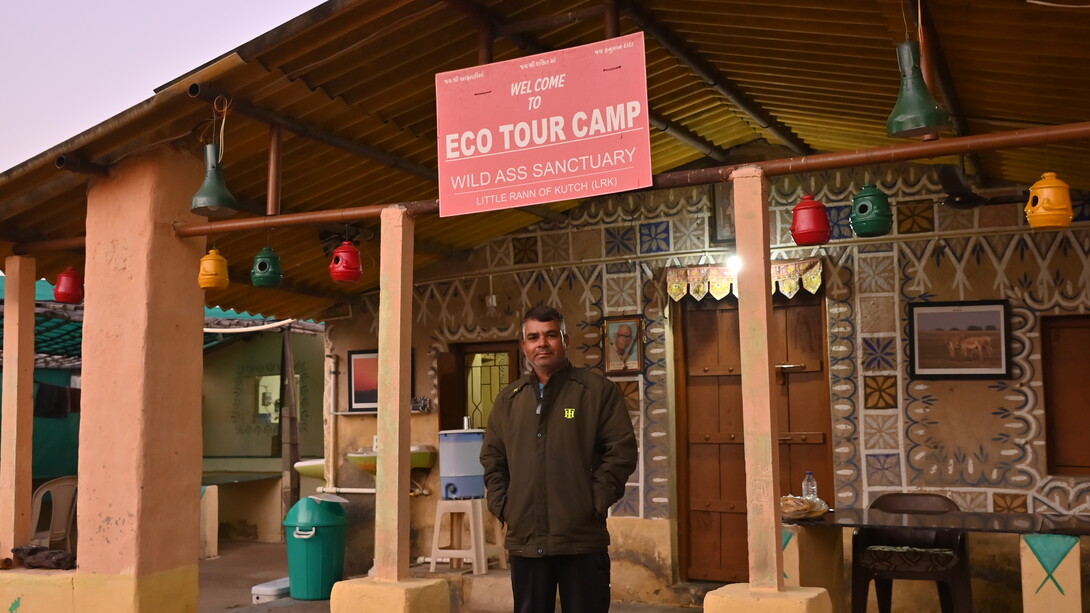
January 2026 has been an inspirational start to a new (Gregorian) year, if I look beyond the daily stories of genocide, conflict, ecological collapse, and the dismantling of ethics in public life taking place across the world. Visits to different parts of India have renewed my faith that we may still forge pathways out of the morass of crises we have been sinking into. Here I provide a brief description of each.
Sensitive visitation in a salt desert
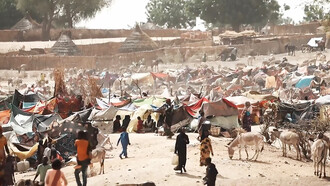
In early January, I visited the Little Rann of Kachchh (LRK) in western India with colleagues Shrishtee Bajpai and Arun Dixit. This is a beautiful and unique landscape, formed by the complex interplay of tidal waters from the Arabian Sea and freshwaters from inland rivers. For some months, it is a vast marsh and shallow lake; for the rest of the year, as the water drains or evaporates away, it is a salt desert. These ecological peculiarities have given rise to a unique biodiversity profile and human communities whose cultures and livelihoods have adapted to the harsh conditions.
We stayed at the LRK Ecotour Camp of Ajay Dhamecha, at the edge of the Rann. Ajay’s father, Devjibhai Dhamecha, set this up as an attempt to provide visitors a glimpse of the wonders that the landscape offers. But his was not a commercial outlook. Rather, with this initiative and with his activism that included firm opposition to destructive activities like industries and car rallies, he was trying to show that livelihoods can be generated without killing the golden goose, which most tourism companies seem hellbent on doing. As an environmentalist and photographer, Ajay is trying to continue this ethos of conservation of the landscape and its wildlife, which is built into how he runs Ecotour Camp1. This includes the low-key and comfortable accommodation blending into the landscape (called ‘bungas,’ huts made in traditional Kachchhi style), serving delicious local food, holding camps for schoolchildren to learn about LRK’s wonders, enabling stargazing sessions, and more. He mentions also that with a focus on sensitive tourism, he is not keen on expanding his operations, satisfied with the limited accommodation he currently provides.
Out in the field, Ajay proved to be adept at many of the landscape’s features: explaining the ecological uniqueness of LRK (which Arun Dixit, as an ecologist who has studied the area for years, added considerably to) and identifying various wildlife species. Both he and Arun described, rather sadly, some disturbing trends: rapidly increasing religious tourism to temples on a couple of the ‘bets’ (slightly higher islands in the desert that remain above the submergence), proposals for highways through the Rann, and the narrowing of the mouth of the only creek coming into the Rann from the Arabian Sea by industrial and infrastructure projects. This narrative was sobering indeed, but still I came away with some sense of hope that initiatives like Ecotour Camp may continue to raise awareness amongst visitors of the importance of conserving LRK and provide an example of how local people can earn a dignified livelihood in an ecologically sensitive way.
Seeding women’s revolution
My next stop, along with several Kalpavriksh colleagues, was an initiative that has inspired me for the last 25 years: Deccan Development Society in Telangana, southern India2. I have written about it several times—how over 5000 Dalit and tribal women farmers have dramatically transformed their agriculture and livelihoods and socio-economic status3. As Dalits (so-called ‘outcastes’ of Hindu society), as women, and as small landholders, they have been triply disprivileged in an intensely casteist, patriarchal, and classist society. But over the last four decades, they have challenged these oppressions and indignities in multiple ways.
First and foremost, by moving towards not only full food security for all these families (from a situation of hunger and malnutrition) but also food sovereignty, claiming complete local control over native seeds (a wide diversity of millets, pulses, etc.), land, knowledge, what they sell, and what they eat. A crucial component of this was to bring back all these elements into the commons rather than privatize them. Then, they established their own community media, including India’s first community radio station and a dynamic filmmaking unit. They created a local version of the official Public Distribution System (PDS), transforming it from a corruption-ridden regime in which the poor got cheap but poor-quality grains into one that disseminated healthy local grains at affordable prices.
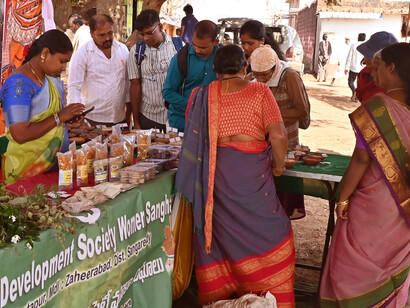
They pushed for the local Krishi Vigyan Kendra (Agricultural Science Centre) to be run jointly by government-appointed scientists and local farmers, so it was truly oriented towards benefiting local people and promoting agroecological methods. A farmers’ cooperative called Sangham Organics helps market excess produce (after strictly adhering to the principle of household and community food security first, market second), and a restaurant in the town of Zaheerabad serves delicious organic food. There’s much more.
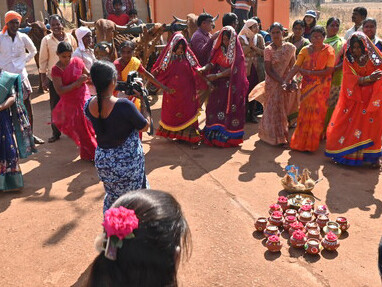
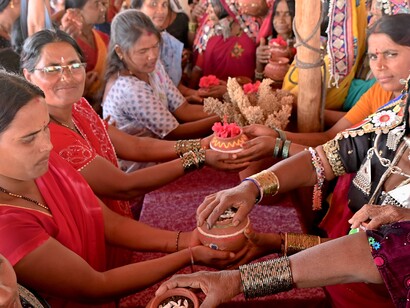
My visit coincided with the celebration of the 26th edition of their annual Mobile Biodiversity Festival, in which diverse grains are taken village to village in bullock carts, and discussions are held with local farmers about the need and viability of switching to localized, organic, biodiverse production. As in the several previous festivals I have attended, there was a lively mix of music and dance, procession and display, and discussion, this time in a Lambada (formerly nomadic pastoral) community.
Every time I visit DDS, I look for what has been sustained and what is new. This time, the biggest change is that PV Satheesh, for the last three decades the anchoring visionary of DDS, is no more at the helm. He passed away in 2023, and there has been a quiet transition to a young woman, Divya Veluguri, as the new executive director. Resource constraints and generational changes have reduced the number of active Sanghams (village-level women’s committees), and some programs like the alternative PDS don’t function any more. Some new ones like poultry and orchards, have been started. The organization is now discussing a possible mix of old and new, including diversifying into some new livelihood options.
This could meet the biggest challenge they face—that of generating interest in a new generation that may not want to continue the traditional occupations as they were—by exploring livelihoods that combine some elements of DDS’s DNA in agriculture with new opportunities in the manufacturing and services sectors. It is going to be a difficult transition, as the mainstream capitalist economy with all its glitzy attractions bears down on them. I got the feeling, though, that the wisdom of the old guard (many of the faces I’ve seen for the last 25 years were still visible) and the enthusiasm and innovation of the new generation will see them through.
Rural Innovation and Self-Empowerment
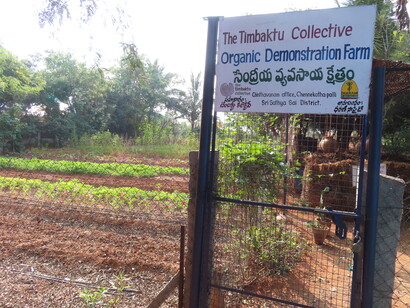
After DDS, another initiative I have visited several times is the intriguingly named Timbaktu Collective (TC), in Andhra Pradesh, also in southern India4. I was there with an international team involved in an action research project, ‘Green Futures,’ looking at positive transformations in India, South Africa, and Denmark.
With the country’s 2nd lowest rainfall area, this region was chosen by a courageous couple to see if they could do something to bring about positive transformation in the lives of villagers. Bablu Ganguly and Mary Vattamattam settled here 35 years back and began a slow process of building on local knowledge and skills and agency, adding their own perspectives and capacities. Cutting a long story short, over these decades TC has diversified into organic cultivation, cooperatives of various kinds, child rights and learning, an experiential school, centers for the disabled to assert their dignity, forest and grassland regeneration and conservation, water harvesting, and more. Their reach is impressive: 40,000 families in well over 320 villages. TC has been instrumental in establishing the credibility of the Participatory Guarantee Scheme (PGS), in which farmers can do peer certification of organic production, avoiding what are otherwise expensive or bureaucratic procedures by private or governmental entities.
As in the case of DDS, I wanted to know what had changed recently. Intriguingly, here too there was a leadership change, with a young woman, Sakamuri Sukanya, having taken over from Mary as Executive Director. New activities had been initiated, such as water harvesting, demonstration plots for fruits and vegetables, and a seed bank that works with about 30 farmers for continuous production and supply of quality seed material. A community cooperative-run ecotourism initiative, the Kalpavalli Bush Camp, is now well established. We spent a night there under the stars and enjoyed an early morning birding walk through the grasslands of Kalpavalli that TC and the villagers have regenerated over a vast landscape of 9000 acres.
Oh, and the name? Bablu and Mary recount that when they first settled, they had young children, and they had to explain where they disappeared to almost every day when they went on their rounds of villages. One day they said Timbuktu, referring to the legendarily hard-to-find location in Africa. The name stuck.
Permaculture wonders
Not far from Timbaktu, I paid a visit to Anantgram farm5, where one of my Kalpavriksh colleagues, Chaitali Chaudhari, stays with her husband. A rather more recent initiative (begun in 2017) than DDS and TC, Anantgram is a privately owned 125-acre plot where the principles of permaculture have been applied to regenerate what was once barren or quarried land. Sukant Gupta, one of its founders, told me that their simple objective was to see if permaculture could be used to make the land prosperous and thriving. A lot of work has gone into channelizing and storing water (coming in from a nearby canal) and careful landscaping with a huge diversity of trees, crops, grasses, etc. Today, 80% of the residents’ food needs are met from the land, there is an active program to reach healthy food packets to consumers in Bengaluru, and while they do not have an active outreach program for surrounding villages, they do host farmer groups who come for learning visits. They also produce a dazzling array of herbal infusions and lovely organic jaggery and now have a guest house where discerning visitors can pay and stay.
What caught my fancy was the diversity of wildlife. Birding was excellent, and nocturnal sightings of snakes were exciting, not least because we were shown some by a super-enthusiastic local naturalist, Ramkrishnappa. While I am not particularly gung-ho about large-scale private ownership of land, especially in a land-hungry country like India, in the current scenario this may at least be one way to demonstrate that with care and love and appropriate techniques, thriving ecosystems with productive potential for food and livelihoods can be regenerated.
Towards self-reliance
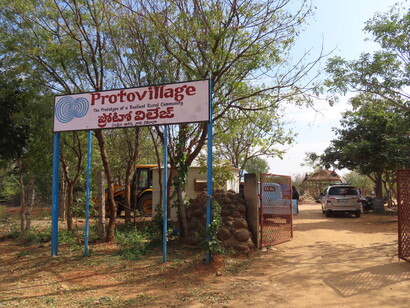
My last stop, also with the Green Futures project team, was a small but potent experiment in creating several elements of a self-reliant rural settlement, called Proto-village6. Just a bit north of Bengaluru in southern India, this initiative was founded by Kalyan Akkipeddi and Shobihta Kedlaya in 2017. Their aim is to demonstrate how a resilient settlement can create self-sufficiency in nine basic needs without damaging air, water, and soil: food and water, energy, shelter, connectivity, clothing, healthcare, education, trade, and disaster management. Spread over 12.5 acres, the place is nowhere close to generating all its food but is experimenting with a range of approaches for this and other basic needs. We saw some of these on a walk around the settlement, guided by resident Vamsi.
Unlike Anantgram, which receives considerable water from a reservoir, Proto-village has built its own water harvesting structures and conservation techniques to be self-sufficient even with the extremely low rainfall of the region (the 2nd driest in India, as mentioned above). It is completely off the power grid, generating all its electricity through decentralized solar panels and being careful with use. With a current population of 25 (including kids), its decision-making involves everyone as a community, having learned principles of consensus-based decision-making from mentors like Narsanna Kopulla and Debal Deb. Before setting this up, Kalyan reportedly cycled around India, living with and learning from adivasis and others.
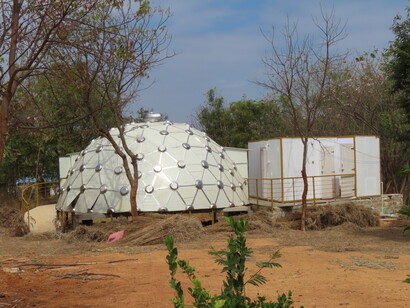
A handloom and textile unit is innovating with cotton, banana, bamboo, rosella, and other natural materials for fiber and dyes. Diverse building technologies are being attempted, with local material and locally available skills. Apparently the indoors in these buildings do not even need fans in the region’s blistering summer. Various food production techniques are being tried to see if even in such a small piece of land, self-sufficiency could be achieved. An economic initiative called Graamam sells 40 products—pickles, soups, crisps, soaps, shampoos, etc. (They have not yet been able to figure out how these products can be affordable for local villagers, not only city-dwellers).
‘Deep Connect’ workshops are offered, at a fee, for anyone wanting to connect with self, environment, others, and purpose. All members are given a basic stipend from these and other revenues; no one works outside. An alternative school (currently only 9 kids, but hoping to expand) has no prefixed curriculum or classes but is free-flowing, experiential, and participatory. One of Proto-village’s recent attractions is a skateboarding facility, open to both local kids and folks from outside. A wellness center is coming up, where health camps are proposed for surrounding villagers.
I was a bit uncomfortable about what seemed like a claim for this being a pioneer in self-reliance (their website home page proclaims, “A resilient rural India begins with its prototype: Protovillage”), given that this has been demonstrated in many settlements for generations. Nevertheless, as a new initiative with innovations that combine traditional and new techniques, I found it exciting. I offered to connect it to the Vikalp Sangam process, which has nearly 100 organizations and networks practicing alternatives and solutions7. Cross-learning is one of the main objectives of this process, and with groups like DDS and TC already involved, linking with others like Anantgram and Proto-village can only strengthen pathways to move away from destructive ‘development’ processes and towards more just, ecologically regenerative futures.
Do these stories of hope amount to much?
I am painfully aware that these five initiatives on their own, or indeed many thousands more like this which do exist across the world8, are not adequate to bring down the deeply entrenched structures of oppression and destruction. The military-industrial complex, with its patriarchal, capitalist, racist, and statist foundations, is at the moment too powerful. Many more such initiatives, networked in alliances with resistance movements, challenging these structures while also showing that other worlds are possible, are going to be necessary. We are far from that.
Yet, I agree with the American historian-writer Howard Zinn in his autobiography9: “To be hopeful in bad times is not just foolishly romantic. It is based on the fact that human history is a history not only of cruelty but also of compassion, sacrifice, courage, and kindness. What we choose to emphasize in this complex history will determine our lives. If we see only the worst, it destroys our capacity to do something. If we remember those times and places—and there are so many—where people have behaved magnificently, this gives us the energy to act and at least the possibility of sending this spinning top of a world in a different direction. And if we do act, in however small a way, we don't have to wait for some grand utopian future. The future is an infinite succession of presents, and to live now as we think human beings should live, in defiance of all that is bad around us, is itself a marvelous victory.”
Let us celebrate the counter-currents that these initiatives represent, for without them, we would be swept away with no hope of survival.
References
1 Dhamecha, A. D. (2026, January 4). Conversation on ecologically sensitive ecotourism at the Little Rann of Kachchh. YouTube.
2 Deccan Development Society. (n.d.).
3 Ashish Kothari, ‘Seeding an agricultural revolution in rural India’, Earth Island Journal, 14 December 2015.
4 Ashish Kothari. (2014). Very much on the map: The Timbaktu Collective [Case study]. Vikalp Sangam.
5 Anantgram. (n.d.).
6 Proto-village. (n.d.).
7 Vikalp Sangam. (n.d.).
8 Radical Ecological Democracy. Global Tapestry of Alternatives.
9 You Can't Be Neutral on a Moving Train: A personal history of our times, Beacon Press, 1994.