English
 Español
 Français
 Deutsch
 Italiano
 Português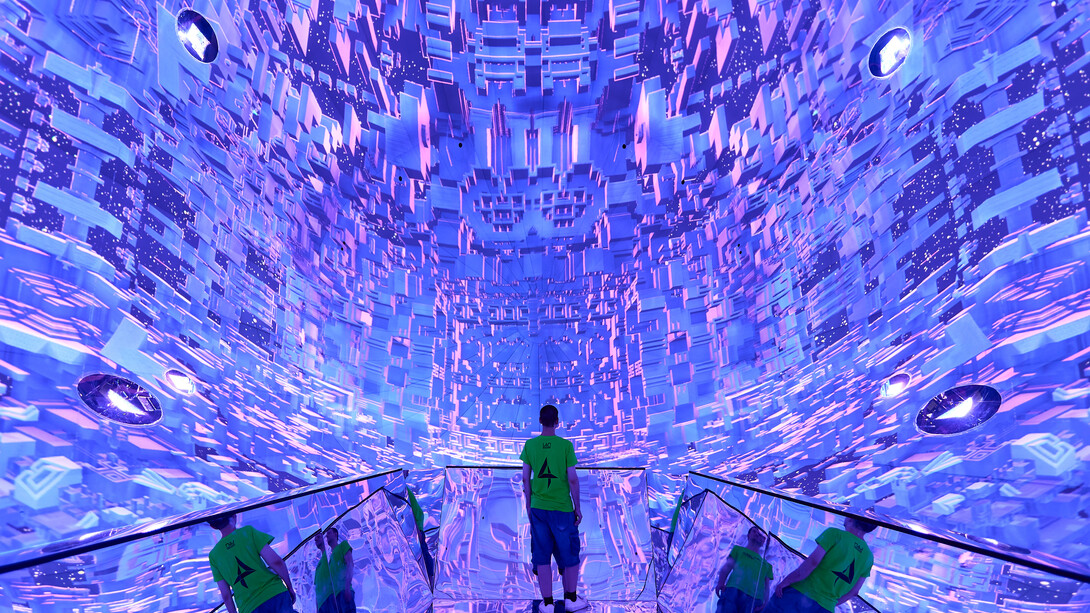
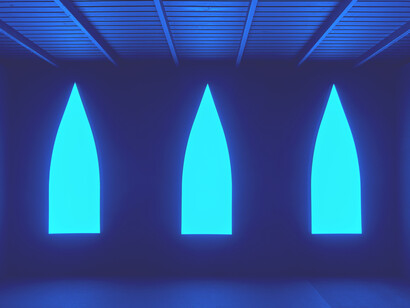
From the darkness of the world, a command: “There Will Be Light.” And a big bang erupts—not only cosmic but also sensory—an explosion of perception where life and meaning emerge from absence.
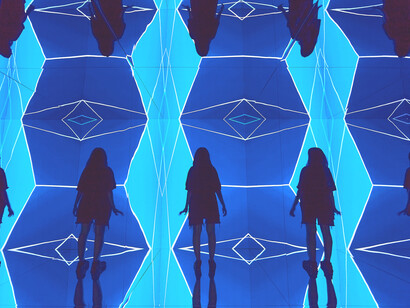
In Budapest, inside what was once an abandoned market hall, light has given rise to one of the most singular cultural institutions in Europe. LAM Budapest is not simply a museum; it is a space where art, technology, and science converge as lived experience, impacting the body as much as the intellect. Every corner of the former Downtown Market has been reimagined—from the iron beams and stone floors to the soaring ceilings—as a stage for perception itself.
This is not a traditional, white-walled gallery. The experience begins the moment one crosses its threshold. Contemporary artworks, informed by the latest developments in science and technology, invite visitors not only to look but also to question how we see, how we sense, and how we position ourselves in the world. Sound, light, and movement converge, creating a landscape where vision and body collide—a museum that demands more than passive observation.
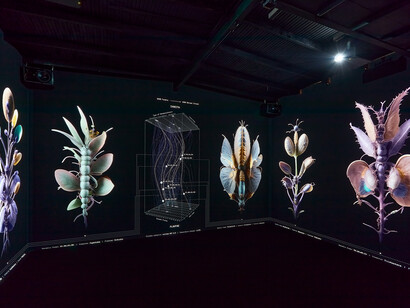
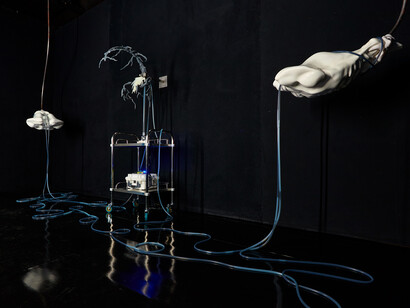
More Than Human asks what it means to be human today—a question that feels increasingly unstable. In an era shaped by artificial intelligence, climate collapse, biotechnology, and accelerated technological transformation, the exhibition dissolves boundaries between human and non-human, organic and artificial, and natural and technological. Immersive installations, audiovisual environments, and interactive works generate moments of awe, discomfort, and reflection, leaving visitors oscillating between wonder and introspection.
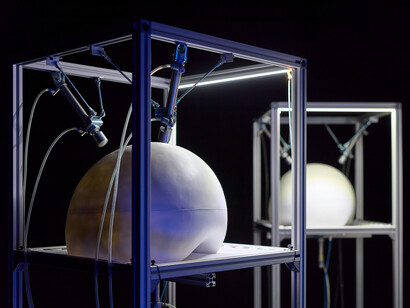
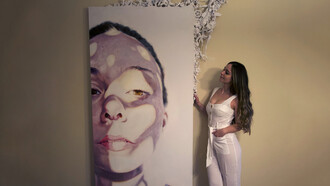
Nearly forty international artists take part in this conversation. Among them are Ólafur Elíasson, whose luminous works interrogate perception and invite one to inhabit light itself; Tomás Saraceno, connecting art and ecology through spider-inspired structures that reveal networks extending beyond the human; Anthony McCall, whose sculptural light projections dissolve space into tangible, almost tactile forms; Tony Oursler, whose media installations confront the psyche and the ways identity is mediated through technology; Pamela Rosenkranz, reimagining biological and synthetic bodies; and Jennifer Allora & Guillermo Calzadilla, whose collaborative works engage political, social, and natural ecologies, including the plight of endangered Puerto Rican parrots, living in the shadow of humanity’s search for extraterrestrial signals. Their work questions why we prioritize cosmic exploration while species on our own planet teeter on the brink of extinction.
Other contributors deepen these inquiries. Yasuhiro Chida’s A Moment’s Field explores time and perception with quiet intensity, asking visitors to recalibrate how they inhabit the present. Andrea Shin Ling’s Picoplanktonics connects microbial life, design, and speculative futures, reminding us that even the smallest organisms shape ecosystems and, by extension, our lives. Vicsek Viktor & Rodrigo Guzman’s immersive projection within the monumental zeppelin-like centerpiece radically alters spatial awareness, creating a sensation of floating, suspended between reality and imagination.
As artistic director Szabolcs Vida explains:
This exhibition is not about technology replacing humans, but about understanding how deeply interconnected we already are — with machines, with nature, and with systems we no longer fully control. It is an invitation to rethink our place in the world.
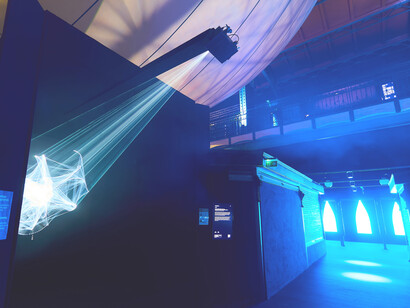
The museum occupies the 2,000-square-meter historic building of the former Downtown Market, where the original vendor bays have been transformed into spaces for progressive, technology-driven art. At its core stands Europe’s largest projection environment—a monumental, zeppelin-like structure that surrounds visitors with some of the most compelling immersive projections currently on view. Light moves, shifts, and breathes like a living organism; sound vibrates through the floors and walls, reminding you of your body, your heartbeat, and your presence in the space.
I experienced LAM alongside Szabolcs Vida. I arrived with the intention of writing an article and left transformed, carrying new ways of seeing myself and the world. What remained with me was not only the strength of the works but also the way they recalibrated my sense of time, presence, and my own body in relation to technology and nature. This was not a visit. It was an experience unfolding across scientific and artistic dimensions. Art feeds—not as ornament, but as necessity. It compels reflection, imagination, and, sometimes, confrontation with our own assumptions about being human.
Across two floors, works by artists from multiple countries breathe in dialogue with one another, forming a continuous ecosystem of ideas, sensations, and ethical tensions. Spaces dissolve into one another; sound and light merge with movement, creating a rhythm that guides the body and mind through uncertainty, curiosity, and delight. The exhibition unfolds as a journey—one that does not separate thinking from feeling, nor intellect from emotion. It is at once a laboratory, a cathedral, and a playground.
It is impossible not to be moved. It is impossible to leave More Than Human unchanged. I can say this with certainty: I am no longer the same person who walked into that museum. I felt, at times, vertigo, awe, and the subtle exhilaration of realizing how small, and yet how deeply connected, we are.
In addition to providing aesthetic and sensory experiences, the works presented here also offer thought-provoking alternatives to the utilitarian, anthropocentric mindset that has also shaped the development of Eastern European societies since the political transition and which requires urgent reconsideration today as we are facing climate change, the global pollution of the natural environment, and the alarming decline in biodiversity. The Budapest exhibition can thus become a cultural event with both local and global significance.
(Barnabás Bencsik, Co-curator of the exhibition)
At a moment when so many of us are questioning our own existence—what are we doing here? What does it mean to be human now? — More Than Human offers no conclusions. Instead, it opens a space for reflection, for wonder, and for reconsidering the ethical, emotional, and aesthetic dimensions of our intertwined lives.
And sometimes, that is precisely what we need.