English
 Español
 Français
 Deutsch
 Italiano
 Português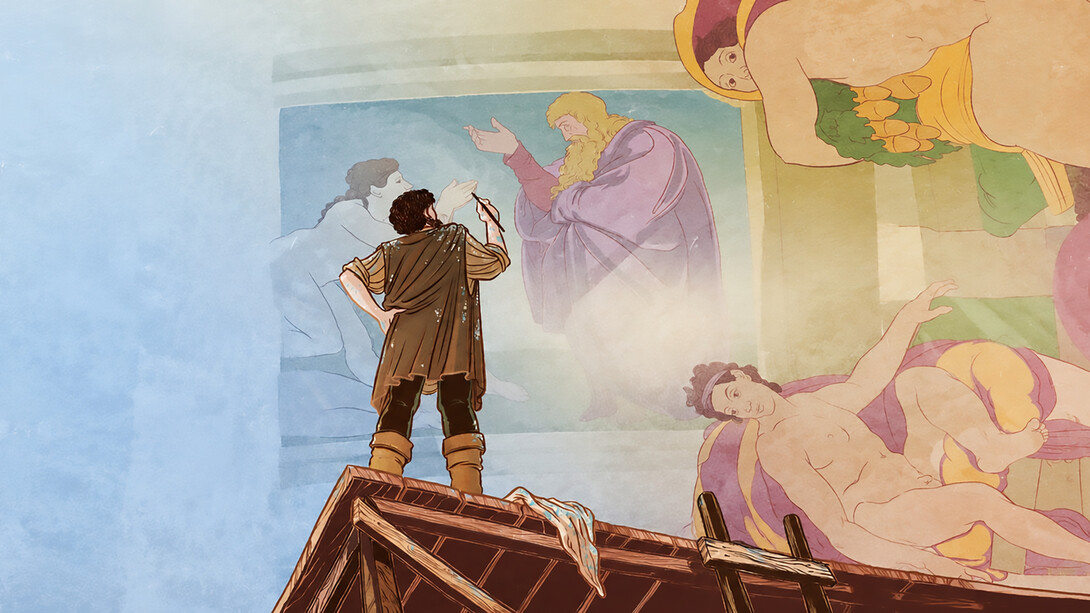
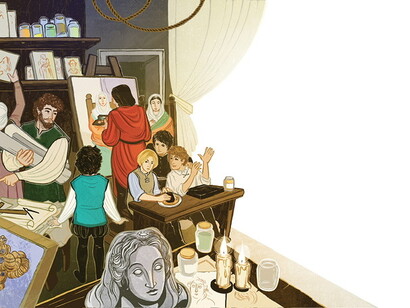
Children are usually exposed to history through fragments of information: historical dates to learn, historical figures to summarize, and masterpieces of arts seen as cultural references far removed from real life. However, history can be made more interesting with storytelling, images, and the element of intrigue. These notions are central to the book entitled Michelangelo and the Dream of the Sistine Chapel written for children and illustrated by Sabrina Gabrielli along with co-authors Valentina Ansuini and Jade Bajeot. Although it can be treated as another typical biography book or museum guide, this project fits into larger debates about childhood engagement with history and art history museums.
The context of authors’ professional lives is important for understanding the book content. Ansuini and Bajeot both have worked as scholarly guides in the Vatican Museums and the Sistine Chapel in interaction with children and families who visited the latter. The book reflects the broader issue of how children interact with historical sites and artifacts. As is commonly acknowledged, children are interested in art exhibitions differently than adults – they rely on their observations and perception of atmosphere rather than historical context.
This idea is consistent with current trends in pedagogical thinking regarding teaching of history and art education. In recent years, teachers and representatives of cultural institutions have attempted to develop methods promoting imaginative involvement, rather than mere memorization. In this regard, illustrated historical literature takes an important place in debates on education of children, education of visitors to museums and other aspects of visual narrative.
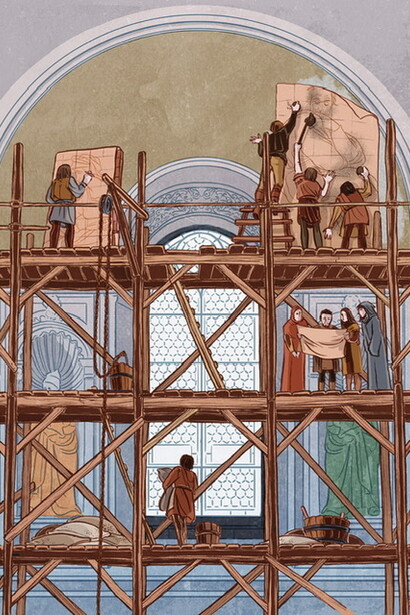
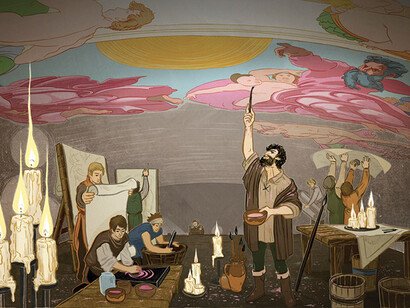
Production of artwork is another aspect that is useful when teaching about Renaissance culture to children. Discussion of frescoes, their preparation, paints used in them, planning, large-scale works of art helps in understanding artistic production from the technical point of view, as opposed to the mere consideration of results of artists’ efforts. These topics may be applied to the discussion of craftsmanship, labor, relation between creative impulse and discipline.
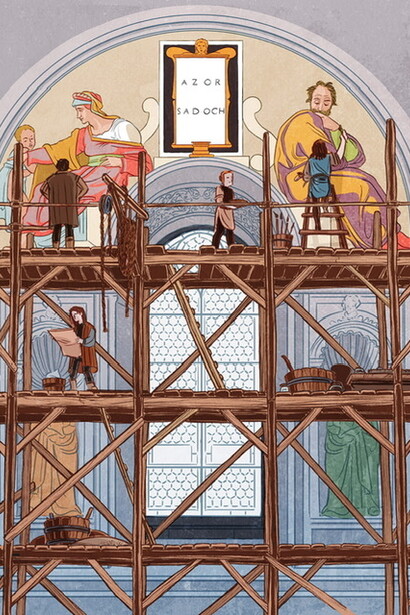
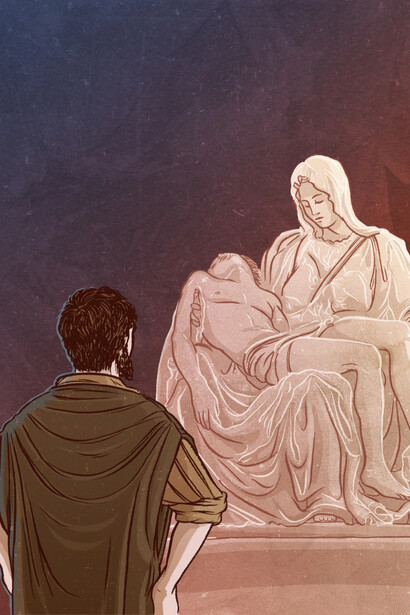
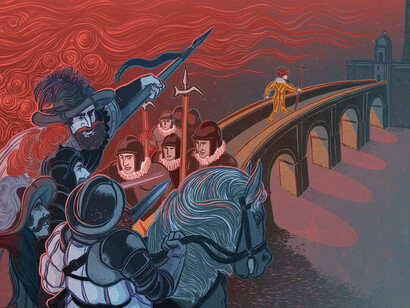
Gabrielli’s illustrations are more than visual accompaniments of the text – they serve as interpretative devices within the process of reading. Images become essential tools for conveying historical buildings, personalities and general atmosphere of a certain epoch.
Simultaneously, such endeavors are indicative of the interdisciplinary nature of art history itself, with subjects related to Renaissance culture often overlapping with architecture, sculpture, restoration, religion, visual culture, and political history. Such presentation of topics, in turn, enables young people to learn about the history not only from different points of view but also without the need to focus on individual historical facts.
It is also important to acknowledge that the Sistine Chapel stands out within the context of modern visual culture. In the case of many children, world-famous monuments are first seen not in person but through photographs, films, digital media, and educational materials. Therefore, illustrated materials dealing with various historical topics are part of a broader discourse on the representation of cultural heritage in children's books.
Such issues have gained particular prominence due to the influence of digital media and the development of new modes of attention. Visual narration has played an increasingly important role in processing and distributing information, particularly among children. Illustration in children's literature and museum pedagogy have responded to these challenges in their own unique ways, bringing about new questions regarding accessibility and engagement in cultural education.
At the same time, contemporary discussions surrounding children’s learning increasingly emphasise emotional connection alongside factual knowledge. Historical education is no longer understood solely as the memorisation of names, dates, and events but also as a way of developing cultural awareness, observation, and interpretive thinking. Visual narratives connected to historical subjects can therefore function as entry points into broader conversations about memory, heritage, and representation. In this sense, illustrated historical literature participates in a wider educational landscape that extends beyond schools and textbooks into museums, family experiences, tourism, and digital culture.
This increasing overlap between publishing, museums, and educational activities has also affected how historical content is introduced to young audiences. There has been an increase in collaboration between museums, artists, educators, and writers to produce interpretative materials that are easier for children to understand without totally stripping away its historical complexity. This development is indicative of new expectations regarding the transmission of cultural knowledge from one generation to another and the ways in which young audiences interact with artistic and historical spaces within contemporary culture.
This novel also serves as a subtle commentary on the changes taking place regarding the function of museums and other cultural organizations within the realm of childhood education. The museum is now seen as playing a dual role in observation and accessibility.
Ultimately, Michelangelo and the Dream of the Sistine Chapel can be viewed less as a standalone cultural object and more as part of wider contemporary conversations about childhood learning, visual storytelling, and the transmission of cultural history. Rather than focusing exclusively on biographical narrative, the project opens broader questions concerning how younger audiences encounter art, history, imagination, and historical spaces in the present day.