English
 Español
 Français
 Deutsch
 Italiano
 Português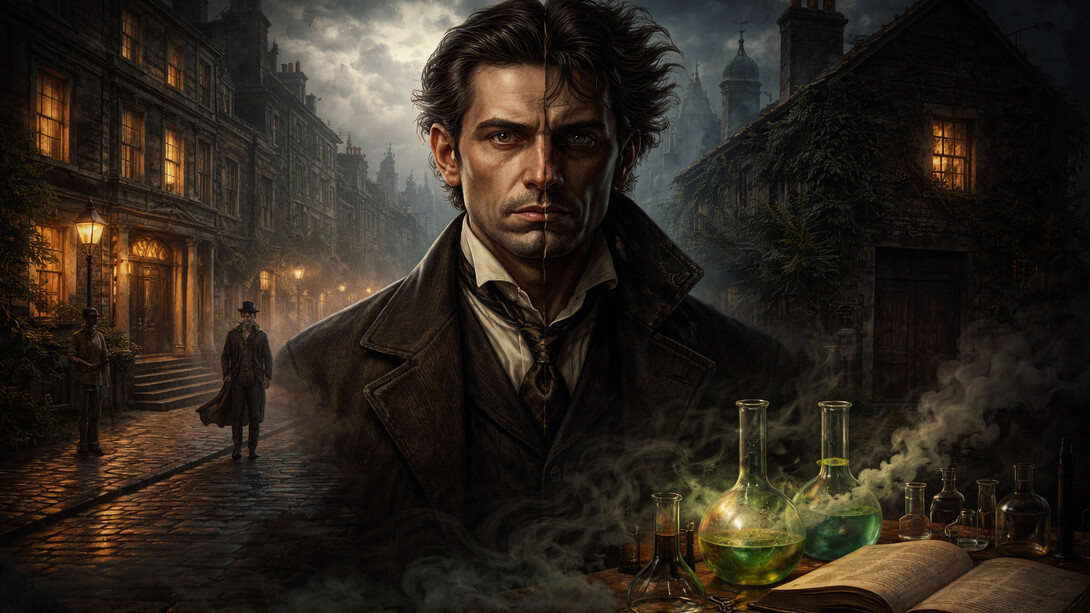
It is unfortunate that the myth of Jekyll and Hyde is now so well known that the reader already knows the outcome, but early readers would have thought of them as two different people. They may have questioned their relationship and the hold Hyde had over Dr Jekyll that made him listed as a beneficiary in his will.
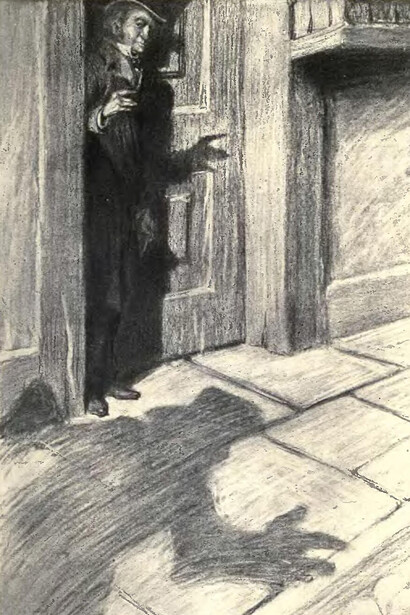
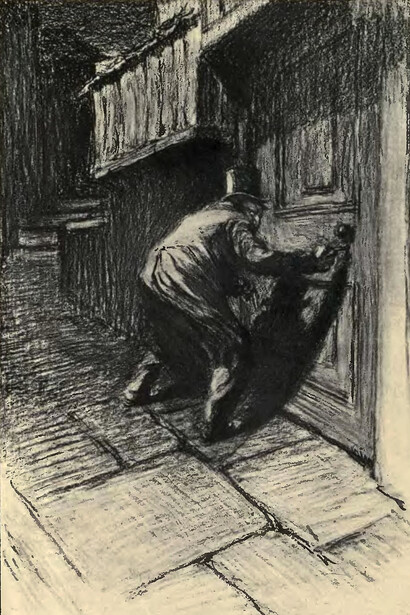
The book begins with an account by the lawyer who describes the strange house occupied by Mr Hyde. It was situated at the corner of a quiet street of shops that did a thriving trade on weekdays. The premises had no windows and only a door on the lower storey. It also appeared neglected, with tramps sleeping in the doorway, striking matches on the panels, and a schoolboy applying his knife to the mouldings. The lack of windows and general neglect adds to the idea of secrecy, not society.
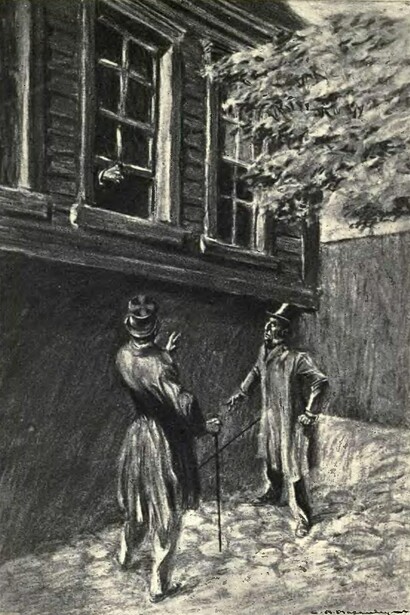
Mr Enfield describes the place as ‘queer’, which in this context is more likely to signify strange, rather than a place of homosexual liaisons. The home of Dr Jekyll is around the corner and is described as a square of ancient, handsome houses which have seen better days and been converted to flats and chambers, the exception being that of Dr Jekyll. Multiple occupancy and society contrast with the secrecy of Mr Hyde’s abode, and the fact that Jekyll is the only person who occupies his premises suggests an affluence which is not common in the area.
Mr Utterson, in an attempt to understand the relationship between Jekyll and Hyde, questions the butler about Hyde. He is told that he has a key to the house but comes and goes via the laboratory. This is a back entrance, suggesting further secrecy. The servants are also told to obey him, which concurs with the lawyer’s instructions that in the event of Dr Jekyll’s death, his estate is to pass to Mr Hyde. When he confronts the doctor about the will, he states that the character of Hyde does not matter and that his position is a strange one which cannot be changed by talking. This reinforces the idea that Hyde has some undue influence over Jekyll, possibly blackmail relating to homosexuality and loss of reputation.
Mr Enfield is the first to relate a story concerning the character of Hyde. He runs into a little girl, trampling all over her and leaving her in the street. When Hyde is brought back to account for his actions, his presence brings Mr Enfield out in a cold sweat. He states, “There is something wrong with his appearance: something displeasing, something downright detestable.” Hyde offers money as compensation for the child’s family, which is presented in gold and a cheque drawn on Dr Jekyll’s account, further calling the relationship between them into question. It also allows the author to draw a contrast between the two men.
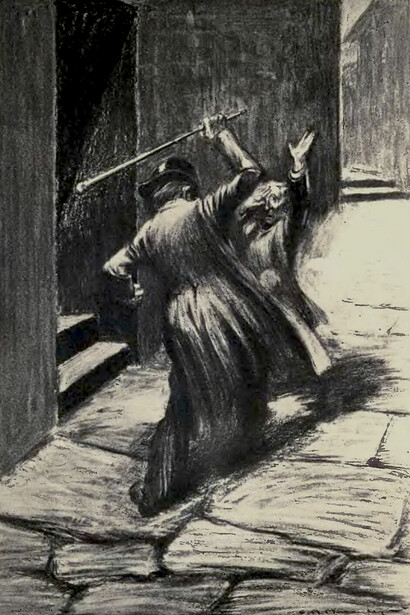
The second incident concerning Hyde’s brutality is a year later and involves the murder of Sir Danvers Carew, who is beaten to death using a walking stick given to Dr Jekyll by Mr Utterson. When Utterson visits Dr Jekyll, he says Hyde has gone and he will not be heard of again. As proof of this, he gives him a letter in Hyde’s hand. This allows the lawyer to seek a comparison of the writing of Dr Jekyll and Mr Hyde, at which he is told that the writing is identical but for the slope. For two months, Dr Jekyll returns to meeting with his friends, supporting the idea that Hyde has gone, but in the middle of January, Jekyll becomes confined to his house and will not see anyone. The reader later learns this reflects the conflict Jekyll is experiencing between the two sides of his personality, telling Utterson he has brought a punishment and danger on himself that he cannot name.
Dr Lanyon’s account begins the revelation. Jekyll asks the doctor to obtain a drawer and its contents, as, following the murder, Hyde cannot leave the premises for fear of being captured. Lanyon, not having seen Hyde before, looks negatively on his appearance. The doctor is curious about the contents of the drawer, and when Hyde offers to mix and take the potion in front of the doctor, he agrees. When he takes the potion, he turns from Hyde into Dr Jekyll, and this is the first time the reader has proof that they are the same person. This revelation ages Dr Lanyon prematurely and leads to his death.
Dr Jekyll writes the final chapter, where he details his faults as being gay and impatient, which is hard to maintain when you wish to present a high standing in public opinion. This, he states, results in duplicity, with any irregularities hidden by a sense of shame. He argues it was from this moral perspective that he learnt to recognise the duality of man. If this dual nature could be confined in two separate people, then the good could walk in righteousness and never be exposed to the guilt and disgrace of the evil one. He describes evil being written on the face of Hyde and deformity and decay imprinted in the body, yet he felt no repugnance.
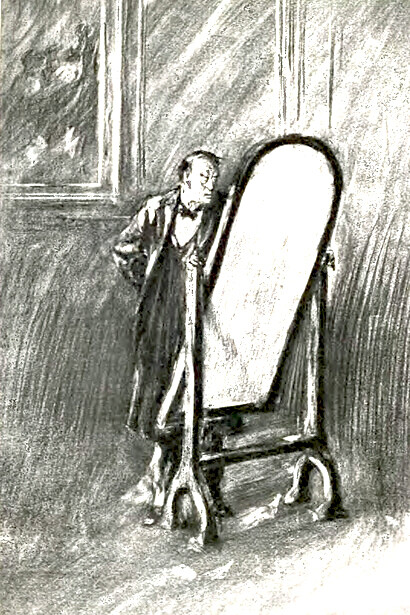
After the murder, he wakes up as Hyde, not Jekyll. Thus, he reflects that the balance of nature may be permanently overthrown and he may remain as Hyde. He describes Jekyll as having a father’s interest and Hyde a son’s indifference. By becoming Jekyll, he feels he has to give up all the indulgences he had cultivated as Hyde. Equally, to become Hyde would be to sacrifice interests and aspirations, becoming despised and friendless. Choosing the better part was difficult, being tortured by the longings for freedom Hyde represented. Giving in to temptation, he takes the potion, resulting in an increased desire for evil. After the murder, he realised his life was forfeit, and he needed to take refuge in Jekyll. As Hyde, he needs to obtain his potions from the laboratory, hence the request to Dr Lanyon.
The long-term consequences of taking the potion become apparent when he feels the pain associated with the change, and it takes a double dose to bring him back to being Jekyll. This wears off after six hours, and he needs another dose. When he goes to sleep, he wakes up as Hyde, his sleep being plagued by the horrors of his other self. As Hyde, he resents the dislike people show towards him, and this manifests in him writing blasphemy in the pages of books, burning letters and destroying the portrait of his father. This situation may have gone on indefinitely but for the fact that he was running out of powder to make the potion. Unable to obtain the original powder, he concludes it was contaminated and resigns himself to the fact that Hyde is permanent.
The scientific case of Dr Jekyll and Mr Hyde is told through accounts of a doctor and a lawyer, which gives it some scientific weight. Yet the dilemma is a very human one: how to control the conflicting influences of good and evil found within the soul of man.