English
 Español
 Français
 Deutsch
 Italiano
 Português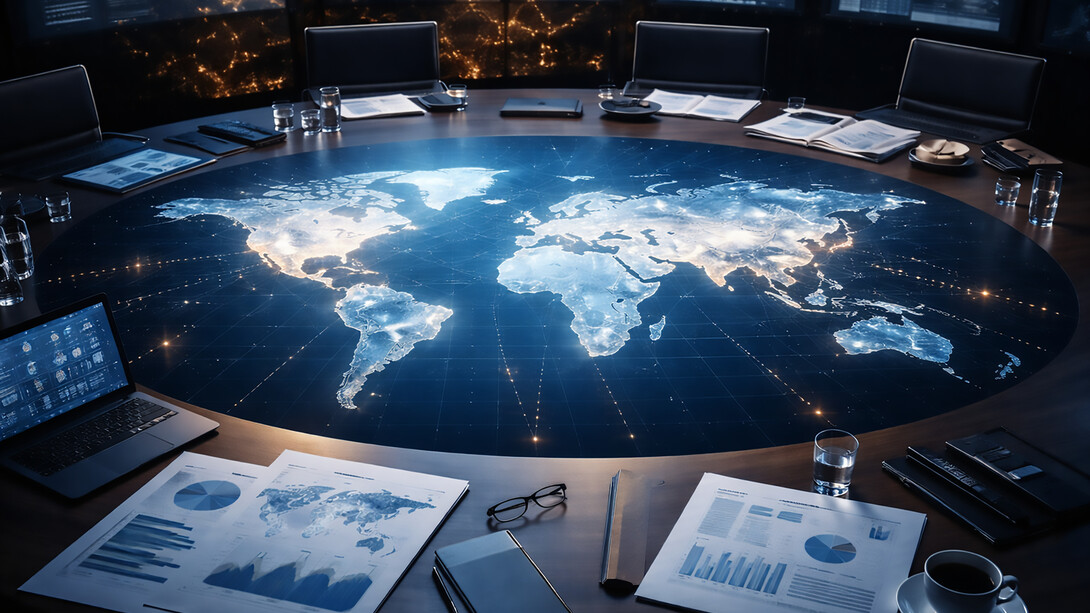
The world is clearly being shaped by a changing global distribution of power. There are many reasons to question whether the world is indeed already multipolar and, in more than one sense, shaped by multipolarisation. The world already entered an era defined by multipolarity.
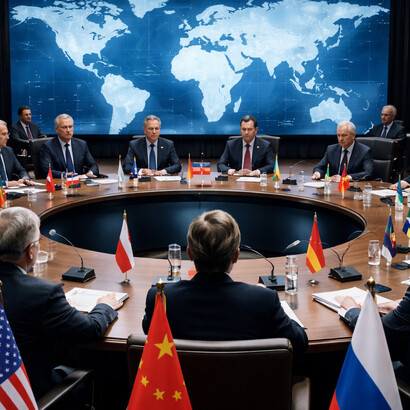
Multipolarity is a distribution of power in which more than two states have similar amounts of power. Multipolarity is a world order with multiple great powers competing for influence. Multi-plurality is a plurality of views and of power, while multilateralism is a cooperative, rules-based approach to international relations, focusing on shared norms and institutions to manage relations.
The world is increasingly multipolar and less multilateral. Multipolarity is a given, and multilateralism is an ambition. Multilateralism was rooted in liberal internationalism, advocating peace, cooperation, rule-based order, and democracy to prevent conflict. Multilateralism could serve as a basis for a multipolar global order in more cooperative rather than conflictual contexts. Multipolarity means having multiple agendas promoted by different players, while equality could be ensured by multilateralism, with the balance of interests, cultures, rights, and traditions among small and large actors. Multipolarity – a world order with multiple great powers competing for influence.
Multilateralism refers to cooperative efforts among states to achieve common goals through shared rules and institutions, while multipolarity is about competition. Multipolarity describes a world where several powers seek influence. No single actor dominates. And while multipolarity is emerging as the dominant structure in the military, political, and economic arenas, multilateralism is declining as the preferred strategy of large and secondary powers alike. Today's power is diversifying, not disappearing: military power (above all), political and diplomatic power, economic and financial power, cultural power, and geodemographic power. Clear evidence of hegemony is currently one of the main problems.
This depends on the willingness of the hegemon to lead (made even more explicit by the publication of the U.S. National Security Strategy 2025) and to be accepted as a hegemon by others. The U.S. is acting as a global policeman and guarantor, and on the other side, we have the rise of revisionist powers, China and Russia. Multipolarity is still trying to replace the U.S.-led order. According to proponents of the hegemony strategy, the best way to achieve a world safe for the United States is to maintain an unchallenged monopoly of power in every key region. It is not enough for the United States to be first among equals.
The U.S. is required to be more powerful than all other great powers combined. The missions shared by all U.S. strategies include homeland defence, deterrence, and U.S. global power projection. The hegemony strategy requires the U.S. to adopt a strategy of dissuading and deterring potential competitors from even aspiring to a larger regional or global role. The U.S. intends to keep military strengths beyond challenge, making the stabilising arms races of others pointless, and military preparations that one country undertakes for defensive reasons can appear threatening to others, who may take military measures of their own and set in motion a spiral of mistrust and military build-ups. American defence capabilities are as great as the next six powers combined; the U.S. accounted for 45% of global spending on the military.
The American military presence in Europe reassured Western countries and acted as a barrier against undesirable events. American presence was supposed to reassure Russia that Germany would not adopt policies of the kind that led to two destructive wars. But today the situation has changed. The U.S. is forcing NATO member states to allocate 5% of their national income for armaments. And Germany is arming itself the most of all NATO allies, followed by Poland. The EU faces existential risks in the multipolar world, adopting more assertive geopolitical strategies which may imply the erosion of some of the principles on which the Union itself is built. The world order could split into competing blocs in the areas of security, economic integration, and technology. The lack of consensus will then fracture the world and force third countries to align with one of the competing systems.
Powers like Brazil, India, and the EU may not dominate, but they increasingly shape the agenda in trade, sustainability, and regional security. The world today is more economically interdependent – supply chains, technology, and climate change force even rivals to cooperate. The real challenge is to design institutions capable of balancing powers. Whether the next phase of global order will be defined by leadership or renewed confrontation remains an open question. Multilateralism sets much higher standards for international behaviour than multipolarity. There have always been three judgments regarding a multipolar world.
The first is the multipolarity featuring unilateral confrontation, as represented by President Trump’s administration. Multipolarisation in their understanding means that countries proceed from their own interests and fight, so ideas such as collective action and international cooperation can be ignored.
The second scenario is one featuring multilateral confrontation, when President Biden divided the world into camps of ‘democratic nations’ and revisionist ‘authoritarian nations’ and openly attempted to rally allies and partners to confront such countries as China and Russia.
The third scenario features multilateral cooperation – something China and Russia are promoting. President Xi Jinping has repeatedly stated that multipolarisation is a primary characteristic of global development and a realistic choice for human progress. So, multilateral cooperation (and not a multilateral confrontation), mutual respect, fairness, justice, and win-win cooperation are the fundamental principles of international relations. At the WEF annual meeting, China stated to firmly uphold the multilateral trading system and warned against the return of the ‘law of the jungle’. Emerging Sino-American bipolarity is increasingly structuring the world system. Since President Donald Trump assumed office, we have witnessed a fierce struggle between unilateral confrontation and sharing the characteristics of hegemonism and power politics. According to Marco Rubio, ‘China wants to be the most powerful country in the world, and they want to do so at our expense; and that is not in our national interest, and we are going to address it.’
The U.S.-style strategic misjudgement of China is because they are unable to drop their obsession with preserving U.S. global hegemony. President Trump is only seeking to strengthen the U.S. position – following the principle of ‘America first’ – and ultimately preserve America’s global leadership by means of sheer power. The U.S. and China are the only superpowers, and the trend points to a new bipolar era. China is already the main powerful challenger to the United States in almost all dimensions. China trails the U.S. in nominal GDP and GDP per capita; it’s the world’s largest economy in terms of purchasing power parity.
China’s military modernisation represents an increasing concern for the U.S. In almost all areas, China has already matched or surpassed America. While Russia is still the only superpower on par with the U.S.A., China seems to be becoming the third nuclear power. And as for China-U.S. relations, it is up to U.S. decision-makers to decide whether they want the tremendous cost of conflict and confrontation or to share the dividends of mutually beneficial cooperation. The choice will be very important for a multipolar world. The U.S. would slow down the development of multilateralism. It’s too early to tell whether China-U.S. relations will stabilise during Trump 2.0. These widely different visions are based both on profound political and philosophical ideas and on strategic choices in real-world political decision-making. The U.S. withdrawal from 66 global organisations spells danger to multilateralism.
The military-technological supremacy of the U.S. and the rapid advancements in the complexity of military technology, and Donald Trump’s election, may bring about a redefinition of the U.S.’s global role as the guardian of the international order, and Washington is not going to give up its top position in the near future. The Trump administration will increase investment in defence and try to push back against China’s continuous rise. The US dollar still remains the most widely used currency for trade and other international transactions, and central banks still rely on the US dollar as the key reserve currency. The BRICS countries have announced their intention to create a BRICS currency to reduce global dependence on the US dollar. But the path to financial multipolarity or de-dollarisation seems long.
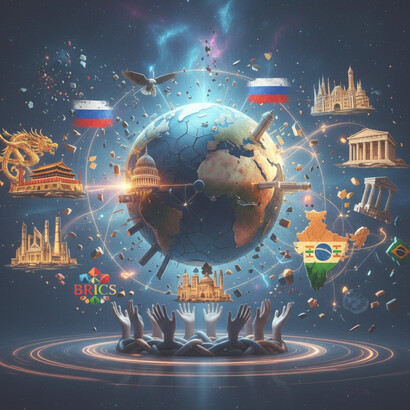
India’s continued rise could shift the system to multipolarity in the future. Brazil exhibits some characteristics of a great power, and South Africa falls short in almost all dimensions. The members of the BRICS have already surpassed the G7. Following the enlargement of the bloc (the addition of Egypt, Ethiopia, Iran, and the United Arab Emirates). Europe should be a great power if they act together. ‘The current of global politics is running from a crumbling hegemonic world towards growing diversity, while the West is trying to swim against the tide’ (Vladimir Putin). Do we live in a world where the U.S. is still the dominant superpower, or do we live in one where the U.S. and China dominate? Others believe we live in a world where powers beyond the U.S. and China can have a strong and independent influence on global affairs. And 80% of the public agrees that the U.S., China, and Russia are great powers.
Today’s international system displays elements of unipolarity, bipolarity, multipolarity, and no polarity. The trend may point toward multipolarisation. The emergence of new centres of power (China and Russia) has brought the unipolar era to a close, ushering in a multipolar world. And the diffusion of power means that no single great power can dominate the system, as the U.S. did in the post-Cold War era. So, nations such as Brazil, Japan, and Turkey are influential regional powers, but they lack the global reach of China and the U.S. These regional powers are acting as intermediaries in great power competition. The BRICS itself is a statement of how profoundly the old order is changing. But for some analysts, the world still remains unipolar, and the U.S. is a dominant hyperpower. Multilateralism promotes the idea that all countries have a role to play in addressing global issues.
Multilateralism recognised that many global challenges should be addressed collectively. One of the key aspects of multilateralism is a rule-based international order, but what we see today is very little or no respect for international law and norms from many countries (especially the most powerful) to maintain stability and fairness in global issues. The multilateral approach values the participation of all nations, regardless of their size and power, in international decision-making processes. And the multilateral approach prioritises peaceful resolution of conflicts through dialogue and negotiation (which is not the case, in addition to all ongoing wars today) rather than unilateral action or force. And finally, the principle 'Leave no one behind' emphasised in the 2030 Agenda for Sustainable Development underscores the commitment to inclusive progress and development for all. Multilateralism helps nations to confront complex global challenges through a universal approach.
The UN is still a form of multilateral system for dialogue, cooperation, and collective action for addressing global issues such as peace and security, climate change, human rights, and sustainable development. The UN has called for a rebalancing of excessive global military spending towards sustainable development and educational and public health needs. But the current international institutions (the UN, World Bank, IMF, WTO, and others) have proven to be ineffective and useless and are struggling to adapt to this new dynamic, calling for significant structural reforms. The World Trade Organisation has been weakened by nationalist policies and persistent trade disputes. The UN Security Council is paralysed by veto politics. The expansion of BRICS is an example that countries are seeking to amplify their collective influence. The Global South is rising, and countries are leveraging their economic size, natural resources, and demographic advantages to gain influence.
Regional organisations like ASEAN and the African Union are gaining influence, too. In Latin America, regionalism over the years has taken a number of forms, from hemispheric political coordination to subregional trade agreements to physical integration (the Central American Common Market and the Common Market of the South (Mercosur)). The phenomenon of cross-regionalism and trade, together with regional power asymmetries and the rise of extra-regional attractors in a multipolar world, impairs further region-building. The concept of a multipolar world represents an alternative to outdated models of international relations and opens up new opportunities for global cooperation and development. It is a strategic necessity and a moral choice aimed at a sustainable future for all nations on the planet. One of the key characteristics of a multipolar world is the presence of multiple power centres, each possessing significant economic, military, and political capabilities.
These power centres can include established global powers, rising powers, and regional powers. Rebalancing power in a multipolar world is a complex ongoing process, characterised by a diffusion of influence away from traditional Western dominance toward new and emerging powers, particularly in the Global South. This is transforming international relations; no single superpower can unilaterally dictate global outcomes. Power is now shared among the West, China, India, Russia, Brazil, and South Africa. We need to build back a better world with more equality, resilience, and a more sustainable world. And the spirit of multilateralism should be: ‘Together we are stronger.’ The theme of the 80th anniversary of the UN celebration was ‘Building Our Future Together’, and its mission is to address today’s global challenges. The multipolar world is paving its way.