English
 Español
 Français
 Deutsch
 Italiano
 Português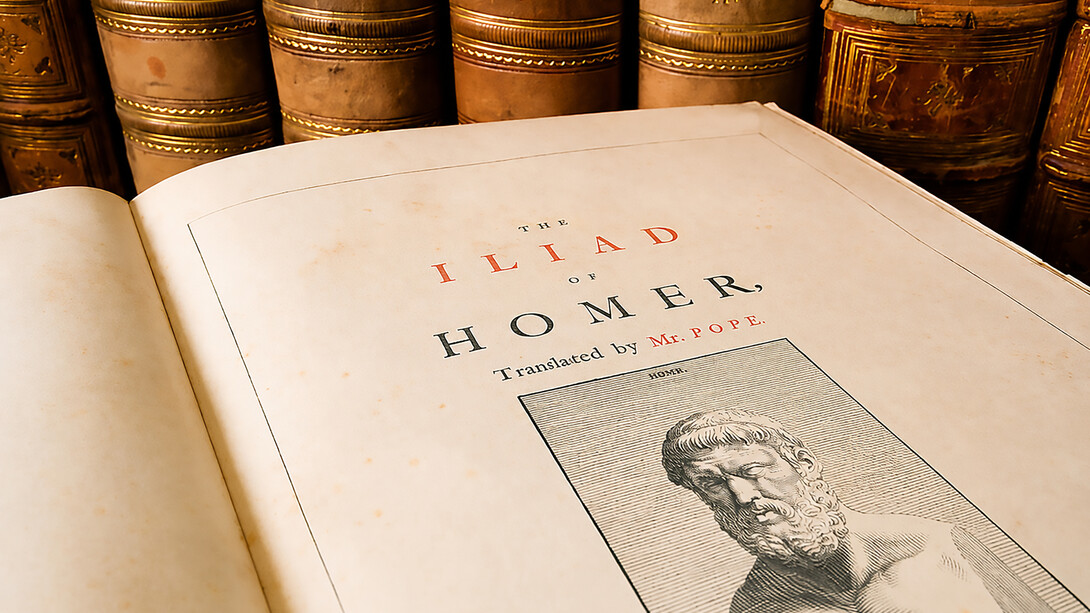
Let me first thank Matt Ehret and the Rising Tide Foundation for inviting me to speak on poetry and geopolitics.1 This is a very therapeutic exercise, as for years I have lived a bipolar life because of what the poet William Blake called “mind-forged manacles".
By “mind forged manacles,” I mean the artificial bias that poetry and political science and other academic disciplines remain in separate worlds, often using different terminologies, and do not make the effort to speak to each other.
For years, I had more poetry publications than political science publications, and so I never put the poems on my CV for fear I would never get a job!
I always find it absurd when people have told me that poetry should not be about politics – and particularly not about geopolitics.
This kind of statement ignores the very origins of European poetry in the oral history of the Iliad and the Odyssey (circa 600 BCE)―two of the greatest epic poems, quintessentially about geopolitics.
Such an absurd statement also ignores the geopolitical dimensions of the Chinese “Heavenly Questions” (circa 300 BCE); the Anglo-Saxon “Beowulf” (probably written between 700 and 750); the French “Song of Roland” (written between 1129 and 1165); as well as later works such as Milton’s “Paradise Lost" (two editions, 1667 and 1674), which involved themes of “envy and revenge” in Milton’s words.
Unfortunately, the general bias against poetry, as illustrated by Plato’s condescending discussion of poets in The Republic – even if Plato himself was a poet – ignores the fact that poetry can contribute to a deeper understanding of politics and geopolitics. It ignores the fact that Shakespeare can be considered one of the greatest “political scientists".
For this essay, I have chosen to discuss themes of Homer’s epics because they each deal with long-term historical struggles of envy, resentment, wrath, and revenge.
The Iliad and Odyssey
It was around the 6th century BC that Homer compiled the Iliad and Odyssey at a time when the Greeks knew next to nothing about the Mycenaean era spanning the period from approximately 1750 BC to 1050 BC.
The two epic poems thus represent an exploration of the past but also an allegory for the present and future. The books were most concerned with themes of treachery, envy, and revenge that possess personal, geopolitical, and cosmic ramifications.
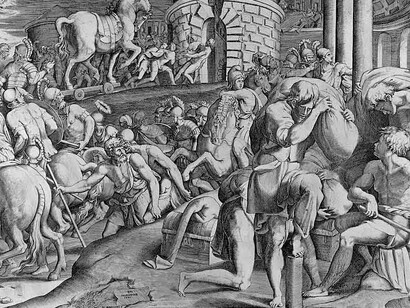
The Aeneid depicts the events in the final weeks of the Trojan War when a coalition of Mycenaean Greek city-states was seizing Troy. The primary focus of the epic is on the fierce quarrel between Achilles and King Agamemnon, the commander of Greek forces.
What is meaningful for the study of politics is not historical accuracy, as the Trojan War may never have taken place, or if it did, definitely not the way it was depicted by Homer, but the dynamics of power relationships between the major characters and the nature of their political-psychology.
In effect, the more powerful Agamemnon slights Achilles’ honour (timé) by taking his war prize, Briseis, the woman captive, from him in compensation for his being forced to give his own woman captive, Chryseis, the daughter of Chryses, a priest of Apollo, back to Chryses. The latter had prayed to Apollo to send a plague on the Greeks to force Agamemnon to give his daughter back.
The story illustrates how even allies can fall into divisive disputes during wartime as they struggle for control over the spoils of war, as symbolised by women captives in the minds of these two male warlords. The fact that Agamemnon, with all his insolence and hubris, refuses to recognise the right of Achilles to the spoils of war by seizing Briseis leads Achilles to refuse to commit his forces to the future battles against Troy―thereby leading to devastating Greek losses.
Revanche
What is most interesting is how Achilles’ personal menis (usually translated as 'anger', 'wrath' or 'rage') transforms into long-term geopolitical revanche in which the personal wrath of Achilles and his resentment of King Agamemnon’s greater power and wealth become fused with the long-term revanchist social-political-military movement of the Greeks versus Troy. This is a major theme of the book, as indicated in the opening lines: “Sing, O goddess, the menis of Achilles, son of Peleus that brought countless ills upon the Achaeans”―as the book, on a deeper level, is about the metamorphosis of wrath as it expands from the personal into the social and political and even into the cosmic.
In Achilles' view, King Agamemnon takes more than his fair share of the spoils of war and does not recognize the value of the contribution of Achilles's forces in the struggle against Troy. Not only does Achilles claim that his forces do the better part of the fighting, but he also resents fighting for the "pleasure" and "insolence" of Agamemnon. Achilles states that he has no quarrel with the Trojans who have not raided his cattle and horses, nor have they cut down his harvests on the rich plains of Phthia which are far from Troy. Therefore, there is no reason for him to risk death to make King Agamemnon even richer and more powerful. Loyalty to the Achaean cause and to the King was not sufficient for Achilles to do battle.
It is a universal theme that impacts the nature of all alliance relationships. Why fight for other states and peoples when their cause is not your cause, and when there are no apparent benefits to be gained by fighting? And yet states are nevertheless drawn into the defense of their allies―whether willingly or not―as would Achilles be unwillingly drawn into the defense of King Agamemnon and the Archaeans for unexpected reasons that would impact Achilles' honor and interests.
Over time, Achilles’s personal wrath against King Agamemnon transforms into uncontrollable revenge versus Troy in backing the Achaean cause―but only after the Trojan prince, Hector, slays Achilles’ close friend Patroclus. Feeling responsible for the death of Patroclus―as Achilles was not there to fight beside him―leads Achilles to reenter the battle against Troy and against Hector in particular.
Although Hector had originally opposed Troy's war with the Achaeans, and although he hoped to reason with Achilles to put an end to the bloodshed, Achilles' quest for revanche against the individual who killed his friend Patroclus is unconsolable and uncontrollable. In slaughtering Hector, Achilles desecrates Hector's body in a violent affront to established norms―setting off a new cycle of vengeance, guided by the gods, as Hector's brother Paris will seek to avenge his brother's inhuman and "unnatural" death by eventually killing Achilles.
The wrath of Achilles becomes "cosmic" in the sense that his revanchist actions against Hector and Troy are no longer determined by human reason and result in unforeseeable events governed by the mere whims and humours of the "gods" – who symbolise events that move beyond human expectations or control―and in violation of social norms.
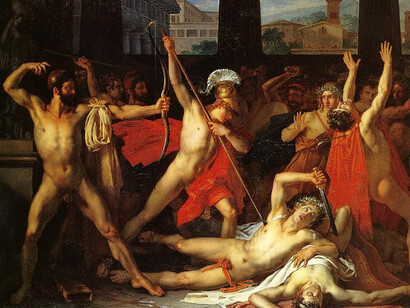
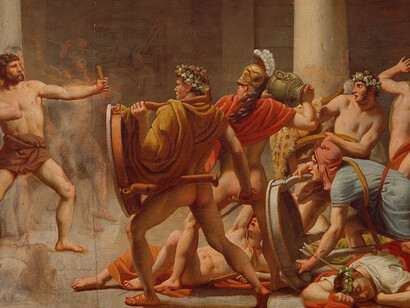
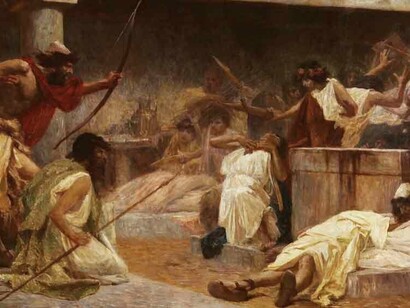
The theme of revanche―wrath that goes beyond rational human control in the belief that neither man nor the gods will intervene―is picked up again in the Odyssey. Homer depicts the revenge of Odysseus, who, after pretending to be a beggar, reveals his identity before he seeks vengeance upon those who have seized his home and violated his servants and his wife, in the belief he is dead. As Homer puts it, those whom he is about to kill have acted unjustly precisely because they do not fear the wrath of either man or the gods:
No fear of the gods who rule the skies up there.
No fear that men's revenge might arrive someday.
Now all your necks are in the noose – your doom is sealed!
Odysseus, of course, is risking his own neck in battling the suitors, but his goals of revenge transcend rationality. Acts of vengeance and counter-vengeance expand and escalate without a certain outcome and without a guarantee of victory. Man can appeal to the gods―but it is not at all certain whether “justice”―as if there were any such thing in war―for the individual or for the social collective will be granted or obtained…
Much as the Greek philosopher Heraclitus pointed out, Homer was an allegorical writer. And as allegories, these great poems help provide insight and understanding of long-term geo-historical conflicts… the Greeks vs Troy; Athens vs Sparta; Rome vs Carthage; England vs France; Spain vs France; France vs Germany; Japan vs China; the Israelis vs the Palestinians, the Arab states, and now Iran; the US vs the Soviet Union and now Russia… just to mention a few…2/sup>
As Heraclitus said, “War is the father of all and the king of all.” So too, regardless of the gendered allusion, war and opposition to war in metaphorical dialectic can also be said to be at the roots of great poetry – often with themes of wrath, envy, resentment, and long-term revenge.
References
1 On Geopolitics, War and the Role of the Poets (featuring Hall Gardner).
2 Hall Gardner and Oleg Kobtzeff, eds, The Ashgate Research Companion to War: Origins and Prevention (2012).