English
 Español
 Français
 Deutsch
 Italiano
 Português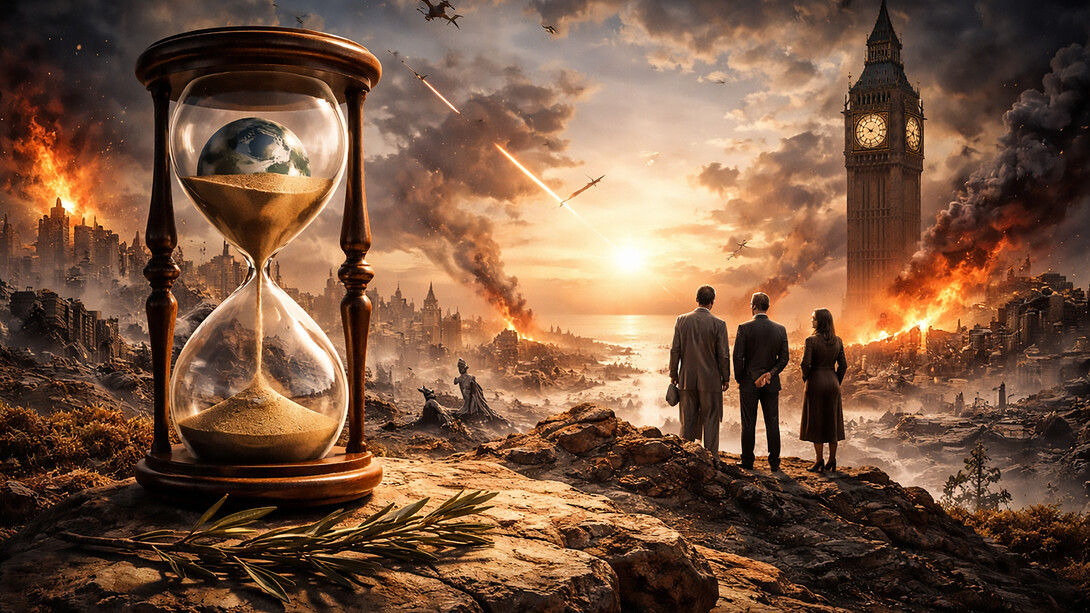
The sostenuto voice of the World Philosophical Forum calls out to save the earth, improve the functioning of the international community, and help ring in a reluctant world peace as the hands of the Doomsday clock tremble in an uncertain dance with geopolitical reality, and meters from the abyss.
Philosophy can elevate the signal-to-noise ratio in the cacophony of competing and destructive interests in our world to help slow down the unraveling of complex biological systems that prop up human consciousness and prevent a technologically manipulated future of limited free will over the long term. In contrast, in the short term, it can mitigate against a big nuclear bang bigger than the big bang of birth that sets evolutionary development in process.
One day, it will have to be officially admitted that what we have christened reality is an even greater illusion than the world of dreams.
(Salvador Dali)
Truth matters more than comfort.
(Andy Rooney)
Through the joint action of the members of the World Philosophical Forum in Athens, progress and general benefit to philosophy can help the world inch a little in the right direction.
In January 2026, the Bulletin of the Atomic Scientists will reset the symbolic Doomsday Clock, currently standing at 89 seconds to midnight. The Bulletin’s driving belief is that politics in the service of power and economic gain constitute a causal agent in the misappropriation of the fruits of human genius. It is the same genius that can push the clock back, enabling reason to retake control. I add that the chances will be better with the deployment of practical philosophy and restate that only reason can move us to the revival of life on Earth; philosophically imbued, it can ensure acceptable equity through fairer, more efficient, and more just policies. Surely, it can happen, and nuclear fusion can be pursued as the ultimate energy goal, providing potentially limitless clean energy without greenhouse gases.
We live with an ill-distributed abundance at a time when all competent hands are needed on deck! As thinking beings, we wonder which system will collapse next: another part of the environment as a result of climate change, health from a global pandemic, a button pressed initiating a nuclear conflagration, the collapse of an economic or banking network, a time when artificial intelligence might take over, or some other unexpected disaster for which we are ill-prepared. One definition of insanity is doing the same thing over and over again and expecting a different result.
Approximately a millennium ago, the unrighteous Anglo-Saxons were called upon to pay taxes based upon their recorded wealth as registered in the Doomsday Book (1086) to William the Conqueror (1066), who was as much Anglo as he was Franco. He was crowned King of England close to Christmas. It took about a century for the French to adapt to English life and less for the Anglo-Saxon elite to regain their lost power. In the land, two languages were spoken exactly as before the conquest by the elite. Today, the setting of the Doomsday Clock is a symbol and metaphor for how close humanity is distanced from disaster. Each year, we are hopeful that it will herald in a turning point, not a tipping point, namely, the time when decline stops, and reversal begins, when war wanes and peace waxes. These are not abstract concerns. They are immediate threats to human survival. Honi soit qui mal y pense.
Between the ages of stone, iron, and bronze, the just-passed winter solstice must have been observed myriads of times and recorded in Neolithic monuments like Stonehenge. It is a notable astronomical event equating to the darkest day of the year and might well have become a doomsday symbol after WWII by the upending of its predictability. Just before Christmas, we know that the day of 15 hours of darkness will start losing out to day, and its 9 hours of light will increase. Should darkness have continued to increase from 15 to 16 to 20 to 23 hours with 1 hour of light, the question of how far it is to Bethlehem would have had little meaning, and the close proximity of Earth, Saturn, and Jupiter, all on the move, would not have been observed by the three wise men.
We should remember, though, that ships, organizations, countries, and empires can sink. A ship can be confiscated, deep-sixed. It brings to mind the captain’s lament in Nineveh when his ship went down in high seas with its cargo of wheat that would never make bread. As a result of the disaster, the captain lost his identity. As a result of Armageddon, we can lose our humanity and our Earth. When uncertainty, mindlessness, and distorted reality characterize our current moment in history, the unexpected should be awaited. A button can be pressed, a key turned, a lever moved, and weapons of mass destruction can be released from the large stockpile. A few moments later, other buttons will be pressed. As midnight approaches, World War III and a man-made holocaust come closer and will be over in 60 minutes. One hour later, culture dies, languages fall silent, books are no longer read, and radio and television fail to broadcast. Museums, music halls, law courts, churches of all denominations, parliamentary houses, and libraries lie in rubble. God forbid that Big Ben's chimes will not make it to their 12th chime.
Humanity’s long history of warfare does not provide much space for peace. Philosophers are falling short of their civic-social role, academies of their social agendas, and scholars all over the world are at risk, as pointed out by Zeke Hausfather. Things aren’t just getting worse. They’re getting worse faster. Barack Obama tells me, “I’m worried, Jeffrey.” When Barack says he’s worried, we should all be worried. This is the time to fight for our democracy and for our core values—right now, before it is too late. In this critical period of time, we are actively moving in the wrong direction with respect to all our existential problems. Some more optimistic reports point to a silver lining.
We stand at a critical juncture in human history. Poised at the start of a new arms race, nuclear-armed states have all but abandoned constructive dialogue. Climate change is advancing at a pace that exceeds scientific projections, with destabilizing consequences for every region of the world. Artificial intelligence, synthetic biology, and other emerging technologies advance rapidly with insufficient governance. The temptation to automate command and control will increase, says Ross Anderson, but in doing so, the danger is greater, and Jacqueline Sneider warns about giving AI the nuclear codes. It calls for something more than the king holding on to the keys of a queen’s chastity belt.
How can humanity bypass what Austrian philosopher Günther Anders calls apocalypse-blindness in Western society? How can the government deal with the rapidly growing mindset of concern, telling us that there is little to no time left to look back and that we must expand our efforts to reshape the future? No longer can the Hellenic olive branch and Goethe’s Gingko leaf rekindle their symbolism, and the dying dove of peace of Picasso cannot be resurrected to help our current situation. We need something else! That something else has not only been promoted by a past Director General of UNESCO with the slogan "There is no UNESCO without philosophy!" which was transformed into "There is no humanity without philosophy!" but also was supported by a former UN Secretary-General through (Civic) Education First! and called out to governments to cultivate a new humanity of citizens of the earth united into global citizenship. This initiative of Ban Ki-moon was also supported by UNESCO in its Strategy for 2014–2021 and is now abandoned.
All across the globe, we’re seeing a rising wave of authoritarianism. Politicians are targeting civil society, undermining freedom of the press, and weaponizing the justice system. And no one is being spared. Even countries that thought they were immune from wholesale assaults on democracy now understand that they are all caught up in this struggle. As the calendar turns to 2026, we all must recognize that this is an inflection point.
When populism and fanaticism penetrate opinion in scientific affairs, disaster is never far behind. It can range from counterintuitive interventions in complex systems and problem fields to denial of the problem space. As Flagship Earth and its crew, humanity, flounder in rising seas, opinion is divided on how to reach a safe harbor. Humanity is going mad and ready to die for nothing as it comes closer than ever to overall self-annihilation. Will it be Heaven or Hell? It was Dag Hammarskjold who aptly told us that the United Nations was not created to take mankind to heaven but to save humanity from hell on earth. Our task is also to keep the green fields of home (MESA) and to ensure that the international community is equipped with the tools to do so (MUNFA).
I offer you Eurasian Bridges for Peace, a most concrete project conceptualized in Athens, which, as a result of crosswinds unknown to cultural diplomacy, came down with baby cradle and all. It fit well, like hand in glove, into our "Appeal to Humanity to convert current Global Chaos to Global peace and prosperity through overall proper common civil-philosophical education of Earth inhabitants." One urgent statement found on the platform webpage of the World Philosophical Forum reads, "Inhabitants of the Earth, get ready!" One proposal of the World Philosophical Forum is that a symbolic peace be negotiated in the sacred place of Delphi, Greece, and an agreement and a universal peace treaty be signed in the Old Hellenic Parliament, Athens, of modern Greece.

Mindset is what matters: two cartoons from the Bulletin of Atomic Scientists.
Two useful approaches to needed mindset modification that I recently came across come from Héloise Fayet in the Bulletin of Atomic Scientists and Maria Papanikou during the 6th Conference on Epistemology: Epistemological Issues in Transportation Safety, Society of Ancient Greek Philosophy (with Athens), at which I was privileged to present a keynote address on the roles of change rates in the emergence of interdisciplinary public health, Physical-δx/δt–δv/δt biological scourge vectors, and environmental tree rings.
Maria Papanikou, in From Control to Preparedness: Room for Improvement in the Management of High-Risk Sociotechnical Systems, takes us from what we have now to a newer view of crisis or exceptional disruptive moments, shifting the focus from human error as a principal cause of accidents to human error as the result of deeper troubles within the system, while Héloise Fayet, in Algorithms of Misperception: Managing Nuclear Risk in an AI World, argues that the challenge ahead will relate as much, if not more, to the conceptualization and perception of nuclear risk—perceived, misperceived, and distorted in the information environment—as to the management of nuclear weapons. It is worth noting that the recent loss of communication in Greek airspace is a case of deeper troubles within the system.
Humanity’s spinning coin portrays a fading civilization on one side, while etched on the other is mankind’s infinite talent. The world seems not to know that complex biological systems propping up human consciousness are unraveling as a result of climate change. It doesn’t seem to know that a big nuclear bang can bring civilization and culture to an end. Mankind seems not to have gotten the message that, without meaningful philosophically imbued education and a mentally healthy population, a technologically manipulated future of limited free will is possible? As an Earth citizen, I ask, will it fall heads or tails? The world can function differently, and its decline is neither fatal nor certain. But without freedom fashioned by civic education and nurtured by classical philosophy, humanity can fail. If leaders can retouch philosophy, the chance of a silver lining will increase; the mindset may be modulated as empathy’s footprint grows.
Reality is universal and complex, with levels of complexity that place it outside the scope of poetry and beyond being tied down within an algorithm dominated by artificial intelligence. The brain is capable of creating individual and local realities. As science and philosophy modulated by spiritual aspects of religion are on an expedition to find and explore the limits of algorithmic thinking in humanity’s attempt to capture more and more of nature’s secrets, to understand them, and to decode them, new and awesome insights will be revealed. Religion is finding new footholds to repeat times when the people left one religion for another, as Christians unprotected from disease returned to Paganism. Today, young people disillusioned with political leadership are leaning towards belief, following a route of broken promises and frustrated hopes marked by a succession of disasters, and living life unable to afford or to do the sort of things that their parents took for granted, such as buying a house or starting a family.
God forbid that not one baby cries, not a single cherry ripens, and that the olive branch is no more. To cease upon the midnight with no pain is a poetic understanding of that dramatic last moment. But midnight is also that awful moment when the last few chimes of Big Ben do not sound. Now, in January 2026, we must remain optimistic (PINOT) as the Bulletin of Atomic Scientists announces its difficult decision. Now in 2026, let’s cling to a suggestion from Laura Williams that prosperity demands we tend the embers, rather than curse the cold.
NB The World Philosophical Forum (WPF), Athens had the privilege of introducing a resolution during a conference held in the inspiring Palais des Nations Non-governmental Organizations of Europe and Asia: Dialogue for Sustainable Development in 2026, (December 18, 2025, UN Geneva) under the umbrella of the International Association of Peace Foundations (IAPF) and its President Chess Master Anatoly Karpov. The WPF Resolution was accepted without any dissenting voice relating to Nikola Tesla, the man who enlightened humanity, his as yet unmeasured contribution to human progress, and calling on the UN to dedicate a special day in his name. The day and date suggested is the occasion of 170 years since his birth, and specifically July 10th, 2026. The World Philosophical Forum continues its activities in Practical Philosophy to support the creation of a World where Peace, equality, and cooperation between individuals and social groups.