English
 Español
 Français
 Deutsch
 Italiano
 Português
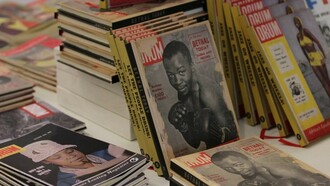
Ramparts Magazine existed from 1962 to 1975. It was a glossy and often illustrated American political muckraker that captured the revolutionary zeitgeist of the era. Ramparts was perhaps best-known as one of the most respected organs of the American New Left. The New Left can possibly best be defined as a loosely organized, mostly white student movement that advocated democracy, civil rights, and various types of university reforms, and protested against the American war in Indochina.
But the term New Left was first popularized in the United States in an open letter written in 1960 by sociologist C. Wright Mills titled Letter to the New Left. He argued for a new leftist ideology that he hoped might transcend the traditional and often dogmatic (“Old Left”) focus on labor issues, into a broader focus on issues such as opposing alienation, anomie and authoritarianism.
Mills argued for a shift from traditional leftism toward the values of the counterculture, and, echoing Karl Marx, emphasized and advocated an international (rather than nationalistic) perspective on the movement.
Mills also claimed that the proletariat (collectively the working-class referenced in Marxism) was no longer the revolutionary force; the new agents of revolutionary change in the decades after World War II were, Mills believed, young intellectuals such as college students, scholars, and editors of leftist academic books, journals, muckraking publications (such as Ramparts).
(Introduction to Ramparts Magazine, "Ramparts Magazine and the New Left’s lost voice"1)
China received a great deal of attention from Ramparts Magazine, especially during the Nixon Administration in the early 1970s when Cold War tensions began to thaw and China began opening itself to global trade, particularly with the United States. In the 1960s, most ink spent on China in the pages of Ramparts focused on Mao Zedong and China’s relations with the Soviet Union.
The first time ever China was the sole focus of an article published by Ramparts seemed to foreshadow the inevitable détente between China and the U.S. and ultimate rise of China as an exporting power and the U.S. as a sinkhole for Chinese goods.
For example, in July 1965, the editorial staff at Ramparts published an article titled “Coexistence or No Existence” in which they decried the state department’s “containment through isolation policy” as wrongheaded, noting that in the pursuit of this policy, the United States stood “virtually alone among the nations of the ‘free world.’” British, French and Japanese trade relations with mainland China continued to expand. The People's Republic, the editors explained, was Pakistan's prime customer for cotton; it was also an important market for dates from Iraq; the list of trade missions from Western European countries and from Africa also steadily mounted.
As such, the U.S.’s “negative, defensive, doctrinaire containment through isolation policy” was “self-defeating.” To somehow continue to believe that we can ever succeed in isolating Mao's China from the rest of the world, the editors concluded, was just another “retreat to Disneyland.” The editorial, in short, championed American coexistence with China over no existence of a relationship between the two.
In March 1968, Ramparts published an article contributed by K.S. Karol titled “Mao’s China.” Karol often wrote about Soviet affairs for Jean-Paul Sartre’s Le Nouvel Observateur. After meticulous research into Chinese history and current affairs, Karol, who was accompanied by acclaimed photographer Marc Riboud, made a four-month trip through China in the winter and spring of 1965. They were permitted to choose their own itinerary and traveled the length and breadth of China.
Karol interviewed mayors, leaders of communes, factory managers, rural peasants and urban party members, the members of the intelligentsia (what remained of it anyway), and the leaders in Peking, including Marshal Ch'en Yi and Zhou Enlai, who was to be Mao’s successor and the architect of China’s opening to the west in the 1970s. Zhou gave Karol a lengthy and exclusive interview, which was later the basis for Karol’s book, China: The Other Communism (1967) which was hailed in Europe and the U.S. as a particularly in-depth and insightful examination of the Chinese People’s Republic.
Karol’s Ramparts article broached the Cultural Revolution raging in China in 1968, and seemed to champion the “Great Proletarian Cultural Revolution” that he seemed to view as a popular uprising of peasants and urban workers against rife corruption within the Communist Party of China and against political oppression reminiscent of life in China prior to the revolution in 1949. “The most serious limitation of the Cultural Revolution,” Karol explained, “could be found in the cult of personality which had made The Little Red Book an ambiguous instrument.”
The Little Red Book (1966) called for the liberation of the mind through its dialectical content and solicited personal responsibility, but at the same time nurtured a religious faith in a truth given once and for all by a man supposedly above history, Mao Zedong.
Mao implored what was left of the left in the West to “take the trouble to look for the inner meaning and multiple aspects of the Cultural Revolution.” He concluded that, “nothing would be more sterile than for the Western left to criticize a social upheaval as profound as China's simply because it did not conform with the New Left's view of what Marxism ought to be.” China was, Karol believed, writing a new and perhaps decisive page of the history of communism in our time—and this, Karol declared, involved America’s future too.
The irony, in hindsight, was that an unintended consequence of the Cultural Revolution in China was that a decisive page in the rise and history of neo-liberalism was unwittingly being written during China’s Cultural Revolution. Another great irony of Karol’s glowing essay of the Cultural Revolution was that within a decade of Ramparts’ publication of Karol’s essay was the magazine, which was a mouthpiece of the American New Left, had itself had ceased to exist; Mao was dead; and China was already beginning to evolve into a global industrial and economic superpower that was a primary lynchpin of consumer capitalism.
In October 1971, China was beginning to develop cordial relations with the Nixon Administration. Ramparts, most notably David Horowitz, produced numerous stories documenting the Sino-American Cold War thaw. Central to the Sino-American thaw was, according to Horowitz, the Sino-Soviet split of 1960.
Tensions between the Soviets and China were renewed in 1969 over a territorial dispute near China’s northern border on Chenpao-Damansky Island. Horowitz cited the Soviet paper Izvestia, which reported that the April meeting of the 9th Congress of the Chinese Communist Party (the post-Cultural Revolution Congress) should be understood as the end of the Communist Party as it had previously existed in China.
The Maoist rally was, Izvestia declared, actually the first Congress of a new organization which had nothing in common with the former Communist Party of China or international communism. Horowitz concluded his essay by sounding a word of caution to Moscow, writing that “the latter-day Stalinists in the Kremlin may, after all, discover that turning back the clock can be a dangerous and ultimately fatal remedy for being out of touch with the times.”
In October 1971, Ramparts published a second essay on China written by Horowitz titled “The Making of America's China Policy.” He put the blossoming of Sino-American relations into a larger historical context. Subsections of the essay included “China and the American Empire,” “America in Pre-Revolutionary China,” “Dealing With The Revolution,” “McCarthyism and China Policy,” “Rethinking Containment,” “Forming Consensus,” “Multi-polar Roulette,” “Policy and Oil,” and lastly, “The New Open Door.”2 Horowitz discovered a great deal of continuity in terms of political ideology and corporate involvement in America’s forays into China in the nineteenth century and again in the 1970s.
Horowitz perceived the blossoming of the Americans’ relations with another anti-democratic regime in Asia to be but another chapter in American imperialism. He, for example, wrote, if the cast of characters seemed monotonously familiar in all these negotiations and maneuverings, that was an inevitable consequence of the stability of those long-term corporate interests and powers on which the American overseas empire was built and which American foreign policy,” he wrote, “by the grace of such bodies as the Council on Foreign Relations, was designed to serve.
Horowitz concluded, as long as the control of the world's resources and wealth was an open possibility for giant corporations with immense political and cultural power at their disposal, the pursuit of empire would continue. And the task of carrying it on would be transmitted through the generations.
In November 1971, Ramparts published a story published by Carl Oglesby titled “Contradictions” that critiqued President Nixon’s Asia policy as the president planned to take a historic trip to China in 1972. Oglesby highlighted that China and Vietnam were woven together in American foreign policy. “From a U.S. cost-effectiveness standpoint,” Oglesby wrote, it had become a sounder policy to contain the Vietnamese revolution strategically by redefining it as lying outside the Bamboo Curtain than to continue in these rootless military efforts to assimilate Vietnam, thus Indochina, to the Free World.
Oglesby concluded by rhetorically asking readers, “How can a tired child like Nixon fail to try proving his manhood against Zhou Enlai?” Such panic as Nixon's late maneuvers implied, Oglesby noted, always stunk of the (Vietnam) war in the distance.
In February 1972, Ramparts published another article written by Horowitz, who had studied classical Chinese at the University of California, Berkeley, titled “The China Scholars and U.S. Intelligence.” Subsections of the article included: “An Intelligence Who’s Who” that delved into the American scholars who had helped comprise the Office of Strategic Services during World War II; the section of the essay titled “OSS and Full Professors” explored the role of esteemed scholars in the OSS, including Harvard's John King Fairbank, as well as his wartime boss, George E. Taylor, and also his co-organizer of area studies at Harvard, Edwin O. Reischauer, and John M. H. Lindbeck.
There was also, according to Horowitz, massive intervention on the part of the Carnegie and Rockefeller Foundations, which created a whole new “institutional complex to overpower the traditional university.” There was also a subsection in Horowitz’s essay titled “McCarthy’s China War” that delved into the difficulty of American academics’ development of China studies, which “suffered a paralyzing blow” as a result of the schism over official policy, which revolved around the “demagogic figure” of Senator Joseph R. McCarthy. The schism, Horowitz explained, hampered American policymakers’ ability to fully understand how to deal with China.
The final subsection of the article was titled “What’s To Be Done?” In it, Vietnam was again presented to be a central to the question regarding the U.S. newfound trade relations with China. The Asian field had been rocked more than most by the Vietnam war, Horowitz wrote, “and as a result was the only one in which the “radical caucus” had been organized as an independent association, calling itself the Committee of Concerned Asian Scholars.
As in Vietnam, the way out was not to be found by going further in; and if the Asian scholars did not act fast to restore integrity and scholarly purpose to their field, Horowitz warned, they would inevitably face an even greater and more daunting task in the future.
In May 1972, Ramparts published an article written by David Kolodney titled “Et tu China?” The title alluded to Brutus selling out Caesar in Ancient Rome. Kolodney, whose article evinced a Marxist analysis of the Sino-American thaw, seemed to feel as though the communist revolution in China had failed miserably. That said, he also believed that the failed revolution was primarily the fault of Americans and not so much the Chinese. It was, after all, he wrote, Americans’ failure to make their own revolution. China was not, he explained, the test of socialism that would come only when a revolution could be built up on a highly advanced economic and technological base and liberate society from the coercive distribution of scarcity.
There had been no such test, Kolodney declared, which was why the New Left’s efforts to borrow their revolutionary vision from China or any other existing society was bound to fail. “We are,” he concluded, “forced to create a vision of our own.” Though China seemed to be fast abandoning the Marxist ideals and principles that supposedly guided the Chinese Revolution in the late 1940s, Kolodney still believed it to be somewhat of a success.
The transformation of Chinese society in the previous twenty years, he explained, remained an unparalleled vindication of the revolutionary process of the power of a liberating idea, of unity and action, and of the creative energy released as people discovered in themselves the determination and the capacity to make their own history” and “revealed” a “revolutionary opportunity” that he believed lied ahead. What that glorious and inevitable opportunity was, Kolodney never said. Perhaps it has yet to happen.
Also in May 1972, Ramparts published an article titled “Why China Turned West” contributed by Jim Peck, who was a member of the Bay Area Institute, who had also been working with the Committee of Concerned Asian Scholars. He asserted that China’s move towards a capitalist model of organizing its increasingly urban industrial economy was the result of nationalism, and ultimately spelled doom for the North Vietnamese, and would prove catastrophic to Leftist movements around the globe.
Peck fondly remembered the promise of true revolution that seemed to be unleashed in the decades after World War II and China’s incredible strides compared to most of the rest of the developing world in the 1950s and 1960s. He, however, ultimately lamented that China’s image as a successful revolution in the broad context of world history would surely be tarnished by China's new foreign policy that was being built around trade with the west, which, Peck argued, all but wrote off the Left in innumerable countries and all but marked “the end of any meaningful commitment” to an internationalist Marxism. “Those disappointed with such an answer,” he wrote, “might question whether the Left in the advanced capitalist world should be looking for solutions among imperialism's victims alone.”
Part of the tragedy of revolutions in the 20th century, he explained, had been the intensely nationalistic character they had felt compelled to acquire in order to survive. This nationalism was quite contrary to Marx’s vision of a global revolution won by proletariats. The world economy had, Peck conceded, broken down new barriers all over the globe since the 1970s, but nationalism, he regretted, continued to limit the effectiveness of liberal movements around the globe, particularly in the United States and China.
In July 1972, Ramparts published an article titled “Three Questions on China” written by George Wald, who was an American scientist who won a share of the 1967 Nobel Prize in Physiology or Medicine. The biggest and most pressing question Wald posed was over the issue of whether or not China would forgo its revolutionary position in the Third World and behave as just another Great Power, pursuing a policy of narrow, national self-interest henceforward.
History had shown, especially in the wake of the Tiananmen Square Massacre of 1989 and China’s neo-liberalism and increased militarism in the late decades of the twentieth century and early decades of the twenty-first that the world’s most populous nation did in fact largely abandon its revolutionary position in the Third World, partly due to the fact that the Third World ceased to exist in the wake of the collapse of the Soviet Union. In many ways, China did follow other superpowers such as the U.S. in terms of becoming more expansionist, consumerist, militaristic, and counter-revolutionary.
The story that followed Wald’s in the July 1972 edition of Ramparts was titled “The China Question and the American Left” written by David Horowitz. He urged American liberals to be more creative and critical in their thinking. He wrote, “we are convinced that the complexities of the current world situation make it absolutely critical for the American left to establish a more sophisticated view of such developments and events (such as the Sino-American thaw) than it has been able to in the past.” Only then, he explained, would the New Left be prepared to fulfill those responsibilities laid upon it, as a center of resistance inside the heartland of America’s increasingly destructive, global empire.”
In October 1972, Ramparts published an article titled “Cracks in the Great Wall of Chinatown” written by Min S. Yee, who had lived most of his life in the Chinatowns of America. Yee wrote of Chinese mothers who had been duped by white mothers into supporting their anti-bussing crusade in San Francisco. Yee’s story coupled with Peck’s above helped to illuminate that the Chinese across the Pacific were proudly nationalistic at a moment when middleclass Chinese women in California were being absorbed into the mainstream of American political life over the issue of bussing as means of forcing racial integration throughout the U.S. Both the Chinese in Asia and in North America were, Yee seemed to regret, depicted as increasingly self-interested and conservative.
In May 1974, Ramparts published an article titled “In the Shadow of War: China’s New Cultural Revolution” written by David Milton, Nancy Milton, and Franz Schurmann. They pondered what would become of China after Mao’s death. They wondered whether the death Maio would also lead to the death of the cult of personality that surrounded him. The essayists also noted how odd it seemed that in Mao’s own lifetime the Soviet Union had become China’s principal enemy, threatening it with war from the north; and the U.S., which had been China’s mortal enemy, had been relegated not only to the status of a secondary enemy but also to that of a possible ally against the Soviet Union.
The essayists wondered what direction China’s newest Premier would lead his nation, whether back towards the communist revolution or more towards trade partnerships with the U.S. and rest of the West. China, the essayist informed readers, had a long history of radicals stirring things up to a boiling point and moderates trying to cool them down. History, however, proved that rather than Enlai wrenching China back towards communism, he, in fact, increasingly ushered China into a state-run capitalist oligarchy that was increasingly at the center of the global economy.
Ramparts’ depiction of China originally evoked promise for Leftist movements around the globe. But later essays betrayed a great deal of anxiety about the rise of neo-liberalism and concomitant collapse of Leftism around the world. One of the great ironies of Vietnam’s defeat of the American empire in 1975 is that it did not lead to the flowering of communism around the globe, but rather to the rise of neo-liberalism throughout the developing world and subsequently foreshadowed the ultimate collapse of the Cold War in the late 1980s and early 1990s, which especially pushed China to the center of the global economy and fast transformed that nation into one of the most powerful economies in the world.
Notes
1 Ramparts Magazine and the New Left’s lost voice at Meer.
2 Multi-polarity strives for a "three-legged" international situation—or even better, from Nixon's point of view, a "two versus one" (such as China and the U.S. against the Vietcong) position.