English
 Español
 Français
 Deutsch
 Italiano
 Português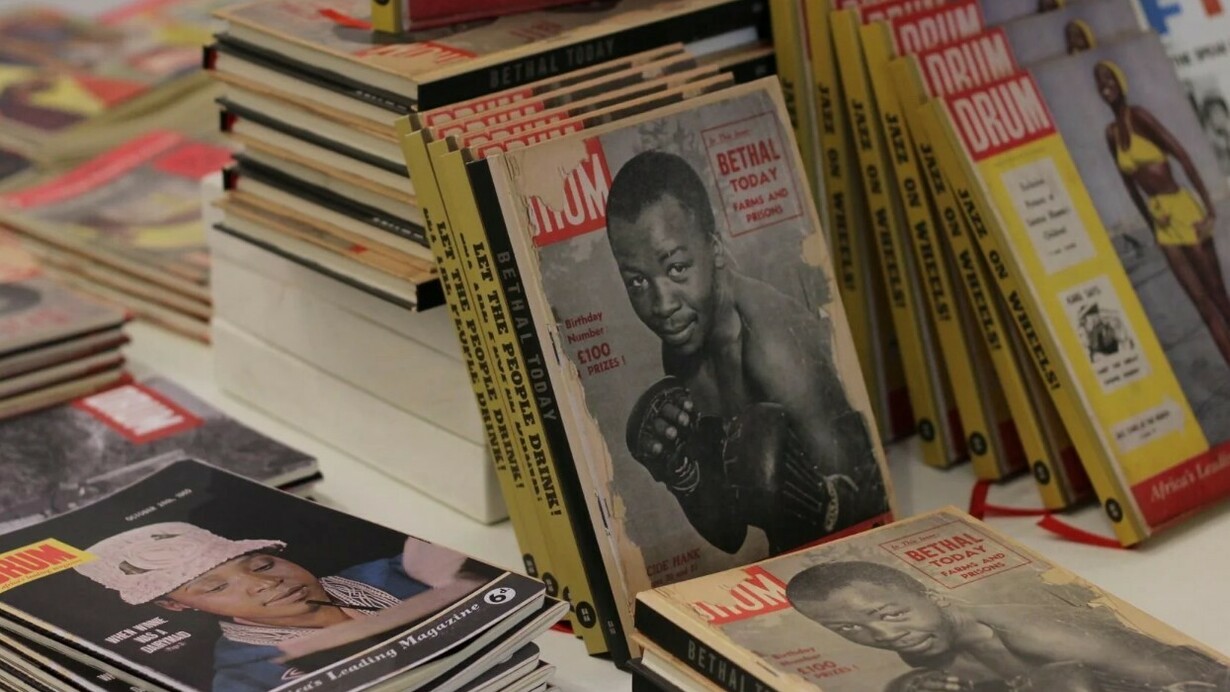
I must have been fourteen the first time I read Down Second Avenue, at school. It felt like someone had broken into my thoughts, opened the hidden cupboards of my mind, and found the unspoken words I carried.
Es’kia Mphahlele was naming what I saw but didn’t yet have the language for. The fatigue of the township, the slow corrosion of dignity, the strange coexistence of pride and despair. That book was my first window into a life rendered on the page with clarity, conviction, and refusal.
That’s when I met the Drum writers. Themba. Modisane. Nxumalo. Nkosi. Those men who created entire cities from ink. They didn’t simply report on Black life; they lived it. They decoded it. They gave shape to things I’d felt but couldn’t yet form: the complicity of survival, the seeds of self-blame, and the way violence creeps in not only through the police van but also through the quiet decisions we make to stay alive. They named the unnameable and dressed it in style: humor, satire, irony, and tragedy. And they did it while the noose of the apartheid state tightened around their necks.
Reading them was like being slapped awake.
Their stories were a theater of our contradictions: tsotsi swagger hiding economic paralysis, the shebeen philosopher sharing wisdom between slugs of cheap brandy, and the Black clerk who wore his tie like a leash. They didn’t romanticize the township. They told the truth about it. They saw its grind, its grace, its ugliness, its moments of sharp beauty, and its devastating collapse.
In The Suit, in Crépuscule, I saw the outlines of people I knew. In one of them, my mother was hiding political dissidents in our house. In another, the rumblings of a neighbor’s secrets. We all knew the house of the informer.
But it wasn’t just about recognition. It was a kickstart. The Drum writers took me by the hand and led me elsewhere: to Fanon’s challenging diagnosis, to Biko’s clean and articulate anger, and to Césaire’s despair. Then further still: Baldwin’s fire, Du Bois’ consciousness, even the mazes of Borges. It was all connected.
The township isn’t separate from theory; the “hood” is the theory. Lived, bruised, negotiated, and stitched together daily. That realization changed everything. It told me I didn’t have to leave where I was to think. The streets were texts. The corner shop preacher and shebeen queen were theorists I didn’t realize I needed.
How, then, can my questions not have any value?
Then came Ntongela Masilela. Dense, demanding, unrelenting. He gave me a framework. Not a ladder out, but a vocabulary to dig deeper. He told us that the Black archive matters. That memory matters. That the violence of forgetting is a perpetuation of the violence before.
The Drum writers were the first to show me that Black art was not a luxury but a necessity. They were not merely artists; they were protesters armed with syntax. Their lives didn’t end well, as many drank themselves to their death, were exiled, or were erased or pushed off the page by a system that responded with brutality. But they never wrote from a place of defeat. Even when despair simmered beneath the sentences, there was a stubborn, defiant joy in the telling. And that, too, I suppose, was part of resistance.
I romanticize them, even though they left too little space for women. Their circle seemed brotherly and insular. But putting across that critique is not to discard and nullify them.
It is to do the very work they began, to interrogate, to expand, and to resist any easy narrative. Their legacy may be unfinished. Incomplete. But it’s very much alive.
And today, when we’re told that history should be streamlined for easy consumption, when our galleries are curated into something unidentifiable, when our cinema no longer represents the world we know and see, while being encouraged to either blame the past or worship it without question…we need them.
We need them as reminders of how urgent and necessary it is to tell the truth about who we are and where we come from, no matter how inconvenient, unpopular, and at times dangerous.
Sometimes I wonder if I can write. And then I see that the township produces minds that rival any in Oxford, in Paris, and in Harlem. That we are handed a candle that is lit from pain, from laughter, from refusal.
Who are we to refuse to carry it forward?
I write knowing that memory is not passive, that it demands care and courage. To remember them is to accept a charge: not to dilute their sharpness, not to tidy their contradictions, not to turn their lives into symbols emptied of risk. What they left behind was not a completed map, but a direction. If we inherit anything from them, it is the obligation to remain awake—to look without flinching, to speak without disguise, and to trust language enough to let it carry the full weight of our lives.