English
 Español
 Français
 Deutsch
 Italiano
 Português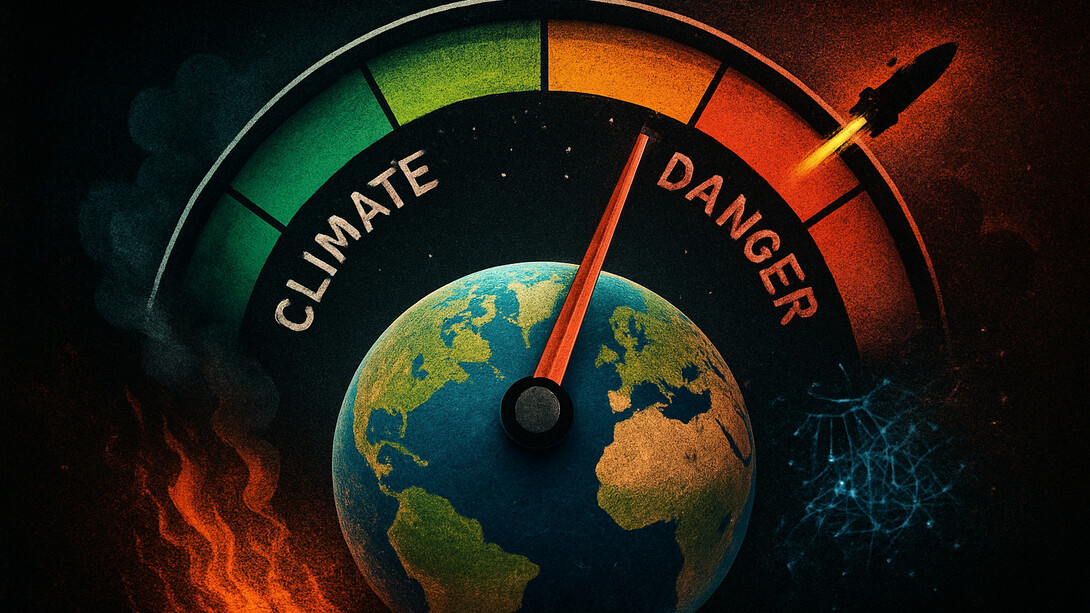
If you have ever driven your car at its top speed, you probably learned something about going too fast. At reckless speeds, we have less time to react to unexpected events. A deer leaping into the road, a sudden patch of black ice, or a blown-out tire can cause us to lose control.
The world is experiencing a similar situation due to the rapid development of new technologies. There have been more in the last decade than in the previous 100 years. Some promise to give us incredible new capabilities. But they can be risky. Some raise profound ethical questions. Some even threaten life as we know it. Yet we continue to develop them more rapidly than we create standards and guardrails for their use. Institutional inertia, international politics, vested interests in the status quo, and the prospect of profit get in the way.
The problem of accelerating danger and lagging governance is especially worrisome in three areas of human activity today: global climate change, nuclear weapons proliferation, and the race to artificial intelligence. Let's consider them one at a time.
Climate change
The world's nearly 200 nations have been meeting every year since 1995 (except one during COVID) to discuss and track progress toward controlling global warming. These meetings are called "Conferences of the Parties" (COPs). The most recent took place last month in Brazil.
The principal cause of global warming is fossil-fuel pollution, which accumulates in the atmosphere like a blanket covering the Earth. The Earth's surface normally reflects some of the sun's heat and light back into space, but the blanket prevents this. The Earth's temperature goes up, which changes the climate. Weather becomes more violent, sea levels rise, drought kills crops and turns forests into tinder, and so on. If this is allowed to continue, species will suffer mass extinctions, more people will die, and parts of the planet will become uninhabitable.
The solution is simple. We must replace fossil fuels with energy that doesn't pollute. Because fossil fuel consumption has already made the blanket too thick, we must develop a way to remove some of the pollution from the atmosphere. The goal is to stabilize the climate by restoring the planet's carbon balance to where it has been the last 11,000 years or so, the so-called Goldilocks epoch, when civilization could thrive.
The international community formally acknowledged this goal in 1992. Countries have met nearly every year since 1995 to discuss how to proceed. However, it took 30 years for all nations to agree on what to do. Meeting in Paris at the end of 2015, they reached a consensus on keeping global warming well below 2 degrees Celsius this century, compared to pre-industrial levels. It was a remarkable agreement, since it's difficult to get 195 sovereign nations, rich and poor, north and south, to achieve consensus on anything.
Countries agreed to each develop their own plan to help stabilize the climate. Yet, the fossil energy industry has used its clout to stall progress. For example, 1,600 of the industry's lobbyists showed up at last month's conference in Brazil, outnumbering the national delegates. As a result, the agreements generated by the COPs avoided even mentioning fossil fuels until last year, when there was a brief reference to phasing them out. But that reference disappeared again this year in Brazil, and nations have never agreed to a timetable for shifting to clean energy.
Today, fossil fuels still provide 80 percent of the world's energy, and countries continue subsidizing them. In 2022, the last year analyzed by the International Monetary Fund, direct and indirect government subsidies totaled $7 trillion, even though oil and gas are among the world's wealthiest industries.
In addition, many countries that are parties to the Paris Agreement are not meeting their own decarbonization goals. The Climate Action Tracker estimates that current plans could result in a catastrophic temperature increase of 3.3 degrees by the end of the century, with temperatures continuing to rise thereafter.
One of the finest moments in climate diplomacy occurred in 2014, when the presidents of the world's two biggest carbon polluters – America's Barack Obama and China's Xi Jinping – met in Beijing and announced that the United States and China would collaborate to reduce their emissions. Their agreement paved the way for all countries to get on board in Paris the following year.
But under President Donald Trump, the United States has withdrawn from the Paris pact and is the world's biggest oil and gas producer. Trump has dismantled U.S. climate science and clean energy financing programs. He has used the threat of trade tariffs to get other countries to promise to buy U.S. oil and gas.
Meanwhile, the pollution blanket grows thicker, the Earth's surface warms, and the weather becomes more deadly and destructive.
There are options. Instead of relying on international consensus, the UN could encourage more "coalitions of the willing" – bilateral or multilateral agreements among countries to share research, technologies, and economic policies that reduce fossil fuel production and consumption. Countries doing a good job of mitigating pollution could use trade sanctions, such as carbon border taxes, against laggards.
What the international community should not do is surrender to fossil fuels by hoping for new technologies that can remove carbon from oil, gas, and coal, or by manipulating nature to make global warming less severe. Sunlight and wind are already the least expensive ways to generate electricity without pollution, while carbon capture consumes a lot of energy and water and makes fossil fuels even more costly. Countries must deploy clean energy more aggressively, stop subsidizing pollution, and allow market forces to end the fossil-fuel era.
In addition, the United Nations can help avoid the crisis fatigue generated by dire predictions of climate change. It can help shift the global conversation from the future we must avoid to the desirable future we can build. The UN has already done much to describe that future in sustainable development goals and in the final report, titled "The Future We Want," from the UN's major 2012 conference in Rio de Janeiro.
While we get our footing on the path to global decarbonization and climate stability, we must address other problems in the relationship between human activity and nature. A recent study documents that 22 of Earth's 34 vital signs are "flashing red" due to "failed oversight, political inaction, unsustainable economic systems, and misinformation." We should dedicate the rest of this century to getting right with nature.
Nuclear proliferation
A second self-generated crisis is the renewed proliferation of nuclear weapons. Many, if not all, of the nine nuclear nations are modernizing their weapons. Russia and the U.S. are talking about resuming nuclear tests. China is expanding its arsenal, Iran continues working on a nuclear capability, and North Korea's missiles can reach major U.S. cities.
Proliferation takes three forms: horizontal, in which more countries acquire nuclear weapons; vertical, in which nuclear nations develop new weapons and increase the size of their arsenals; and scattered, in which non-state actors acquire nuclear devices.
The post-Cold War era of arms control has lost its momentum. Russia, the U.S., China, and France are parties to the principal international treaty – the Nuclear Nonproliferation Treaty of 1970; India, Pakistan, Israel, and North Korea are not. Russia and the U.S. have 90 percent of the weapons, and the last remaining treaty between them to limit stockpiles and warheads will expire in February.
The pressure of horizontal proliferation has grown with Iran's nuclear weapons program. Vertical proliferation has grown with North Korea's weapons program and China's expansion of its stockpile. Most other nuclear nations are modernizing their arsenals. Experts say that while the number of warheads has declined since the Cold War, the number of deployed weapons has grown. More than 9,600 nuclear weapons are poised for potential use.
An assessment in June by the Stockholm International Peace Research Institute concludes that a "dangerous new nuclear arms race is emerging at a time when arms control regimes are severely weakened." The Institute says, "Revitalized national debates in East Asia, Europe and the Middle East about nuclear status and strategy suggest there is some potential for more states to develop their own nuclear weapons." The war in Ukraine, Vladimir Putin's threats to use nuclear weapons, and Trump's foreign policy vicissitudes have created additional uncertainty.
Many experts doubt the world can put the nuclear genie back in the lamp, but we must try. We must assume that as nuclear arsenals grow and expand to unstable nations, despotic leaders, and bad actors, somebody will use them. Our goal should be the complete elimination of these weapons, with international monitoring to ensure compliance.
Artificial intelligence
The world is also racing to develop it, though no one yet knows what winning looks like. However, even the investors and researchers behind artificial intelligence worry about a strange new world in which super-smart algorithms replace human intelligence. Much more than jobs are at risk. Human agency – our capacity to make choices and influence the world around us -- could be overtaken by machines. Technology mavens like Elon Musk say machine intelligence could "end humanity" or render it irrelevant within five years.
As the Pew Research Center explains, "Today there is general agreement that smart machines, bots and systems powered mostly by machine learning and artificial intelligence will quickly increase in speed and sophistication between now and 2035...Some analysts have concerns about how business, government, and social systems are becoming more automated. They fear humans are losing the ability to exercise judgment and make decisions independent of these systems."
AI – more specifically, the branch called artificial general intelligence, or AGI, which can do virtually everything humans can do, but better -- is not the first technology to raise important ethical issues, but research and use often continue without the guardrails to prevent unintended consequences or deliberate abuse. Technology is moving much faster than our governing institutions and political will, especially when nations seek strategic advantage, and investors seek profit.
One new AGI company assures us that jobs requiring "high-level human interaction, complex problem-solving, and emotional intelligence are generally considered safe." But are they? Looking at examples like unaddressed climate change and the spread of devices that can destroy life on the planet, artificial intelligence could conclude that our species is a dangerous force on the Earth. In fact, the idea that the world has entered the Anthropocene – a new epoch in which humanity has become the most destructive force in the biosphere – is based not on the good our species has done, but on the damage it has caused.
AGI is not only solving math problems. It is replicating some of humanity's most sublime abilities. It can reproduce a Michelangelo sculpture, a Rembrandt painting, a Hemingway novel, or a Bach sonata in minutes. If human creativity becomes redundant or inferior, and if AGI makes human intellect unnecessary, will our organic abilities atrophy?
What will become of human relationships as new generations turn to bots for friendships, mentoring, and even romance? It’s already happening. Can AGI be programmed to have conscience, empathy, morality, and souls? Can it be designed to tell and show us only what's true?
We should be worried. Better yet, we should act. We must overcome denial, special interests, greed, and generational selfishness. We have not yet demonstrated the wherewithal to reverse global warming, abolish weapons of mass destruction, or build guardrails for AGI.
Yet, we have experienced the ground truth of these risks in Hiroshima and Nagasaki, and now in the violence of our weather and AGI deepfakes. Common sense should guide our responses. Rather than sending thousands of mirrors into space to reflect sunlight or fertilizing oceans with artificial whale poop, we can leave fossil fuels in the ground and accept the clean, ubiquitous energy that has always been around us. Rather than counting on mutual assured destruction to prevent nuclear war, we can rid the world of the weapons. Rather than allowing algorithms to control us, we should take care to control them. Our ability to foresee and avoid perverse consequences is the opposable thumb of human intellect. We should use it to grasp the future we want, where technology enhances rather than replaces the best and highest human qualities, we collaborate with the rest of nature, and step back permanently from the brink of annihilation.