English
 Español
 Français
 Deutsch
 Italiano
 Português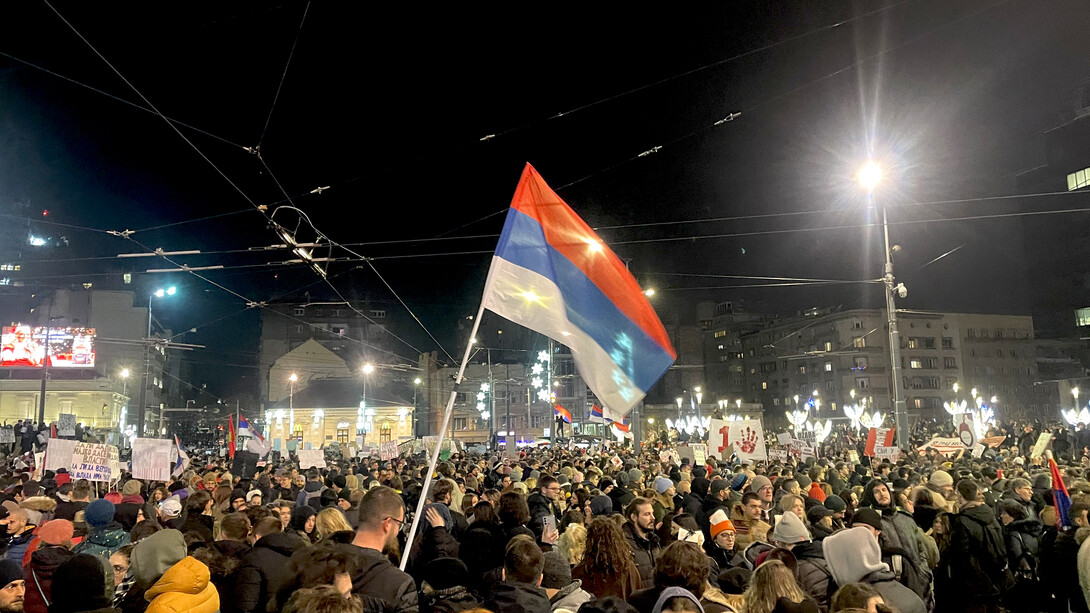
Our ideas of democracy are changing daily. In my opinion, democratic systems - and by extension, democracy as an idea - have never felt so consistently exploitable. Important decisions and the ability to choose, act, or even to understand those decisions feels alienating and improbable.
So what would be a good democratic system now? How to create conditions that will foster the democratic history into new conditions? These are some key questions that await European countries, and specifically the European Union. The EU’s positioning on this matter will have real consequences for establishing a strong identity in the near future.
While the war between Russia and Ukraine remains the most glaring problem, an important process for defining what the EU’s future democracy might look like is happening right at the borders of the EU: in Serbia.
Current state of democracies
Let’s talk specifics and establish what I mean by saying that our democratic systems are consistently exploitable/alienated.
What it means to be exploitable
Exploitable means that, due to internal or external conditions, someone is in a position of power to abuse someone for the abuser’s benefit. This is not to say that everyone in a position of power is misusing or abusing the power, just that the conditions in which the powerless abuse the powerful could never reach reality. Also, abuse is always harmful to the abused.
The conditions for a system (e.g. democratic system) to be exploitable come in many ways. For now, we’ll leave discussing external conditions like resource dependency, tariffs, or similar for another time. Our focus will be on the internal conditions of democratic systems that enable their abuse, that is, exploitability.
Contemporary democratic systems are different expressions of creating what a democratic society should function as. For example, the USA’s, Germany’s, or Croatia’s democracies have very different institutions [expressions] to function as close as possible to the democratic idea of a given society. This is all adapted within the theoretical and geographical borders of what we recognize as a (democratic) state.
As governing power needs to be institutionalized, this also means that the system's critical spots are not just anywhere, but in a handful of structurally inevitable institutions that hold power. The ever-changing nature of societies makes room for blind spots suitable for exploitation, which we’ll call system vulnerabilities.
Exploitable democracies
Let’s recap the logic of the previous idea.
The idea is that the people should rule in a society. This society is called a democracy. To establish a democracy, we needed to have an idea of how a democratic society would function and adapt as needed. We established the importance of societal needs (public spending, military, healthcare, diplomacy, etc.) that need democratic decision-making, as these topics concern our collective and very personal livelihood.
Starting from the first historical idea of democracy, in Ancient Greece, to the contemporary age, the actual number of the population has increased exponentially over time. With that, a larger percentage of the total population started to get voting rights. The logistics of voting in person for every single decision required adapting to representative models: institutions like the parliament, president, ministries, banks, or the media. Those are the structurally inevitable institutions we mentioned earlier.
Focusing on institutions that create democracies thus gives us an actual, tangible point of analysis for detecting the state of our democracies. These institutions are the power centers of a democratic system. On a side note, for a much more coherent theoretical framework, I’d use the work of Robert Dahl.
What is exploited and what is harmed
Let’s take some examples of systemic vulnerabilities.
In the USA, the presidency of Donald Trump still establishes how much the democratic principles can be bent for gaining a position of power. Some examples include offering reward money to vote for Trump, like a prominent donor, Elon Musk, did. The issue of the richest man in the world with whacky ideas and owning a media institution such as Twitter is far more complex and troublesome. But this is important to note, as we’re yet to see how USA TikTok will change in the future.
The media presence of Trump makes war acts, conspiracy theories, advertisements (for Tesla, for example), foreign diplomacy, cryptocurrency, or memes into one attention-grabbing media-consumption product. The reason for so much attention here is not just a familiar plastic example of how an institution (POTUS) can be exploited. The issue is that this standard overflows into other, mainly European, democracies.
And to that end, Hungary is anticipating the elections next year, which could mean the departure of Viktor Orban, whose governance was marked by corruption scandals, Soroš conspiracies propaganda, freedom of expression censorship, and a strong promise of protecting and expanding on nationalistic interests.
In France, Macron is balancing between overstaying his welcome and a need for stability in a society that cannot reach a consensus. Still, the very possibility of someone being in this position to select a representative of the people at his own judgment is a systemic vulnerability. Will it be abused or is it already abused is for anyone’s interpretation.
For countries such as Croatia, Greece, and Bulgaria, the system vulnerability is corruption. Even more concerning is that corruption is not being sanctioned; that is, the juridical system is corrupted. The issue of really weak opposition is highlighted here, too.
Romania has forbidden one potential presidential candidate to participate in elections. Continuous discussions on the nature of AfD continue in Germany. The UK is still handling the negative effects of Brexit. At the core of this democratic decision was the misinformation campaign whose depth was revealed by the Cambridge Analytica scandal.
And the European Union, a democratic system with a sub-pair election and a bureaucracy which is consistently represented as borderline pointless.
Gen Z protests that are happening all over the world, all due to similar specifics.
In short, what is being exploited are the democratic institutions needed for the stable functioning of a good democratic society. The relevance of media in these examples is also something to take notice of. For Dahl, maintaining the high quality of the informational system is a necessity for a good democracy. Citizens, if they were to govern themselves, should be well informed and have a possibility to be well informed.
What is being harmed is the ability to create a democratic society. The harm comes in the corrosion of the ability to make conscious, meaningful choices for a society you participate in. Obviously, corruption also takes away public investments, but this is much easier to pass over. That is, until systemic neglect results in a number of murdered people (the Greece train crash in 2023., where 57 people lost their lives, for example). Nothing really substantial changed. This is a point where consistent exploitation without alternatives mixes with alienation.
A significant number of European democracies have several of the same issues. We can slowly construct an ideal type of a democratic society where systemic vulnerabilities are being exploited.
These are the new conditions that the European democracies, as much as the EU, will have to adapt to.
Society is intimate
While the issues within democracies might seem anecdotal or sporadic, we don’t have to search too far to find out how an almost completely distorted democracy functions. This is Serbia right now.
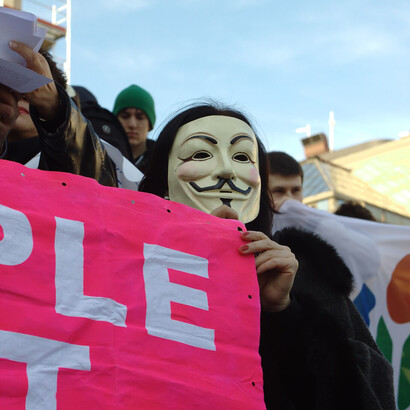
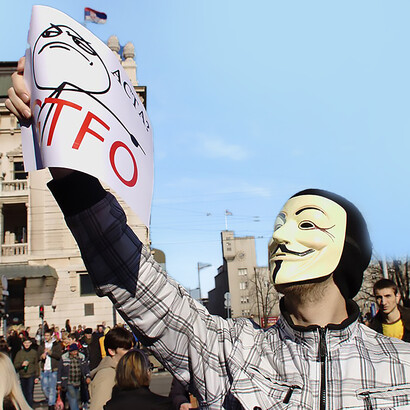
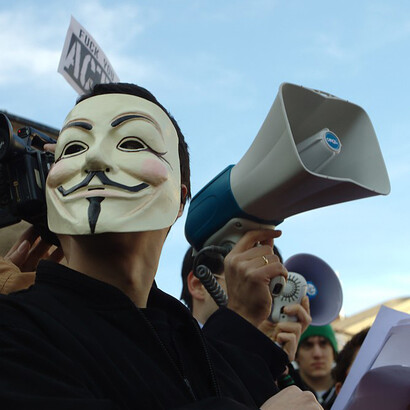
Student protests in Serbia
It’s been a bit over a year since the 1st of November 2024., when the Novi Sad railway station canopy collapsed.
A month after the tragedy happened, with no movement in terms of punishing the responsible, along with clear marks of corruption and videos of governmental officials straight out lying about the construction for propaganda reasons, students from Novi Sad started to protest out of solidarity for the victims. This was the start of the student protests in Serbia.
In a short amount of time, the whole country had its universities shut down.
This is the situation that remains, but the stakes now are not just losing another year without educating the future highly valued workers. For Vučić and his supporters, just like for the students and their supporters, these are existential tensions. It’s us or them… in political terms, for now.
But it is also a culmination of a decades-long sentiment that the Serbian government is actively harmful to Serbia. Distrust towards Vučić (the president, with almost all the power in the country) stems also from disgust towards what he made his followers, fellow countrymen, believe.
The media personality of Vučić is so grand in the eyes of the senior population that doubting him for the failed state of the country is equal to treason. For the majority of the younger population, he’s a manipulator, a gaslighter, a mobster with a detailed track record of exploiting the most vulnerable in Serbian society.
What is the point of a democracy?
“Disgust” with President Vučić might be an understatement. This is a man who has actively ridiculed people asking for help and public investments from him. He understands they need him, and for a vote, he’ll promise to fix their issues. The levels of humiliation he has inflicted on others, the lies and violence used against the students and citizens in general, make the situation irreconcilable.
The fact that the recent accusations (regardless if they’re true or not) that Vučić participated in Sarajevo safari seem plausible with his personality and activity at the time should speak volumes. If you happen not to know what Sarajevo safari was, I would suggest avoiding knowing about it. It’s honestly one of the most disturbing, defeating things I’ve heard about.
But Vučić and his party own all the institutions. The media, the justice system, and the public sector are extremely loyal to Vučić, mostly due to involvement with corruption.
Needless to say, this has affected many individual lives.
Stories of people getting beaten up by mobsters and the police, the illegal occupation of the capital’s main square, mocking the parents of one of the killed victims, or parents disowning their children for the sake of Vučić created a sense of schizophrenia for the whole society.
Because at this point, no matter if you’re children-skeptical or not, what is the point of a society if it rejects its connection with its younger generation? What is the point of a family if you’re sacrificing it for a country? For students, what is the point of a democracy if there’s no freedom to govern yourself? How to belong to a community if differences are so stark?
Serbia and the question of democracy for the EU
In my opinion, Serbia is a microcosm of everything that’s happening in democracies all over the world. However, students and the way they are protesting is something not explored in this article, unfortunately, and there is plenty to learn from.
The unique aspect of student protests is that they’re reaching out to actual human beings, connecting and sharing their presence with the vulnerable population of Serbia. What is asked for is just that the institutions at least follow the rules they’ve set themselves.
And the EU position here is a stalemate. If they support the protests, that would be enough for Vučić to consolidate power around the idea that foreign influence is affecting the internal state of affairs. The EU, so it seems, does not want to meddle too much in this. On the other hand, by communicating with Vučić, the EU silently gives approval for his governance.
The resolution of these protests is coming relatively soon, even if it takes a year or two more. However, it’s not just the European Union or European countries that need to position themselves for these circumstances. Most of all, it’s the European citizens who need to find solidarity and curiosity to articulate what a new European democracy should look like.