English
 Español
 Français
 Deutsch
 Italiano
 Português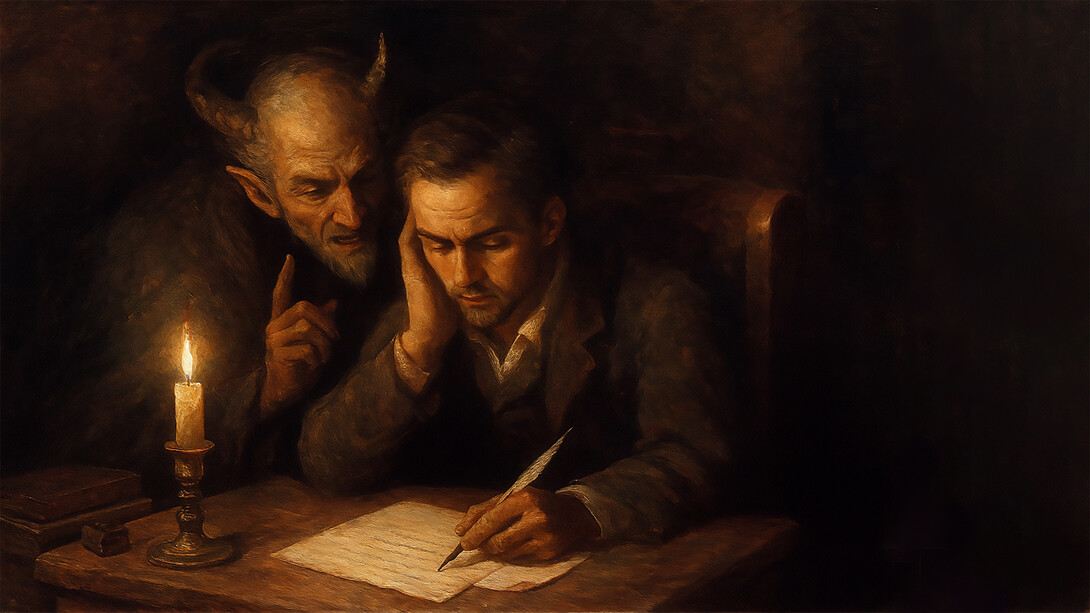
This book takes the form of a series of letters between two demons, Uncle Screwtape and his nephew Wormwood. The idea is to take a satirical look at the trials and tribulations of a new Christian from the devil’s point of view. How he manipulates our emotions and our circumstances to produce a negative outcome.
In the second letter, Screwtape remarks that the patient has become a Christian, but not to worry, all the old habits of mind and body are still present. Even when a person attends church, Screwtape suggests Wormwood emphasise the disappointment, unfamiliarity and alienation of the liturgy, not understanding the rituals, with the songs written in small print that is difficult to read. Screwtape encourages a strategy of self-absorption and making prayers ineffective, resulting in no positive change in action.
Screwtape suggests the greatest road to hell is the gradual slope with no turnings and without milestones or signposts. By keeping up the habits of Christianity, a person can be made to believe they have just adopted some new friends and amusements. Over time, they will begin to dislike the religious duties, think little of them and forget them as soon as they are over. In terms of repentance, Screwtape advises that as long as it does not result in any action, it does not matter how much a person thinks about it.
In relation to marriage, Screwtape suggests some Christian women could make life difficult, if only they could be persuaded to marry. The idea is to guide a man away from those who are spiritually happy, healthy and fertile. As an emotion, the importance of love is far superior to loyalty, mutual help, chastity and the creation of life. To be in love means joining a new family and people who are older Christians. This new circle of friends is often viewed as better educated and more intelligent than previous acquaintances, thus fostering a spiritual pride without the awareness of how many mistakes are being tolerated just because a person is new. Likewise, love for these people is based on an affection for one of their members; otherwise, a person may find these people puzzling or even repellent. To separate Christians and non-Christians, Screwtape argues you must make Christians, or ‘his people’, delightful and non-Christians appear boring.
Screwtape draws a distinction between men and women as a point of conflict. Unselfishness for women means taking on the trouble of others; for men, it is not giving trouble to others. Women think of doing good for others, and men think of respecting other people's rights. In their differences, they both regard the other as radically selfish. Both parties do things they do not want to do and feel the self-righteousness of sacrifice whilst harbouring a grudge at the ease with which that sacrifice has been accepted by the other. “If people knew how much ill-feeling unselfishness occasions, it would not be so often recommended from the pulpit.” The effort needed to maintain unselfishness may lead to fatigue, but this alone does not produce anger. It is the unexpected demands placed on a person who is already tired that will lead to resentment.
Screwtape feels the separation of Christianity and politics is important, as he deems the establishment of a just society would be a disaster. “Men or nations who think they can revive the Faith in order to make a good society might just as well think they can use the stairs of Heaven as a shortcut to the nearest chemist’s shop.” This is using faith as a means to produce social justice and not as a valuable truth.
Answered prayer is just as good as denial, according to Screwtape. If it does not happen, then this is evidence that prayer does not work. If it does, then there are physical causes leading up to it which would have happened anyway. Prayer and perseverance against routine adversity, the decay of youth, quiet despair and the drabness of life, Screwtape argues, can breed a resentment that is to be encouraged. If the middle years in life are prosperous, then a person becomes tied to the world. The best way to achieve an attachment to earth is by making a person think earth can be transformed into heaven by politics, science or psychology. However, Screwtape bemoans the fact that some people in the worst trials are formed into the people God made them to be. If the will to try is there, God is pleased, even when people make mistakes. He sees the most dangerous time as when a person believes they have been forsaken but still obeys.
Due to the time the book was written, during World War II, there is a reference to military service that arouses both hope and fear for the future. There is an emphasis on what will happen to people, not on what they are doing now. The future is uncertain, with all vices rooted in the future: fear, lust, avarice, and ambition. If people are constantly worried about the future and perpetually in pursuit of the rainbow, then they will never be happy or content in the present.
Humans live in a time of change, and living in time means experiencing reality in succession, experiencing different things. Change is also balanced by permanence; therefore, the church year is marked by individual festivals, giving a sense of permanence and structure. Screwtape emphasises the individual’s need for change through the constant pursuit of novelty. Novelty costs money, which breeds a sense of avarice and unhappiness. The greater the desire for novelty, the more extreme the desire for pleasure. When an individual’s understanding is influenced by the latest trends, God wants us to ask, is it righteous or prudent?
Screwtape asks an alternative question: is it in accordance with the culture of our time, progressive or reactionary? Some changes are for the better, some are for the worse and some make no difference. By making the future seem like the promised land, it becomes something only heroes attain and not something that everyone reaches, no matter who they are. This makes heaven not a gift but something that is earned.
Originally, Lewis wrote the book for Tolkien, but he objected to the satirical nature of the subject matter. Tolkien worried individuals might become obsessed with the devil’s schemes, rather than see them as a warning against manipulation.