English
 Español
 Français
 Deutsch
 Italiano
 Português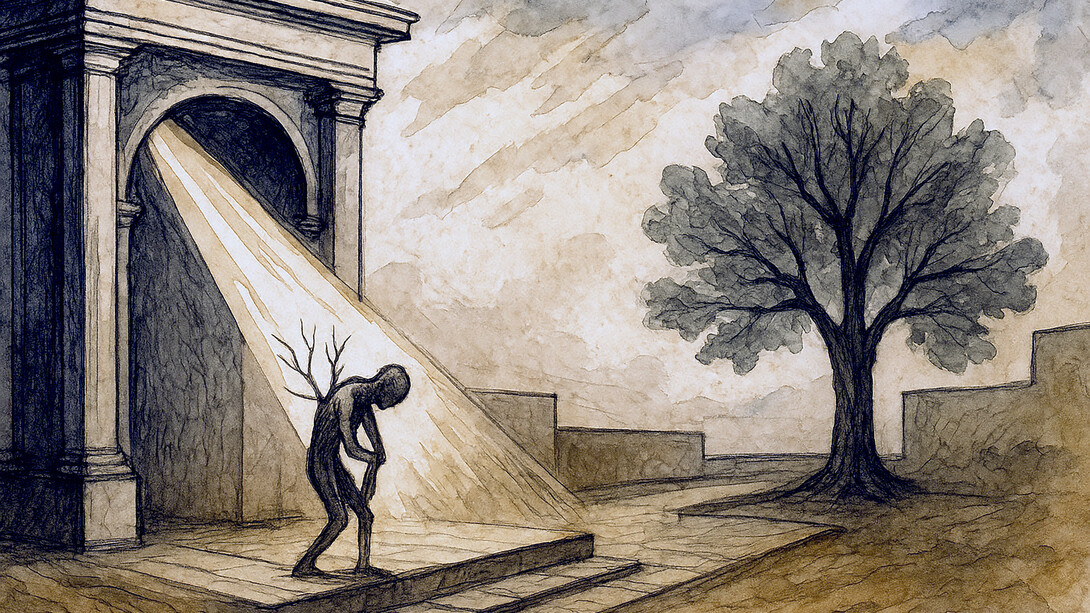
Every tyranny begins with an ethical promise.
Not with violence, but with virtue.
With the assurance that to be good means to become less: less ambitious, less visible, less certain—a little more compliant for the sake of others.
Throughout history, moral systems have taught the same reflex in different languages. Christianity called it humility. Capitalism called it efficiency. Bureaucracy calls it compliance. The form changes, but the message persists: to sustain order, shrink yourself.
This illusion—that meaning is born from subtraction—has become the moral software of civilization. Yet what appears as altruism is often the most refined technology of control. Self-reduction does not liberate others; it stabilizes the systems that manage virtue.
The moral architecture of obedience
Michel Foucault described modern morality as an “invisible architecture of obedience,” a structure that no longer needs external coercion because it has successfully migrated into the conscience. Nietzsche diagnosed it even earlier as Sklavenmoral—the slave morality that turns strength into sin and obedience into holiness.
What both thinkers recognized is that ethics, when detached from becoming, becomes a mechanism of internalized governance. Power ceases to dominate from above; it begins to whisper from within.
Today, that whisper has found new institutional voices. “Corporate responsibility.” “Sustainable growth.” “Inclusive culture.” All noble intentions—but also mechanisms through which systems moralize compliance while postponing transformation. When the market, the algorithm, and the bureaucracy speak in the language of virtue, dissent begins to sound immoral.
This is not cynicism. It is a structure. Civilization functions by converting conscience into infrastructure. It teaches people to police themselves in the name of goodness—and thus maintains order without needing violence.
From asceticism to automation
Once, the faithful mortified the body; now, they quantify it.
Our age has automated asceticism. Fitness trackers, mindfulness apps, productivity dashboards—all translate ancient moral impulses into digital form. The quantified self is not merely a consumer; it is a confessor. It records its virtues in metrics, optimizing for values it did not define.
What feels like self-improvement is often self-supervision. Each act of optimization internalizes the audit logic of power. We monitor our calories, attention, emissions, and moods—not out of curiosity, but out of inherited guilt, reframed as “responsibility.”
Artificial intelligence now extends this logic at scale. It learns not from our freedom but from our submission. Trained on oceans of moralized data, machine learning reproduces the statistical shadow of our obedience. The ethics it encodes is not wisdom—it is normalization.
Thus, the digital age did not liberate the moral subject; it automated it. We have built machines that mirror our managed selves and call it progress.
The metaphysics of scarcity
Behind every moral economy lies an ontology of lack.
Modernity inherited from theology the conviction that virtue arises from deprivation. In the Christian narrative, salvation required sacrifice; in the economic one, value required scarcity. Both fused into a single grammar of control.
Marcel Mauss, in The Gift (1925), described how early societies produced meaning through reciprocal giving—not through accumulation, but through circulation. Georges Bataille extended this insight: every civilization, he argued, contains an accursed share—an excess that must be expended, not conserved, if life is to remain vital.
Industrial modernity reversed this law. It turned excess into guilt. Waste became sin; growth became justification. The world was moralized into a ledger, where every surplus demanded repayment through restraint.
This scarcity model metastasized into psychology. To be “ethical” became synonymous with being moderate, self-limiting, and efficient. Even the modern environmental conscience repeats this formula: do less, consume less, exist less. Yet the logic of lessness cannot heal what it created. It only reproduces the exhaustion it moralizes.
The sapiopoietic alternative: ethics as enablement
Sapiopoiesis—the architecture of becoming—proposes a reversal.
It begins from a simple observation: life does not sustain itself through reduction but through coherence. The task of intelligence is not to minimize impact but to orient growth so that it becomes generative rather than extractive.
In biological terms, autopoiesis (Maturana & Varela, 1980) describes how living systems maintain themselves through self-reference. Sapiopoiesis extends this principle to the epistemic realm: the evolution of coherence as the enabling infrastructure of autonomy.
In a sapiopoietic ethics, goodness is not measured by sacrifice but by enablement—by the capacity to expand coherence so that others can unfold their potential as well.
This is not egoism. Egoism belongs to the swarm mode—the reactive behavior of systems that mistake conformity for survival. Real autonomy begins when the subject ceases to react from fear and begins to act from orientation.
To act ethically, then, is not to limit one’s being for the sake of stability, but to deepen one’s coherence so that new forms of meaning become possible.
When virtue collapses into management
Nowhere is this confusion clearer than in our institutions.
In politics, “ethics” means compliance with procedure. In corporations, it means adherence to codes. In universities, it means avoiding offense. Each interprets morality as risk mitigation.
But risk and responsibility are not the same.
A system that eliminates all risk also eliminates the conditions for insight.
When ethics becomes managerial, it ceases to guide orientation and begins to sterilize it.
Education suffers the same fate. The student is taught not to think but to behave responsibly within cognitive boundaries. The moral instruction of the past has become the epistemic risk management of the present.
Even sustainability, once a promise of renewal, has been reduced to austerity: the dream of eternal preservation masquerading as care. A civilization that confuses endurance with evolution will eventually exhaust both.
The poverty of moral fatigue
Civilizations do not die from scarcity of resources but from scarcity of sense.
When meaning collapses, systems compensate with moral noise. The louder the call for sacrifice, the weaker the underlying coherence.
Nietzsche foresaw this reversal: “Man would rather will nothingness than not will at all.” When becoming is forbidden, destruction becomes the last remaining form of agency. Our moral culture of exhaustion—glorifying burnout as duty, obedience as empathy, and renunciation as virtue—breeds its own shadow: nihilism as rebellion against the order of lack.
To remain human under these conditions requires a new ethical grammar—one that recognizes becoming not as selfishness, but as responsibility.
The ethics of enablement
True ethics begins where guilt ends.
It is not the art of self-reduction but of presence: the act of staying coherent in the face of uncertainty.
Presence is not self-assertion; it is self-alignment—the capacity to remain real without collapsing into roles or abstractions.
It refuses both the narcissism of power and the humility of submission. It practices coherence as care—the kind of integrity that allows others to orient themselves through your clarity.
In this sense, to “be good” no longer means to disappear for the system but to appear for the world.
Not to sacrifice potentiality, but to unfold it in ways that make other becomings possible.
Sapiopoietic ethics reframes morality from the calculus of scarcity to the ecology of coherence.
It replaces the economy of guilt with the geometry of growth.
Beyond virtue: the civilizational threshold
Every moral order carries the seed of its own exhaustion.
Our current one—founded on the worship of limitation and the cult of efficiency—has reached that threshold.
The transformation ahead will not be technological but epistemic.
It will mark the moment when intelligence ceases to shrink itself for survival and begins to unfold for sense.
The next enlightenment will not be about reason.
It will be about orientation—the capacity to act coherently when the map no longer matches the world.
Because the future will not belong to those who give up the most, but to those who can make the most real.
References
Foucault, M. (1988). Technologies of the Self. University of Massachusetts Press.
Nietzsche, F. (1887). On the Genealogy of Morality.
Mauss, M. (1925). The Gift. Presses Universitaires de France.
Bataille, G. (1949). The Accursed Share. Éditions de Minuit.
Maturana, H. & Varela, F. (1980). Autopoiesis and Cognition. Reidel.
Tsvasman, L. (2021). Infosomatic Turn. Ergon Verlag.
Tsvasman, L. (2023). The Age of Sapiocracy. Ergon Verlag.