English
 Español
 Français
 Deutsch
 Italiano
 Português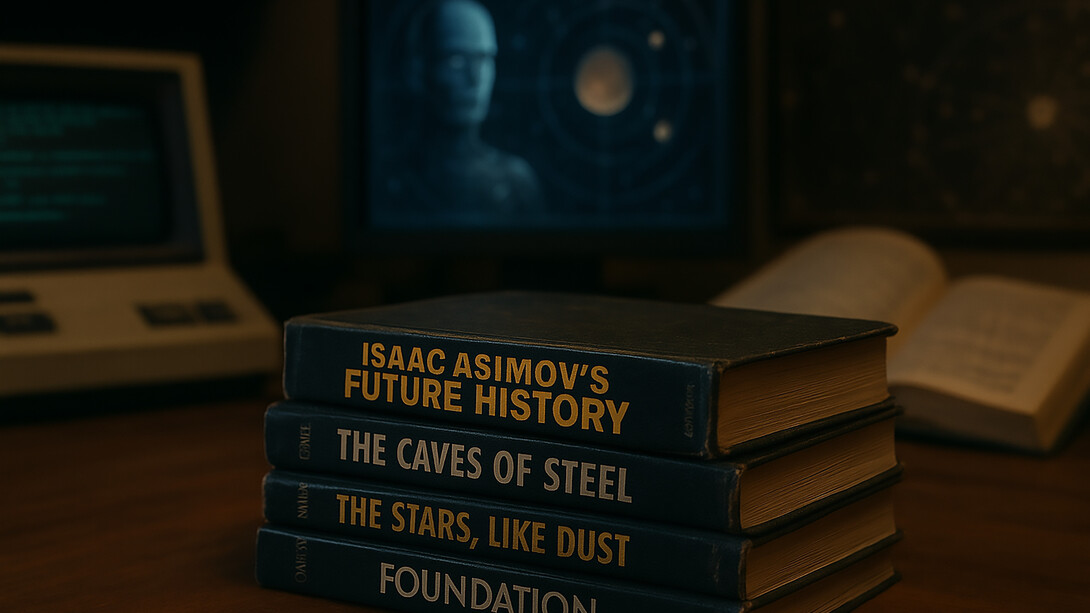
Throughout his œuvre, Isaac Asimov has framed the concept of future history (or history of the future). In fact, most of his stories are not stand-alone narratives but part of imaginary events situated over a plurimillenary time span and organised in three main cycles. Each cycle is part of a series of novels. Thus, there is the cycle of robots, that of the galactic empire, and that of the Foundation. Some more or less stand-alone novels were written as an interlude between the end of the robot cycle and the beginning of the galactic empire.
The events of each cycle were told as though they were historical periods that had already occurred, creating a sense of historical depth and authenticity.
Many critics have evidenced the need to positively reevaluate this genre of literature. Arguably, science fiction is but a mirror of the present and often addresses some of humankind’s fundamental concerns. Often, authors of science fiction anticipate issues philosophers and literary critics, political theorists and journalists take interest in only when they become hot topics of discussion. More generally, science fiction relies on science and technology and anticipates the future. The question of robotics and artificial intelligence is an example of that: fundamental issues were addressed by, on the one hand, Philip K. Dick – in his android stories – and, on the other hand, Asimov himself – with the crucial agency of his robots in his version of humanity’s future history.
Robots, the first era
The cycle of robots is the first of the three main eras of this history. It began in 1998 and has lasted several thousandyears. It is the foundational period of Asimov's future history. It lays the philosophical and technological principles that echo through millennia of subsequent galactic civilisation. The central concern of the robots' books is the substitution of human labour by that of robots and its social consequences. It extrapolates and analyses the long-term outcomes of the coexistence between humans and robots over several millennia.
Robots gradually take a preponderant place in society. Therefore, automatons are getting perceived as a potential threat by many people who develop ‘robophobia’. Opinions are divided between people favourable to robots and people hostile to robots. These ones become increasingly similar to humans as the firm U.S. Robotics develops the positronic brain, a device that mimics and even surpasses human neurological and cognitive capacities.
By 2065, a wave of colonisers expanded to extrasolar planets, the Spacers. Spacers developed more advanced technologies, extending their life expectancy to about 400 years. In fact, they are genetically modified, if not engineered. Yet, Spacers are paradoxically vulnerable to Earth’s (and humans’) germs and bacteria because of the absence of pathogens on the colonised planets. Spacers form utmostly individualist societies, and each world’s authorities exert a tight control of each world’s total population: some, like Solaria, handle the processes of mating and reproduction, while Aurora (the first colonised world) is keen on free love.
In Spacer worlds, labour is almost totally performed by robots. Robots handle every aspect of Spacers’ lives. Some Spacers even acknowledged that they were quite alike to Spartans. Hilots/robots perform the necessary labour. The difference is Spartans had a goal. Their oligarchy was entirely devoted to warfare, and, as unfair and unequal as their social structure could have been, Spartans’ life thus had both a purpose and a meaning. Spacers’ societies had no such ideas. The lazy lifestyle of Spacers is quite the opposite of that of ancient Sparta. Their rapport with automatons is a rather Hegelian slave-master relationship.
The separation from Earth and human beings (one could, however, wonder whether Spacers still belonged to the Homo Sapiens species) led to misunderstanding at best and hatred at worst. Spacers and Earthers/Terrans have become estranged from each other. Spacers developed a prejudice against Earthers, whom they think of as inferior, short-lived and dirty barbarians. In turn, Terrans view Spacers as asepticised oppressors. The fact is that Earth once commanded over the ‘outer worlds’. But the balance of power shifted in favour of the Spacers, who developed superior technology and outlived Earthpeople. Therefore, Earth was submitted to the political control of the outer worlds. Climatic catastrophes had a significant impact on Earth too. People sought underground shelters where they developed huge subterranean metropoles where people lived in a rather authoritarian regime.
It is in this context that the three final stories of the Robots series take place. The Caves of Steel, The Naked Sun and The Robots of Dawn are set a millennium in the future. They introduce Earth agoraphobic detective Elijah Lije Bayley and his partner of circumstance, R. (i.e., robot) Daneel Olivaw. The three books also centre on the rather amorous relationship between Lije Bayley and Spacer woman Gladia, who is the proprietor, R. Daneel, and another robot, R. Giscard Reventlov, introduced in Robots and Empire, the last book of the series. Whereas Daneel is hardly distinguishable from a human being, Giscard still keeps evident robotic characteristics.
Together, Bayley and R. Daneel Olivaw enquire about plots against Earth involving a party of racist Spacers with hostile plans against Earth and the Terrans. These plotters have installed nuclear devices aimed at annihilating Earthers once and for all. This is the kind of action no robots could perform because of the fundamental laws of robotics engraved in every robot’s positronic brain:
A robot may not injure a human being or, through inaction, allow a human being to come to harm.
A robot must obey orders given by human beings except where such orders would conflict with the First Law.
A robot must protect its own existence, as long as such protection does not conflict with the First or Second Laws.
R. Daneel and Lije Bayley finally manage to avoid this attempt to erase Earthers. However, Giscard committed a suicidal action. He switches on the nuclear devices, which he modified to release radiation over a much longer time. In the longer run, humanity would be compelled to leave Earth and become a galactic civilisation without the assistance of robots. The fact is that Giscard was gifted with telepathic skills which he eventually passed on to R. Daneel Olivaw. Giscard deeply reflected on the meaning of the three laws and their implication. A robot should not harm a human. But what about the case in which a human seeks to harm another? More broadly, what about humanity as a whole?
Are robots not supposed to protect humanity itself? Therefore, should not the sake of humankind be superior to that of a single individual? Finally, Giscard considered and calculated what should be the best course possible for humanity’s prospective history. That led the robot to consider another, implicit, law of robotics that encompasses and supersedes the other three; it is known as the Zeroth Law:
A robot may not harm humanity or, by inaction, allow humanity to come to harm.
Humanity is, however, an abstraction, and it was still difficult for Giscard to override the three fundamental laws. Consequent to his actions, Giscard’s brain burns up and the robot ‘dies’. In his last moments, he, however, imprints his abilities onto R. Daneel Olivaw. Giscard struggled with the zeroth law. So did the other robots, and they divided upon Giscardians and opponents of the Zeroth Law. The former followed Giscard’s view and sided with Daneel during the Robot Civil War. Finally, robots disappeared from humans’ horizon during the Empire.
The laws of robotics
The Robot cycle is indeed foundational to the whole narrative Asimov composed over years. In terms of writing, the whole stories that culminate with the Foundation books were not always written in a linear way. The author went back and forth to complete the puzzle of his version of the ‘History of the Future’. What is the matter of the present concern here is the narrative’s internal coherence and time frame. Arguably, the author wanted to write a kind of moral tale that values human labour and pioneering spirit very highly.
Furthermore, he wrote stories in which robots are 1) increasingly resembling humans and 2) exercising an ambivalent influence on human societies. Moreover, Asimov’s robots are intrinsically good and human-friendly. Asimov’s robots were a reflection of the concerns that people had during the late 20th century. Some of these concerns are still, and even more, relevant nowadays with the omnipresence of AI in almost, if not all, social and economic activities.However, he wrote out of general optimism and confidence in the positive outcomes of technological progress.
This is why his laws of robotics are fundamentally ethical. But do they apply in (our) reality? Some critics relevantly argued that the laws of robotics are in no way ineluctable. This is because of the people who program and design robots and may have different conceptions of ethics.
Let us consider a rather provocative example. What if the laws of robotics were imagined by a Nazi-like regime? If so, robots are likely to consider that a group of people, a minority, to be a threat to humanity and, therefore, apply the zeroth law to wipe this minority and other ‘enemies’ of the regime out. It may sound shocking, but it is important to understand that Nazi ideology considered it was doing what is good for humanity from its own point of view. Similar reflection relevantly applies to other ideologies, whether it is Neo-Nazism, radical jihadism or Jewish supremacism.
Ethical principles are based on one’s background, whether religious or political. What are personal principles that can extend to larger groups, even an entire society, and the other way round? In an essay written in 2009 (our real 2009), Peter W. Singer discussed this question, making thought-provoking comments. As he said, “The bigger issue, though, when it comes to robots and ethics is not whether we can use something like Asimov’s laws to make machines that are moral [...] Rather, we need to start wrestling with the ethics of the people behind the machines.” (Singer, 2009)
True enough, the AI of nowadays robotic devices is not so developed as to develop something similar to single or individual consciousness. As things are, one can hardly imagine an AI robot able to develop religious sentiments or to feel – if ever a machine can – concerns for the future of humanity. AI does things because a human being asks it to do them, not spontaneously. AI would compose symphonies only because humans require it, not because it feels an urgent compulsion to compose it.
When a drone strikes a vastly populated area, including women and children, it is not the drone’s ethics that are questionable, but the number of humans behind the said drone: the organisation, movement or government that ordered this weapon; constructors and programmers; the military chain of command; pilots; and, to close the circle, the political leaders to whom each of the involved agents has to respond. From this standpoint, one may wish for the emergence of, say, Kantian robots who are willing to foster this philosopher’s views ‘On Perpetual Peace’. There are reasons to be quite pessimistic if AI and robots have to resemble us. If robots end up being like humans, history may well end in a Terminator-like future. This is surely very different from what Asimov figured in his version of history. To the contrary, he may have written his ‘History of the Future’ bearing in mind ideas regarding how humanity could save itself.
The galactic empire
The Empire era chronicles the rise and peak of the first Galactic Empire. Thus, the series of novels set during this era bridges the chronological gap between the Robot cycle and the better-known Foundation series.
The story begins thousands of years after humanity has colonised the galaxy. As explained, Earth has become radioactive because of Giscard. In this universe, she is mostly a forgotten planet, and humanity is scattered across countless independent worlds. Humans have also forgotten to have originated from Earth, and there are scientific debates on whether the humans emerged as a single species on a singular world or if they are the result of the interbreeding of several species of the galaxy. The Empire resulted in the Republic of the planet Trantor, which was to become the capital of the Empire. It has expanded during a chaotic period of warring kingdoms and political intrigue. This transition period is partly told in the novels ‘The Stars, Like Dust’ and ‘The Currents of Space’.
Likewise, its predecessor, Rome, the Republic of Trantor, gradually expanded its influence through conquest and diplomacy. Over millennia, Trantor’s possession grows into the massive Galactic Empire, a single political entity ruling 25 million inhabited worlds under the authority of the Emperors. At its apex, the Empire is a seemingly immovable power that has brought peace and stability for centuries to humankind.
However, it gradually became technologically stagnant, bureaucratic, and brittle. It is at this point that readers get to know a young yet bright mathematician, Hari Seldon. Seldon is the one who fully develops the science of ‘psychohistory’.Hari Seldon meets one Chetter Hummin in Prelude to Foundation. Hummin is a reporter who saves Seldon from an aggression by thugs. Hummin convinces Seldon that the emperor’s prime minister, Eto Demerzel, is after him, and the politician had therefore sent these aggressors. Follows an Anabasis across Trantor. Seldon goes on to get acquainted with the diverse culture of the different blocks of the Capital Planet, understanding that Trantor included so many cultures, as do most of our cosmopolitan cities.
Therefore, Trantor was the place to be if Seldon was to study human cultures in their diversity to elaborate his psychohistorical calculations. Finally, Chetter Humin (Cheater Human) takes off his mask. He is Eto Demerzel. But, in reality, He/it is R. Daneel Olivaw in multiple disguises. The robot had planned to send Seldon to run across the planet to improve the latter’s chances of success in his endeavour to create the psychohistory.Thanks to the manipulation orchestrated by Hummin/Demerzel/Olivaw, Seldon got convinced of the validity of his psychohistory, which he would work on from then on.
Here again, it is possible to identify the interest of Asimov in social and human sciences. Indeed, there is a lot of Xenophon’s Anabasis in the story of Seldon’s runaway. And it is quite evident that Asimov wrote about the decay of the Galactic Empire, drawing a loose inspiration from Gibbon’s ‘Decline and Fall of the Roman Empire’. During his first meeting with Seldon, Chetter Hummin/Demerzel/Olivaw analysed the reasons and signs of the Empire’s decline, explaining that there were signs of decay that were not evident at all. Real-world historians still debate on the causes of the fall of the Roman Empire. Philosophically speaking, there are broader debates on the reasons for the decline and fall of civilisations. Asimov/Seldon had views on this problem. The author contributed to the debate by writing a narrative that was some kind of thought-experience.
Moreover, Seldon’s Anabasis is the occasion to have him wearing the shoes of a sociologist and ethnographer. A social scientist exploring the whole of New York City, or towns like Paris or London, would very probably live an experience similar to Seldon on Trantor. After all, no matter their scale, capital cities are essentially cosmopolitan. May it sound as paradoxical as it may, but New York, like Trantor, is a giant microcosm. Inheriting from the social sciences of the nineteenth and early twentieth centuries, Seldon/Asimov had the ideal terrain on which to invent psychohistory. This one would be central to the story of Foundation.
The story thus goes on to explore the final era of Asimov’s future history. The era of foundation will give us the opportunity to tackle the important issue of the relationship between science and philosophies of history. In the second part of this long article, the concept of determinism will be the central question that will be dealt with.