English
 Español
 Français
 Deutsch
 Italiano
 Português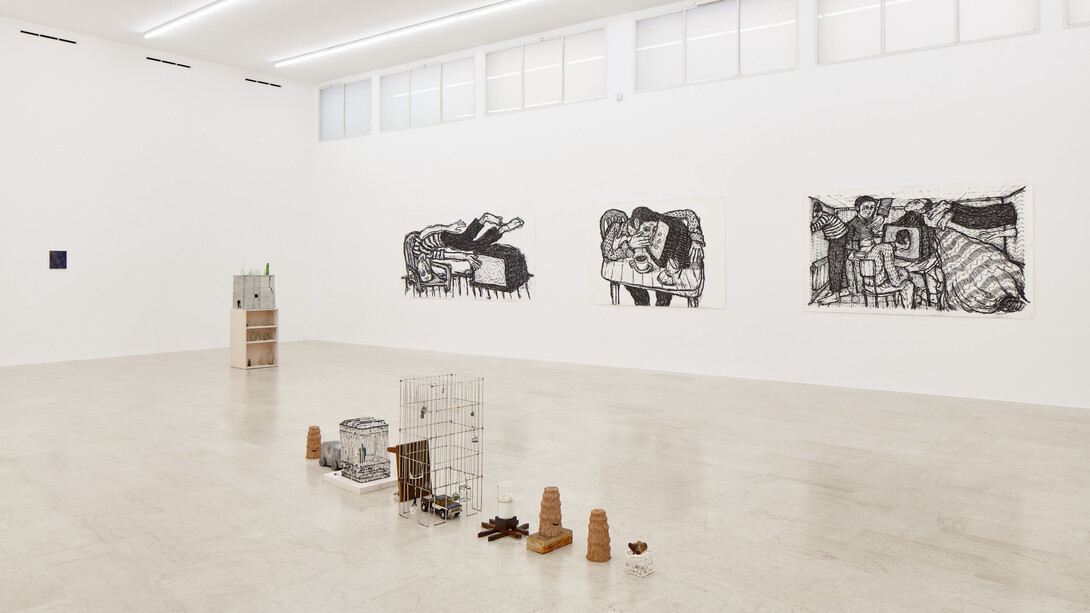
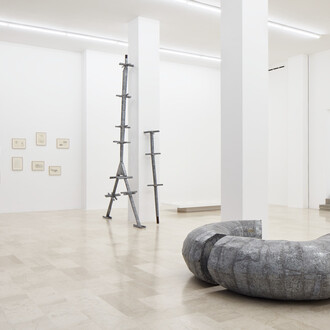
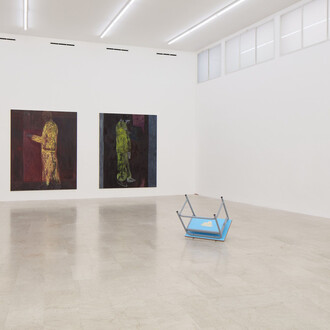
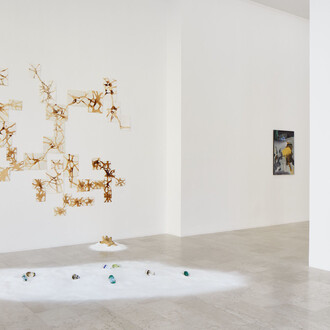
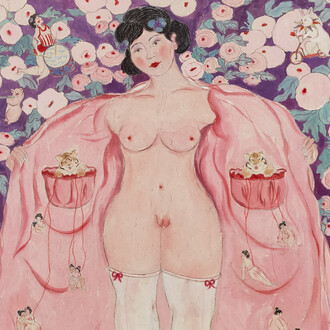
What the eye brought back brings together the work of eleven artists exhibiting at P420 for the first time. The exhibition originates in travel, in that particular existential condition of the observer moving through the world, a mobile witness gathering signs, images, and presences without the urgency of defining them. It unfolds as a constellation of returned gazes and encounters—with works and with artists—sedimented in the visual and emotional memory of the viewer. Conceived at a distance, What the eye brought back is a project shaped by the passing of time, where non-linear bonds persist with lasting solidity.
The selected artists, met over time and across diverse contexts, do not converge around a thematic framework but share a common horizon of sensibility. Their juxtaposition follows the logic of a notebook—an open, organic archive. Each work invites us to consider looking not merely as an optical act but as a mode of thought. In this sense, the exhibition approaches the idea of a mental space where each work is a point of intensity resonating with others, without the need for hierarchy or sequence.
What the eye brought back attempts to reconstruct a visual geography made of visions reactivated across distances, of images migrating from one context to another, carrying with them memories, desires, and subtle tensions. It is an exhibition about seeing as a form of memory, listening, and openness, as articulated by Matteo Binci in the accompanying essay:
"Every exhibition is a form of writing and montage. Some unfold as linear narratives, others as visual poems or thematic essays. What the eye brought back expands the possibilities of the notebook, the travel diary where notes do not follow a sequential logic but respond to the urgency of a moment, the intensity of an encounter. What the eye brought back arises from an intimate and rhizomatic process: the memory of encounters accumulated in recent years by the founders of P420, resurfacing here as fragments of a desiring archive. Édouard Glissant spoke of the ‘right to opacity’ as a condition of relation: what we encounter is never fully transparent but retains its irreducibility. These artists—names once jotted down as private notes—now appear in a constellation of opacities that invite relation rather than decipherment".
Artists on view: Hamra Abbas (1976, Kuwait City, Kuwait – lives and works between Lahore, Pakistan and Boston, USA), Majd Abdel Hamid (1988, Damascus, Syria – lives and works between Beirut, Lebanon and Ramallah, Palestine), Maha Ahmed (1989, Lahore, Pakistan – lives and works in London, UK), Bekhbaatar Enkhtur (1994, Ulaanbaatar, Mongolia – lives and works in Turin, Italy), Edgar Calel (1987, Chi Xot, Guatemala – lives and works in Chi Xot, Guatemala), Leonardo Devito (1997, Florence, Italy – lives and works in Turin, Italy), He Xiangyu (1986, Kuandian, China – lives and works between Milan, Italy and Beijing, China), Khaled Jarada (1996, Gaza City, Palestine – lives and works in Paris, France), Xian Kim (1992, Seoul, South Korea – lives and works in Seoul, South Korea), Iva Lulashi (1988, Tirana, Albania – lives and works in Milan, Italy), Brett Charles Seiler (1994, Harare, Zimbabwe – lives and works between Cape Town, South Africa and Leipzig, Germany).