English
 Español
 Français
 Deutsch
 Italiano
 Português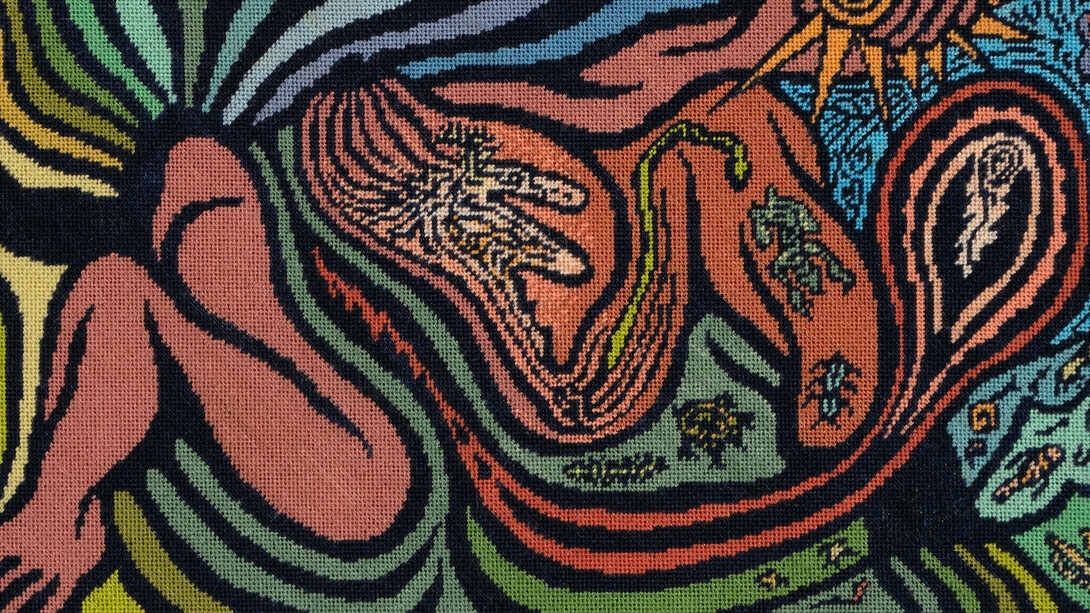
In conjunction with the upcoming 2026 Venice Biennale, Alberta Pane is delighted to host a solo exhibition by world-renowned American artist Judy Chicago (b. 1939) at its Venice gallery: The materiality of Judy Chicago, curated by Allison Raddock, which will run from 8 May to 22 November 2026 (opening by invitation only on 7 May). This focused exhibition aims to offer a comprehensive overview of Judy Chicago’s work, through the lens of the materials and innovative techniques that have defined the artist’s six-decade career while introducing viewers to a new series of work which will make its debut at Galleria Alberta Pane.
A pioneering figure in feminist art, Judy Chicago was for many years primarily associated with her iconic project The dinner party (1974-79)—viewed by millions of people since its creation and acquired in 2001 and permanently housed in 2007 by the Brooklyn Museum as the centerpiece of the Elizabeth A. Sackler Center for Feminist Art—to the point where the artist used to wonder, “Would the body of my art ever emerge from the shadow of The dinner party?”.
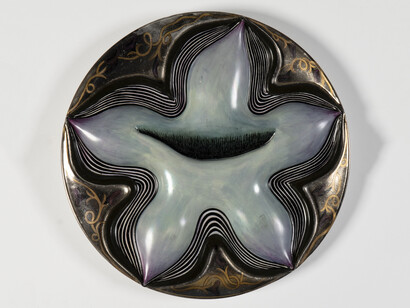
From spray-painted car hoods and porcelain plates to needlework and glass, Judy Chicago has continuously challenged artistic hierarchies, embracing techniques historically dismissed as “craft” to expand feminist and conceptual art practices. For this exhibition, curator Allison Raddock has conceived a journey that, moving through some of the most important series of the artist’s career, extends to her most recent works. It includes collaborations with Studio Berengo in Venice, JRP|Editions in Zurich, and the Corning Museum of Glass in New York for the creation of a new series entitled Judy Chicago: lilies/ goddesses. Eight new sculptures in glass and bronze will make their world debut in Venice.
In the last decades, the perception of the artist’s work has shifted, and Chicago’s layered and rich production has been fully recognized, with major institutional exhibitions, for the contribution it has made to the history of art. In this sense, her first retrospective, held in 2021 at the de Young Museum in San Francisco and curated by Claudia Schmuckli, was pivotal in revealing the breadth of themes and techniques that have shaped her lifelong artistic journey.
Chicago’s new series grew from her 2024 An homage to Arles, commissioned by LUMA Arles as part of their re-conception of the New Museum’s 2023 retrospective, Herstory, curated by Massimiliano Gioni. Together with the 2024 groundbreaking exhibition Revelations, at Serpentine North in London, curated by Hans Ulrich Obrist and inspired by Chicago’s illuminated manuscript of the same name (originally conceived in the early 1970s), the understanding of Chicago’s oeuvre was transformed while also demonstrating the consistency of her ideas across her career, despite differences in media, scale and imagery.
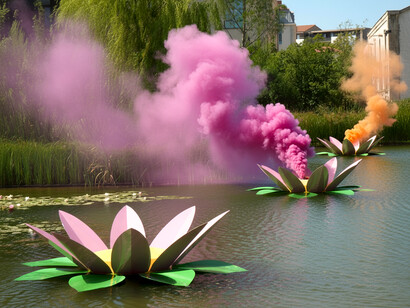
An homage to Arles culminated in a burst of fireworks techniques that emanated from a group of metal lilies floating in a pond, an obvious reference to both Monet’s lilies and the work of the Impressionists, which Chicago first saw (and was deeply influenced by) when she was a child studying at the Art Institute of Chicago. The sculptures in the Lilies/Goddesses series vary in their scale to accommodate a variety of sites—from tabletops or sculpture bases in interior spaces, to outdoor lawns, ponds and potentially, even produced in monumental size.
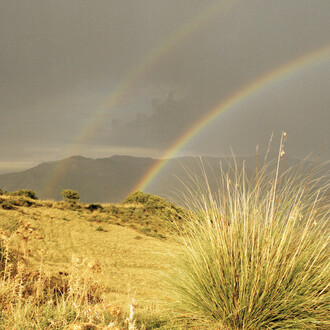
With the inclusion of Judy Chicago: Lilies/Goddesses in the Venice exhibition, viewers can appreciate aspects of Chicago’s vision as an artist while also raising urgent contemporary issues. One facet of the artist’s work in dry ice, colored smoke, and fireworks that has rarely been discussed is its apocalyptic dimension, which also links it to Revelations. At first, the intention of these pieces (which were much smaller in scale than the more monumental, recent works—though not in vision) was to “soften” or “feminize” the often harsh, manufactured environment. Gradually, as the pieces increased in size, her concerns included a desire to emphasize the beauty and vulnerability of our planet and the ever-growing tragic consequences of global warming and climate change which, at this point, threaten both our planet and everyone who shares it—human and non-human alike. Chicago’s goal has been to challenge the patriarchal paradigm that has brought us to this point and to emphasize the importance of incorporating female voices into a truly diverse, safe, and egalitarian future.
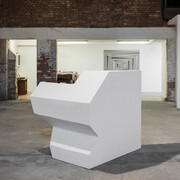
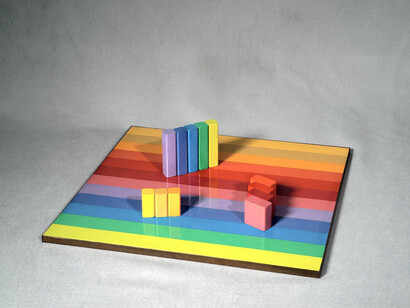
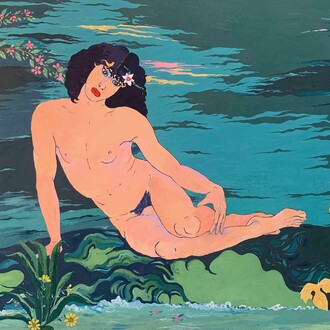
Also included in the exhibition are drawings and minimalist sculptures from the late 1960s, plates and drawings from The dinner party (1970s), embroidered textiles and drawings from the 1980s Birth project, acrylic and oil paintings from PowerPlay (1980s), as well as more recent photographs from the Garden smoke series.
Artist, writer, educator, and feminist Judy Chicago has spent decades championing a broader definition of art, an expanded role for the artist, and women’s fundamental right to freedom of expression, becoming an internationally recognized symbol of these commitments. The materiality of Judy Chicago offers a compelling visual narrative that celebrates her artistic journey and underscores her belief in art as a powerful vehicle for intellectual transformation and social change. The exhibition is accompanied by a catalogue conceived by the graphic design studio Multiplo and edited by Alberta Pane, featuring an exclusive interview between Chicago and Massimiliano Gioni.