English
 Español
 Français
 Deutsch
 Italiano
 Português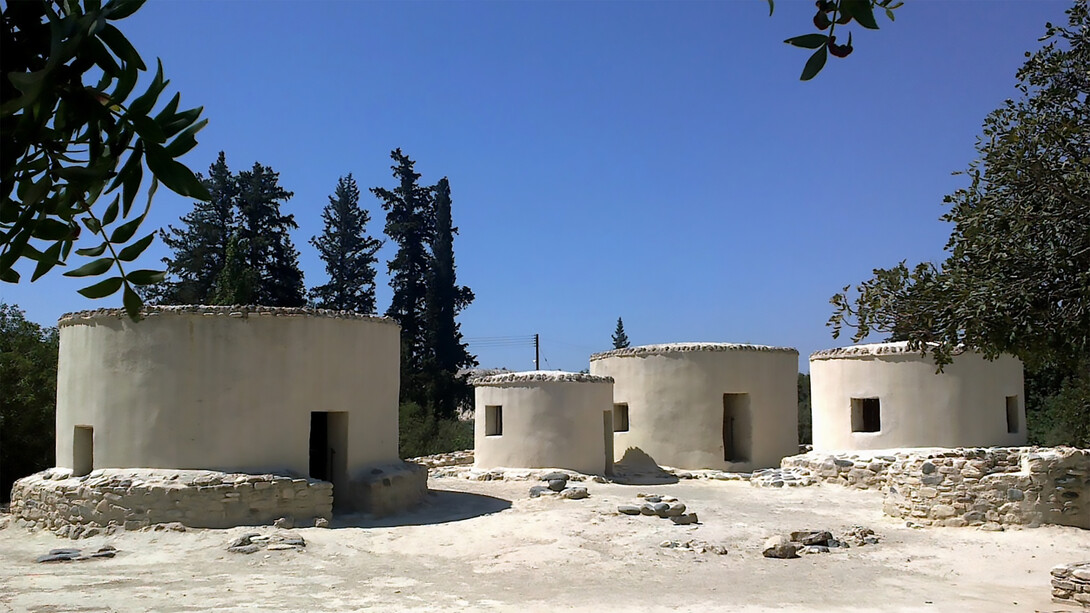
When I first began exploring the evolution of art and human creativity, I never imagined how deeply it would lead me into the heart of ancient communities. Yet time and again, I find myself circling back to one essential truth: art is not only about expression, it is about connection. And nowhere does this become more evident than in the Neolithic settlement of Khirokitia (Choirokoitia) in Cyprus—a site that speaks not only of survival, but of the profound human desire to live together, to build, and to belong.
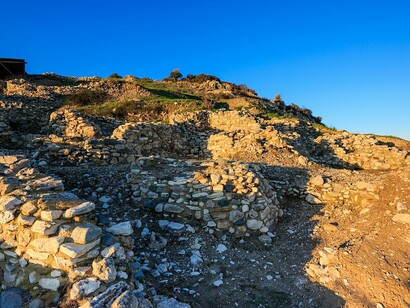
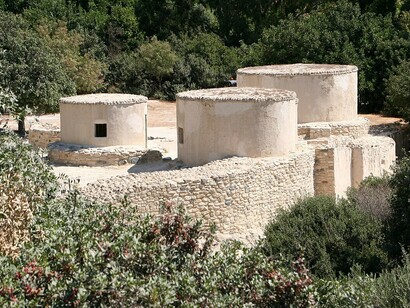
Discovered in 1934 by the archaeologist Porphyrios Dikaios, Khirokitia has since become one of the most significant Neolithic sites in the world. Dating back to around 7000 BCE, it presents us with one of the earliest examples of a truly structured society. Standing there in my imagination, among its reconstructed round houses and terraced hills, I cannot help but feel that this is not just history—it is memory. It is humanity remembering itself.
A village of circles
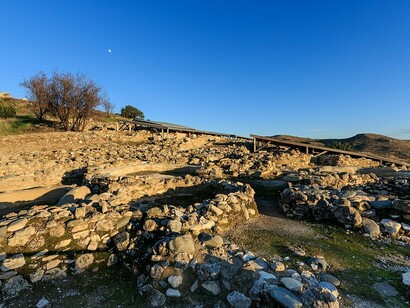
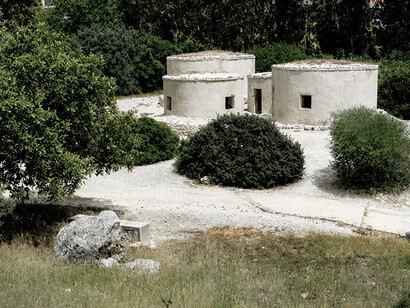
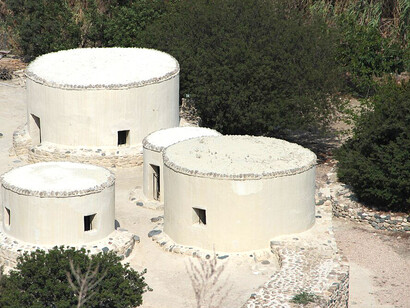
Khirokitia is best known for its circular houses, built with stone foundations and mudbrick walls, some rising as high as three meters. These round homes were not random in design. They echo something primal in us: the circle as a symbol of unity, protection, and continuity. Unlike the straight lines of later civilizations, these circular spaces suggest that early humans still lived close to the rhythms of nature.
Inside these homes, archaeologists discovered stone-built platforms, perhaps used as beds or workspaces. Imagine families gathered here, preparing food, weaving baskets, and shaping tools, while the fire in the center illuminated their faces and the stories of the day.
These were not isolated shelters; they were interconnected by narrow passageways, forming a labyrinth of human closeness.
When I think of these circular houses, I see them as more than architecture. They are soulscapes in stone. Each dwelling is a microcosm of life, repeating itself like the cycles of the moon and the eternal return of seasons.
The first structured community
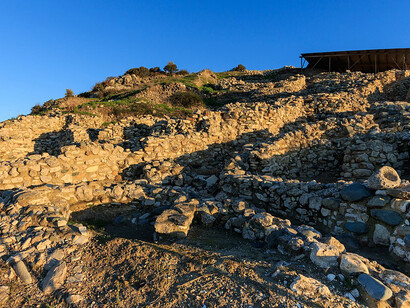
What fascinates me most about Khirokitia is not just the homes but the social fabric woven into the village. This was not a loose gathering of hunter-gatherers. It was a settled community, organized with boundaries, common pathways, and even what appears to be an early form of urban planning.
Archaeologists found evidence of fortification walls, suggesting that the people of Khirokitia felt the need to protect their settlement. This speaks to the complexity of their lives: cooperation within, defense without. To live together required rules, rituals, and perhaps even leaders or elders who guided the community.
I find this especially moving. Because when I reflect on my own art, I see it as a way of creating order out of chaos, of forming an inner community within myself. The people of Khirokitia, too, were artists in this sense.
They painted not on walls, but through the very act of living together, of crafting a life where survival was shared and meaning was collective.
Life and death intertwined
One of the most haunting discoveries in Khirokitia is the way its inhabitants treated death. The dead were not cast away or buried in distant fields. Instead, they were laid to rest beneath the floors of their homes. Imagine walking on the packed earth of your dwelling, knowing that your ancestors quite literally rested below your feet.
This practice reveals a worldview that blurs the line between life and death. The ancestors were not gone; they remained present, protectors and companions in the daily rhythm of life. Children played above the resting bones of grandparents, while mothers prepared food in homes layered with memory.
As an artist, this touches me profoundly. In my own journey, I often feel that my work carries voices from those who came before me, whispers of histories, both personal and collective. Khirokitia embodies this same truth: that to create, to live, is to remain in dialogue with those who shaped the path before us.
Ritual and belief
Though no painted murals or elaborate sculptures have been uncovered at Khirokitia, the settlement itself is art…a living sculpture of human intention. And yet, fragments hint at their beliefs.
Carved figurines of stone, mostly human forms, suggest that ritual and spirituality infused their daily existence.
These figurines, simple yet powerful, remind me that art does not always announce itself loudly.
Sometimes it whispers. Sometimes it is the small, intimate object held in a palm, a reminder of fertility, protection, or the mysteries of life.
At Khirokitia, I imagine ritual was woven into every layer: the building of homes, the burying of the dead, and the gathering of families.
Their art was not separate from their survival.
It was survival.
A legacy carved in stone
Why does Khirokitia matter so much to me? Because it marks a turning point in the human story. It is one of the earliest places where we can say with certainty: here, humanity chose community.
Here, people decided that life was not meant to be solitary but shared.
This choice required imagination. To build walls, to plan pathways, to organize dwellings—it all speaks to the creative evolution of the human mind. Just as the painter envisioned a canvas before the first stroke, the people of Khirokitia envisioned a society before it was lived.
In my work as an artist, I often return to the idea that creativity is not merely about beauty but about possibility.
Khirokitia is a testament to that. It is the blueprint of possibility, carved in stone and mud, whispering across 9,000 years that we are capable of shaping worlds together.
Walking among ancestors
Khirokitia is not just an archaeological site. It is a mirror. It reflects back to us who we were, and in doing so, asks us who we want to become.
Are we still building in circles, united and inclusive?
Or have we lost sight of the rhythms that once bound us so closely?
Closing reflections
In tracing the journey of art, Khirokitia reminds me that art is not always painted, sculpted, or sung. Sometimes art is the courage to gather, to protect, to remember, and to believe.
The people of this Neolithic village were artists in the truest sense: they imagined a way of living that had never been tried before, and in doing so, they etched their presence into the fabric of humanity.
When I paint, I feel connected to them. My brush becomes their stone tool, my canvas their circular home, and my silence their ritual.
We are all part of the same continuum, the endless attempt to shape meaning from existence.
And so, Khirokitia remains not just a site on the island of Cyprus, but a soulscape in the story of humanity.
An ancient whisper reminding us that to live is to create, and to create is to belong.