English
 Español
 Français
 Deutsch
 Italiano
 Português
To have a blank piece of paper in front of you, a canvas, a horizon, a person, the world in short, is to be stimulated, to be motivated, to start and continue processes. I talk about blank paper as a way of summarizing the plurality of encounters, the multiplicity of experiences that affect us.
Let's begin this approach with perception. Perceptual data is highlighted from countless contexts. This highlighting can be spontaneous, random, or it can be the result of some direction. In other words, blank paper flies in the wind or is presented on supports that are themselves accentuated. Therefore, the perception of blank paper, although emphasised, is also shaped by its support, by what sustains it. This metaphor makes it easier to understand that the direction of opinions and experiences - propaganda and current politics, for example - is emphasised in the production of supports responsible for the encounter, for highlighting what is desired and what is to be avoided.
Investing in advertising, expanding consumption, increasing clicks, and ‘doing politics’ (as common sense refers to demagoguery), all of these actions today are largely based on digital buzz marketing. Keyboards, memes, posts sell and motivate, talk and explain everything to everyone. Truths and lies succumb to keyboards. In this context, what matters is transmitting; what matters is the medium, even if the message and the initial objectives of what you want to communicate are adulterated.
In the 1960s, the Canadian philosopher Marshall McLuhan, one of the greatest scholars of communication, already sensed the importance of media over messages when he said that the media were an extension of the human body and that this would transform our society. He meant that the medium is what makes the message understood; in other words, every message has to be displayed in the right medium; otherwise, its purpose will be lost in whole or in part. He said that the characteristics of the media affect society more than the content they transmit, more than the message. Imagining the possibility of a drum being played by something other than a person, to transmit a message from village to village in the middle of Africa, exemplifies this idea well.
McLuhan's insight was absorbed and metabolised, and today on social media, posts, lives, and memes imprison truths, facts, and events, disseminating only what is convenient and profitable for their sales, advertising, and ideological interests. The comparison of facts, the determination of trends, and choices follow the path of manipulation based on fake news and supposedly lucid choices and decisions, which are actually induced actions directed by algorithms and closed circles of information. These performance bubbles are constantly creating villains and heroes, superficial polarizations, establishing amusement parks, and seeking the dream of nirvana. These are the paths that address the contingent and arbitrary choices of the participants, the population.
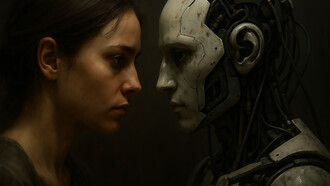
Even McLuhan didn't imagine that democracy, or even scientific conclusions, could be destroyed in this way. Nowadays, we have man reduced to himself, to his body, with its choices, fears, and thoughts, and with the media being the stronghold of the message. It's solipsism put on the most absurd level: I do it alone, I know everything, I communicate everything, I criticize and judge, I decide and guide. This attitude is hallucinatory, just as it causes the neutralization of the human. The human being, by equating artificial intelligence (AI), annihilates himself, denies himself as human, and reduces himself to a game of alternative possibilities brought about by progressions. They are limited to imagined and sought-after possibilities.
To think is to perceive, and when perception refers to the past, to outdated testimonies, everything is disorganized. We see the crystallization of attitudes, a thinking that is a repetition of successes and automation of what we want to maintain. There is no longer any chance; we live to maintain survival, to continue the social system and the beliefs that support it unchanged.
In the political sphere, this process is becoming increasingly evident and serious. In several countries, we have seen this scenario of manipulation and confrontation unfold. In the last elections in Brazil (2022), we experienced a kind of democratic placebo. The scenario was dominated and oriented by digital platforms, memes, and fake news, seeking to manipulate voters towards desired results.
But, fortunately, something was saved, and that was the questioning of what life is, what democracy is, what society is, as well as a small remnant of lucidity that was finally maintained. It was the lucid or non-alienated citizen who turned the wheel and managed to overcome flags, parties, and fake news, shattering myths and bogeyman stories. In these elections, it wasn't Lula who won, but the fight against torture, against lies and the usurpation of indigenous lands, against environmental degradation. What won was the rescue of a continental country from the caves of lies and illusions. It was a fierce contest and a victory by a few points; it took little for lucidity to succumb to the dictates of illusion, denial, and the scientific and moral regression that was being enthroned in the country.