English
 Español
 Français
 Deutsch
 Italiano
 Português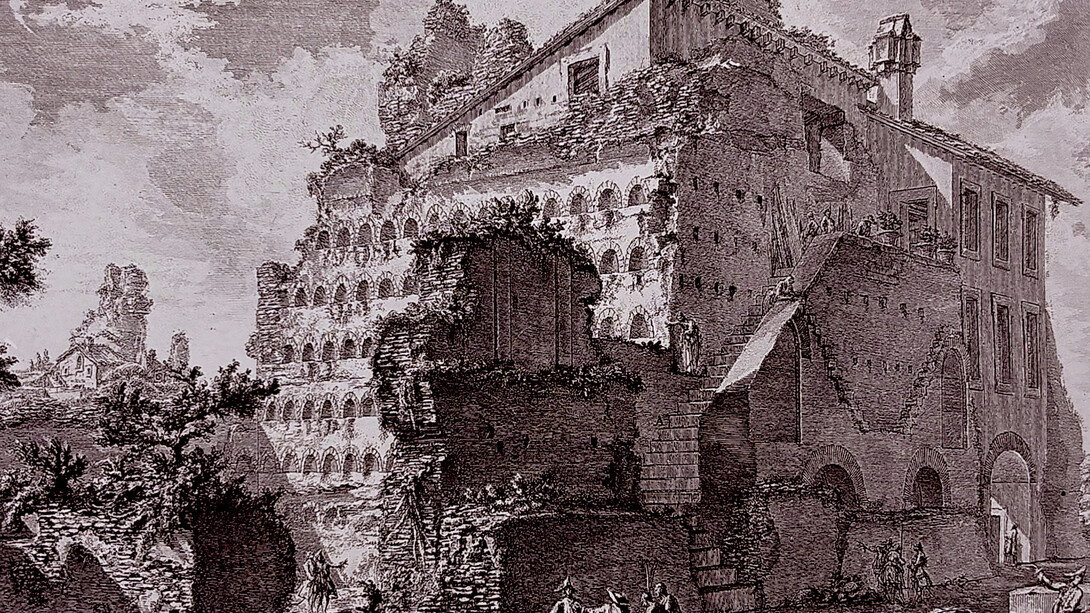
Giovanni Battista Piranesi, born in Mogliano Veneto in 1720, was known as an architect, etcher, engraver, publisher, antiquarian, archaeologist, theorist, and book designer until his death in Rome in 1778. His architectural and artistic educations, along with his fondness of archeology, allowed him to develop a unique vision of architecture that blended archeology and invention, empirical study and dreamlike fantasy. This synthesis created works that functioned both as cultural artifacts documenting the past and as intellectual provocations that challenged established ideas about space, history, and human perception.
Piranesi’s fascination with Rome’s ancient ruins was an active engagement to provoke or awaken new architectural perspectives and not mere antiquarianism. His famous series Vedute di Roma (Views of Rome) are copperplate etchings that depict the ruins in a striking scale and drama. Unlike traditional archaeological illustrations that sought objective accuracy and truth, Piranesi’s etchings display these ruins as mystical and grand spaces that allow imaginative engagement. These images were popular souvenirs for travelers on the Grand Tour, but also they carried a strong ideological message. Piranesi celebrated the technical mastery of Roman style, advocating for a revival of its bold architectural spirit in his time. This was a clear counterargument to some critics of the time who preferred Greek restraint and classical order over what they saw as the excesses of Roman architecture. For Piranesi, architecture was never a purely rational or decorative work, but rather it was a theatrical, psychological, and ethical endeavor capable of shaping civilizations and their collective identities of culture.
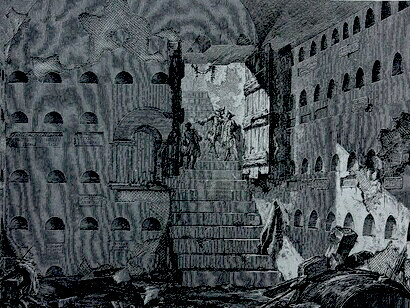
Piranesi's Carceri d'Invenzione (Imaginary Prisons) marked a departure from his archaeological reconstructions. This series of etchings portrays colossal, labyrinth-like interior spaces filled with staircases that have no end, suspended bridges, and voids. These spaces defy physical logic and function, which may hint that it’s not being the prison for the body but for the mind. In Piranesi's portrayal of an imaginary world, instead of clarity and order, memory becomes fractured, recursive, and twisted, expressing Enlightenment rationalism's limits and concerns. These psychological dimensions anticipate later explorations of consciousness in literature by Edgar Allan Poe, Franz Kafka, and Jorge Luis Borges, who examined how the mind can become trapped within its own structures. Piranesi’s prisons thus foreshadow modern ideas about the subconscious and interiority, using architectural form as a powerful language for psychological complexity. The Carceri serve as thought experiments in phenomenology, demonstrating that architecture is not simply a backdrop for human activity but a force that shapes consciousness and identity. Through this lens, Piranesi bridges the gap between architecture and psychology, crafting spaces that are as much diagrams of internal mental states as they are external forms.
Piranesi’s work is firmly rooted in the Romantic and post-Romantic traditions, where ruins and shadowy spaces are seen as pathways to the sublime. His imagery captures the tension between the rational ideals of the Enlightenment and the irrational depths of the subconscious, a dialectic that profoundly shaped modern architectural thought. This interplay continues to resonate powerfully in contemporary culture, particularly in the digital realm and imagined architectural landscapes.
Building upon Piranesi’s visionary approach, speculative architects such as Lebbeus Woods, Mark Foster Gage, and Winy Maas (The Why Factory) continue to use drawing as a means of critical inquiry. Through exaggeration and the design of unbuildable forms, they challenge contemporary social, political, and environmental conditions. In a world marked by ecological crises and digital transformation, Piranesi’s work reminds us that architecture’s most radical power often lies not in what is physically constructed but in what is imagined. His legacy also raises vital ethical questions about architectural imagination: if we can design anything, what should we design? Many contemporary speculative projects, though sometimes fantastical in appearance, confront urgent issues such as climate change, spatial inequality, and political instability. Like Piranesi’s subtle critique of Enlightenment optimism, these projects provoke reflection on the values encoded in spatial form, the ideologies expressed through architecture, and the futures we choose to envision or ignore.
Ultimately, Piranesi’s greatness is found not merely in his technical skill or historical scholarship but in his refusal to separate reason from emotion, history from invention, or mind from matter. His architecture consists of both cultural discourse and psychological interiority, blurring the boundary between what we see and what we think. Whether documenting ruins, imagining prisons of the mind, or mapping speculative cities, Piranesi was far more than an antiquarian or documenter of archeology; he was an architect of possibility. His work reminds us that architecture is as much about imagination as it is about construction, and that the most radical spaces often exist not in cities but within the mind. In the face of new challenges such as virtual realities, climate emergencies, and algorithmic design, architecture may find its deepest inspiration not in the material world but in the realm of the imagined, the symbolic, and the yet-to-be.

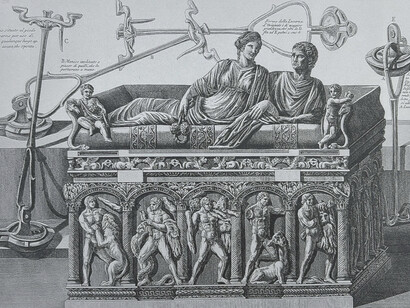
![[Vignetta del titolo], 115 x 182 mm. Retrieved from Ficacci, L. (2022). Various Works. In Piranesi: The Complete Etchings (p. 324)](/attachments/8b70e4d3b139ba3e3ac2b79dd3b799c14eee3570/store/fill/410/308/a652b4ce51230f637632595a72f1713aae183df8a40fb819459f9e6e6215/Vignetta-del-titolo-115-x-182-mm-Retrieved-from-Ficacci-L-2022-Various-Works-In-Piranesi-The.jpg)
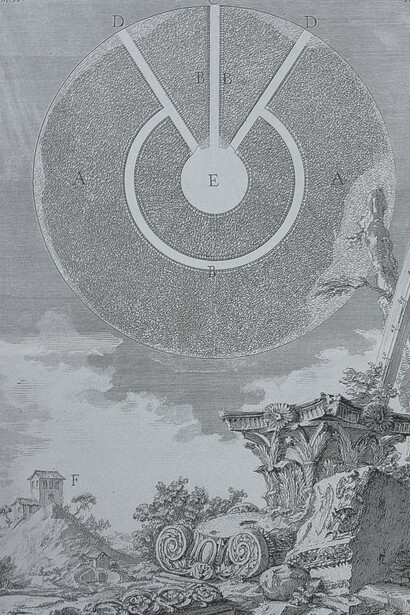
![[Vari capitelli], 470 x 275 mm. Retrieved from Ficacci, L. (2022). On The Grandeur and the Architecture of the Romans. In Piranesi: The Complete Etchings (p. 361)](/attachments/bacaf3949462b61c3649325a69d0292ad6fdb0b8/store/fill/410/615/0706f1444cfb8efba53aa3798f645028a457bf2f63cb1ac8b299d322679e/Vari-capitelli-470-x-275-mm-Retrieved-from-Ficacci-L-2022-On-The-Grandeur-and-the-Architecture.jpg)
![[Carcere V], 560 x 410 mm. Retrieved from Ficacci, L. (2022). Fanciful Images of Prisons. In Piranesi: The Complete Etchings (p. 127)](/attachments/e01a856f46a2fd67f9e39863afce5d7f4360b5a6/store/fill/410/615/6570b549c6ecd7edfc84346946222fb1070b9b804bba5f2cb403d0de74db/Carcere-V-560-x-410-mm-Retrieved-from-Ficacci-L-2022-Fanciful-Images-of-Prisons-In-Piranesi-The.jpg)