English
 Español
 Français
 Deutsch
 Italiano
 Português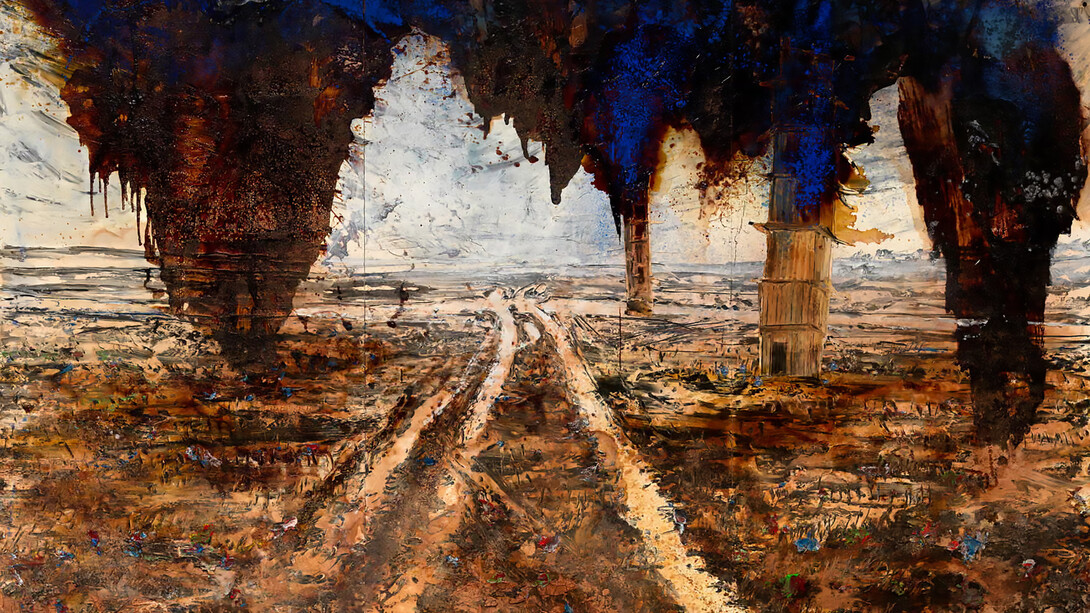
In an era dominated by digital mediation, artificial intelligence, and the proliferation of synthetic environments, the traditional practices of landscape-related art stand at a critical crossroads. Once a privileged site of human engagement and insight into nature, landscape-based/located art is now in danger of being dwarfed by a technologically saturated culture that renders painterly, photographic and sculptural representations of direct experience increasingly obsolete. As we scroll through algorithm-curated Instagram feeds, watch TikTok videos of distant coastlines, or become immersed in photorealistic AI-generated vistas, our relationship to the natural world—and its artistic register—has fundamentally shifted.
In trying to understand if landscape and art are currently still meaningfully cohabiting, I find myself returning to philosopher Jean Baudrillard's concept of simulacra, and I think his vision is both prescient and useful in understanding our current condition. In Simulacra and Simulation, he argues that in the postmodern world, signs and symbols no longer point to a tangible reality; instead, they become realities in themselves, replacing the real with the hyperreal.1
Applied to our current visual culture, this means that an image of a sunset may feel more “real” than witnessing the event itself. The glow of an iPhone screen can now easily exceed the resolution, luminosity, and atmosphere of a ‘real’ dusk, dawn, or scudding mackerel sky. Nature, once wild and unpredictable, is now neatly packaged into digestible, shareable formats—rendered palatable by the aesthetic logic of social media platforms and the deep-learning capabilities of generative AI. Against this context, landscape painting—a practice once grounded in the direct observation of the landscape and its flora and fauna—faces existential or perhaps potentially terminal threats.
One has to ask, of course, what value there is in sitting before a canvas and attempting to capture the sensuous contours of a hill or the light glancing off a stream in any case when pitched against the thing that has become contemporary art. The question becomes far more acute however, when we are faced with machinery that can instantly fabricate entire imagined terrains with sublime precision. One wonders if there is any conceptual space left for slow, reflective, manual ‘mark-making’ when viewers have become rapacious and rapid consumers of image torrents. Of course, the arguments are not new and are easily recognizable within the context of those seemingly ancient debates that raged around the millennium between devotees of wet and digital photography. I would argue, though, that these debates were less existential than the neglected conversations that need to be had in relation to representational art.
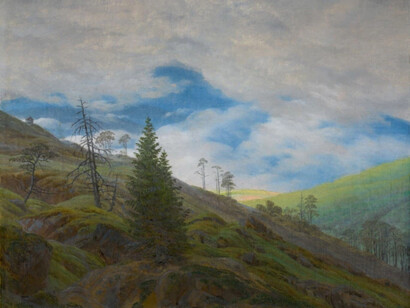
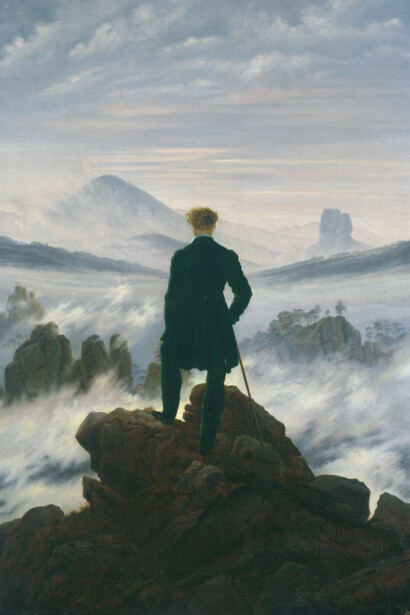
Historically, landscape painting evolved as a means of interpreting the world through a distinctly human lens. From the pastoral scenes of 17th-century Dutch painters to the dramatic romanticism of Caspar David Friedrich and the monumental canvases of the Hudson River School, artists brought not only technical skill but also emotional resonance and cultural narrative to their momentary depictions of place. To be clear, landscape painting was never really just about topography; it was about memory, spirituality, identity, and more particularly, power, both social and political.
Malcolm Andrews, in Landscape and Western Art, emphasizes how the landscape genre has always mediated between the real and the ideal, serving as a cultural construction shaped by prevailing attitudes toward nature.2 Today, though, those mediations are no longer solely engineered by humans. Algorithms trained on vast datasets of imagery can produce landscapes that use tropes to evoke emotion, memory, calculatingly, and even nostalgia, despite having no experience of, or correlation to, the physical world they mimic. This uncanny capability of AI forces a confrontation with questions raised nearly a century ago by Walter Benjamin in The Work of Art in the Age of Mechanical Reproduction.
Benjamin warned that the "aura" of a work of art—its presence in time and space, its singularity—would be eroded in an age of infinite replication.3 While he was speaking primarily of photography and film, his concerns are amplified in our era of generative media, where the replication is not just mechanical but apparently ‘creative’. When AI can generate countless “original” landscapes indistinguishable from human-generated ones, the notion of artistic authenticity is profoundly problematized, maybe even terminally destabilized.
Artists today are not merely competing with machines—they are working within an entirely different epistemological framework. Generative AI systems like DALL·E, Midjourney, and others are not simply tools; they are co-creators, or perhaps usurpers, depending on one’s perspective. These systems produce images based on patterns, not perception; probability, not presence. And yet, the results often feel emotionally resonant, even sublime. It remains to be seen what this will mean for painting, which has traditionally hinged on the human act of looking and manually interpreting the mood, chiaroscuro, etc., to ‘capture’ the elusive and momentary wonder at a shape-shifting world.
The painter’s predicament is predicted by one of my favourite reads in the form of the literary alienation depicted in Joris-Karl Huysmans’ À rebours (1884). The novel’s protagonist, Des Esseintes, retreats from the chaotic unpredictability of the natural world, preferring synthetic flowers, orchestrated garden-scapes, and other aesthetic surrogates.4 Nature, for Des Esseintes, is flawed, unruly, and vulgar—artifice offers control and refinement. His rejection of organic reality in favor of constructed environments eerily anticipates our own drift into virtual landscapes, curated Spotify nature sounds, and VR simulations of forests. Like Des Esseintes, we increasingly consume nature as spectacle rather than experience it as presence.
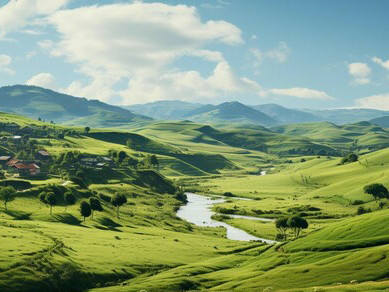
Cultural theorist Timothy Morton has coined the term “ecological kitsch” to describe our idealized, sentimentalized visions of nature. According to Morton, the picturesque mountain stream or the peaceful meadow is often a fantasy in any case—an aestheticized image that conceals the complexities and crises of the Anthropocene.5 This romanticized nature is not only a distraction but also a form of denial. And yet, it is precisely this kind of nostalgic imagery that AI and digital media excel at producing. The irony is that the more we aestheticize nature through technology, the further we remove ourselves from the ecological realities/horrors it is subjected to.
In this climate, traditional landscape painting may seem like an anachronism. But perhaps it is precisely this potential irrelevance that might grant renewed significance. In a world of endless digital simulations, the slowness, imperfection, and physicality of painting might just be able to serve as a form of resistance. The act of observing a landscape—of spending hours in the shifting light, absorbing its sounds and textures, and translating that experience into brushstrokes—offers a kind of presence that the algorithm cannot (currently) replicate.
The artist’s struggle with the unpredictability of nature, the imperfection of the hand, and the limitations of perception are all reminders of our embodied engagement with the world. Contemporary artists who continue to work with the landscape are increasingly aware of these tensions. Some embrace technology, incorporating satellite imagery, drone footage, or machine learning into their practice, while others return to more traditional methods as a way of foregrounding the human touch. In both cases, the landscape is no longer a passive backdrop but a contested space—a site where questions of authenticity, ecology, and aesthetics collide.
Of course, it would be naive to imagine that the role of landscape in art has not previously been challenged. Seminal artists such as Long, Ackling, and Fulton were a generational phenomenon who were at the cutting edge of British landscape-based art in the late 1970s and early 1980s. Their challenge to established convention at the time was seen as equally grave and subversive. Richard Long, with his elemental walks across moors, deserts, and mountains, resisted the idea of landscape as the disconnected spectacle of the pastoral idyll in a largely post-industrial society.
Since the late 1960s, his minimalist interventions—such as a line of stones across a field—assert the value of embodied experience, of being in the land rather than viewing it. Long’s art, impermanent and process-based, presents a softer and more humane challenge to the spectator. And as challenging as his work may have been to the pictorial tradition, it still stands in stark contrast to what I would call the bleak inhumanity of AI-generated images. AI landscapes are typically detached from time, weather, or physical exertion—and more importantly, depleted of charm.
As artificial intelligence increasingly mediates our perception of the natural world, it contributes not only to cultural displacement but also to environmental neglect and erasure. The very technologies that generate hyperreal landscapes risk severing our sentient connections to the physical earth, fostering a disembodied, consumptive gaze that encourages detachment rather than stewardship. As we engage with endlessly replicable, aestheticized "naturescapes," the urgent ecological crises—biodiversity loss, deforestation, and climate catastrophe—fade into the background of algorithmic spectacle.
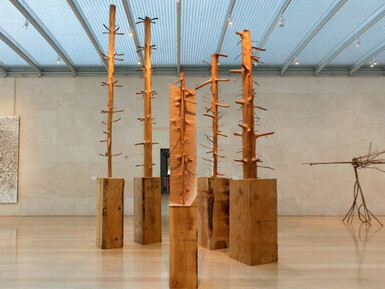
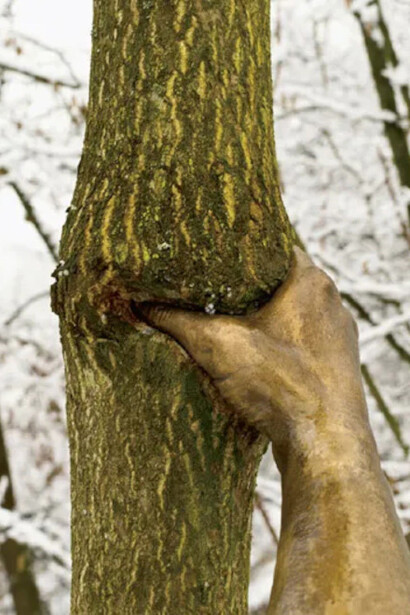
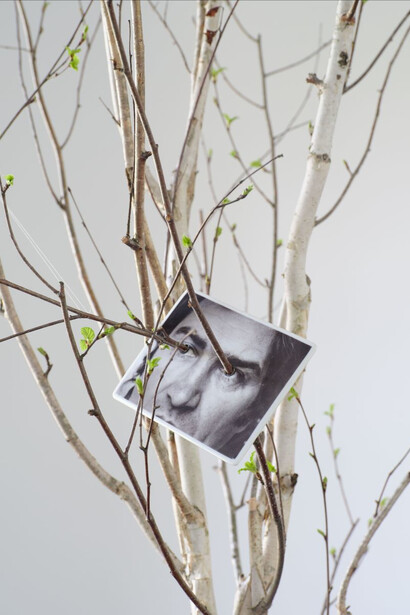
There is resistance though, I would argue that a determined and fierce repudiation of AI’s fatal inevitability can be witnessed in the form of Giuseppe Penone’s integration of his own body into natural materials—trees, bark, breath. Penone offers salvation and a punctilious counterpoint to AI’s seemingly omnipotent abstraction. Penone reveals nature not as a raw resource or background, but as relational, sensual, and reciprocal. The artist’s contact with nature and landscape is visceral, terrifying and proximal; we are brought close to the exquisite mortality of nature and perhaps forced to consider our own.
Similarly, Anselm Kiefer’s monumental paintings, with their scorched lead and crumbling surfaces, evoke landscapes both historical and wounded; ecologies saturated by memory, violence, and entropy. These are not idealized vistas but scarred terrains that challenge viewers to confront human complicity in environmental devastation. Unlike generative AI, which often beautifies or sanitizes nature, Kiefer makes decay and trauma visible. For me, Kiefer’s work continues to mobilize landscape as a proxy for a Europe traumatized by the consequential tragedy and guilt of World War II; the landscape not only bears witness to vast human suffering but also carries the scars and pockmarks of bomb craters and captures the spirit of a generational sensibility that will be forgotten at our peril.
AI struggles with history, given its often politically sanitized data sources; if you don’t believe me, just ask your Amazon Alexa something really contentious. At this point in time, whilst AI might be able to produce something that ‘looks a bit like’ a Kiefer or Rothko, the essential drivers are missing.
In a more transatlantic setting, James Turrell’s light works and giant earthworks like the Roden Crater reframe landscape as a cosmic instrument, aligning perception with planetary rhythms. His manipulation of sky and earth forces viewers to slow down, to witness celestial movements long eclipsed by increasingly hi-res screens. In doing so, Turrell reawakens our capacity for awe—an emotion foundational to ecological ethics. The scale of landscape and of humankind’s insignificance are a potent antidote to the ultimate control offered by generative AI, ChatGPT, and the ilk. Artificial intelligence is, after all, not a fit replacement for natural biodiversity or cosmic wonderment.
Together, such artists challenge AI’s seductive simulations by grounding art in presence, materiality, and environmental consciousness, urging us to remain rooted in a world that increasingly risks being forgotten. Moreover, the rise of land art and site-specific practices—such as those documented by Suzaan Boettger in Earthworks—suggests that landscape itself can be both medium and message.6 These practices often involve direct interaction with the earth, emphasizing process over product and temporality over permanence. In contrast to the static, consumable image of the landscape, land art invites viewers to experience place through movement, immersion, and sometimes even decay.
In conclusion, I am not trying to assert that landscape is being eradicated from art—yet. It is, however, being fundamentally and involuntarily redefined. While technology challenges traditional modes of representation, it also forces us to ask deeper questions about our relationship to nature and the role of the artist in a world of synthetic perception. Landscape-based art, far from obsolete, may emerge as the critical practice that offers slowness in an age of speed, presence in an age of simulation, and symbolic flaws and transcendent meaning in an age of flawless signs. It reminds us that nature is not simply something to be seen or rendered—but something to be lived with, engaged, and treasured.
References
1 Baudrillard, Jean. Simulacra and Simulation. Translated by Sheila Faria Glaser, University of Michigan Press, 1994.
2 Andrews, Malcolm. Landscape and Western Art. Oxford University Press, 1999.
3 Benjamin, Walter. The Work of Art in the Age of Mechanical Reproduction, 1935.
4 Huysmans, Joris-Karl. À rebours. 1884.
5 Morton, Timothy. Ecology Without Nature: Rethinking Environmental Aesthetics. Harvard University Press, 2007.
6 Boettger, Suzaan. Earthworks: Art and the Landscape of the Sixties. University of California Press, 2002.