English
 Español
 Français
 Deutsch
 Italiano
 Português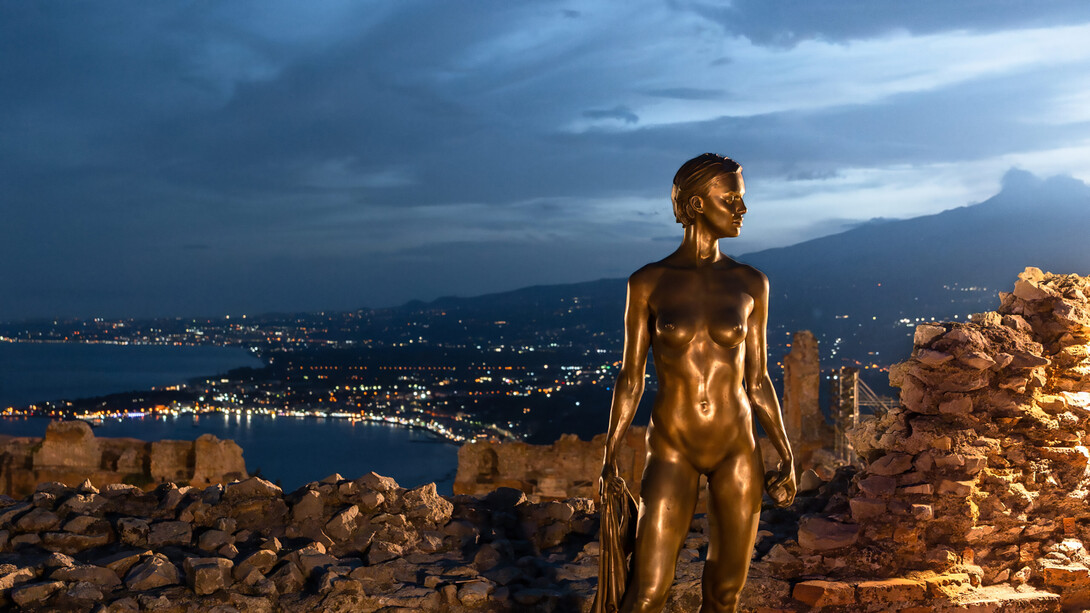
To enter the Teatro Antico di Taormina is to step into a space where time does not accumulate linearly but folds in upon itself. Stone here is not inert matter; it is a resonant surface, charged with voices, movements, silences, and expectations sedimented over centuries. It is within this stratified and symbolic architecture that Gesti Scolpiti (Sculpted Gestures) unfolds—a project by Jago that resists the logic of exhibition-as-display and instead proposes sculpture as an act of temporal negotiation.
Rather than positioning contemporary works as interruptions within an archaeological site, Jago’s intervention embraces continuity and friction at once. His sculptures do not attempt to “blend in” with the ancient theatre, nor do they impose themselves as alien presences. They inhabit a more unstable threshold: that of the gesture. Gesture, in this context, is not merely a physical movement but a unit of meaning—an action suspended between intention and consequence, between body and world. The exhibition’s title is therefore not descriptive but programmatic: Gesti Scolpiti names sculpture itself as a gesture extended in time, an act that continues to speak long after the hand has withdrawn.
The Ancient Theatre, conceived as a space for collective vision and shared experience, amplifies this understanding. Historically, it was a place where bodies were exposed—actors, orators, and spectators alike—where speech was projected outward and upward, and where the individual voice became part of a civic and ritual dimension. By installing his works here, Jago reactivates the theater's original function: not as a backdrop, but as an interlocutor. The sculptures enter into dialogue with an architecture that has always mediated between presence and absence, visibility and disappearance. At the core of the exhibition lies a persistent and obsessive motif: the hand.
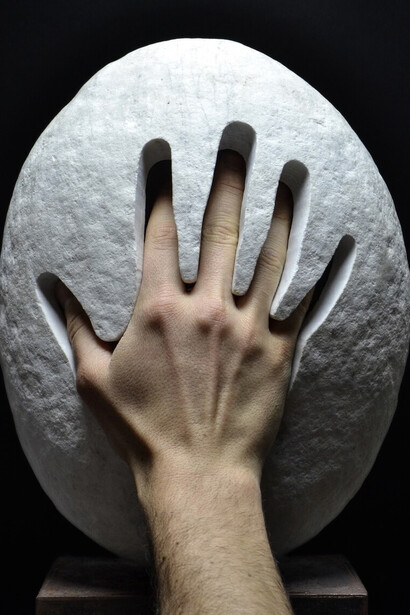
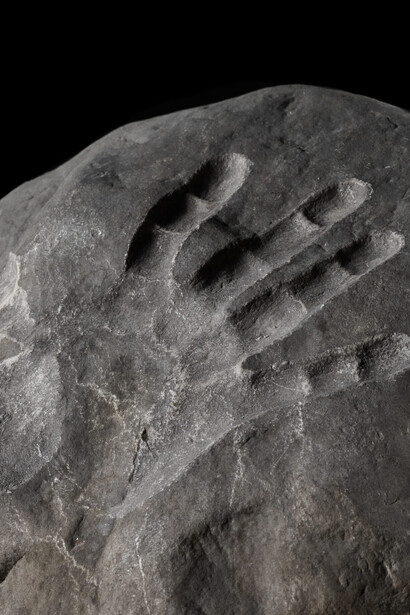
In Impronta Animale (2012), Memoria (2015), and Prigione (2016), all carved in statuary marble, the hand is not simply represented—it is evoked as origin, instrument, and trace. The hand is the first technology of humanity, the primary interface between the body and the world. It is through the hand that matter is transformed, surfaces are marked, and memory is externalized. Jago returns to this primal gesture not to celebrate mastery, but to interrogate vulnerability.
Impronta Animale recalls the earliest forms of human inscription: the negative handprints found in prehistoric caves, created by pressing pigment around the hand rather than drawing it. These gestures were neither decorative nor expressive in the modern sense; they were acts of existence. To leave a handprint was to assert “I am here,” to anchor one’s presence within a hostile and uncertain environment. Jago’s sculpture echoes this ancestral impulse, translating it into marble with a precision that paradoxically preserves fragility. The work suggests that every sculptural act, no matter how refined, carries within it this original urgency: the need to leave a trace.
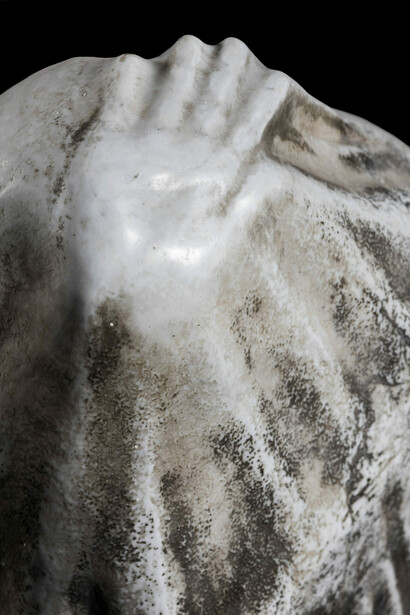
With Memoria, the gesture becomes absence. The hand is no longer protruding but carved as a hollow, a void shaped by contact. Memory, in this sense, is not accumulation but erosion. It is what remains after time has passed through matter, removing as much as it preserves. The sculpture proposes memory as a physical phenomenon—something that can be touched, worn down, and eventually lost. In the context of the Ancient Theatre, where countless gestures have vanished, leaving only architectural scars, this work resonates as a quiet meditation on disappearance.
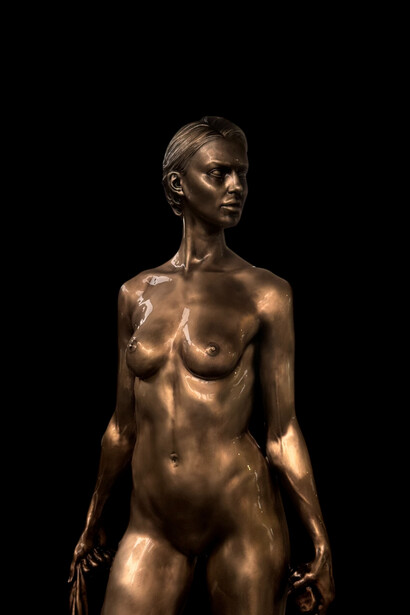
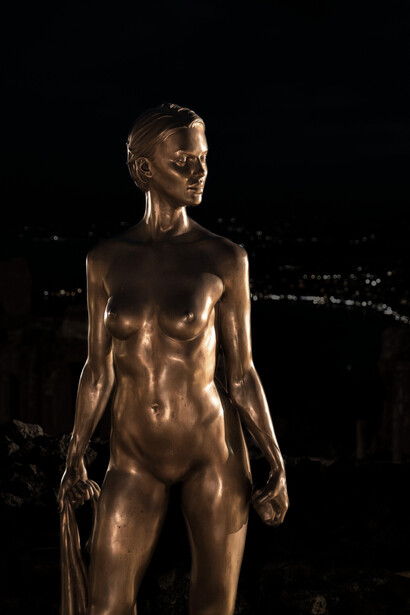
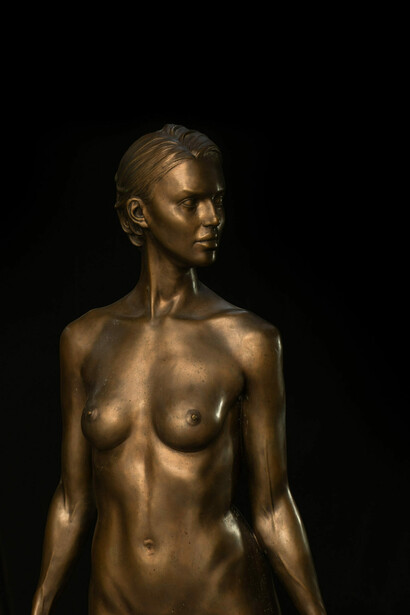
Prigione intensifies the discourse by introducing the body in a state of suspension. A figure struggles to emerge from the marble block, yet remains partially trapped within it. Limbs strain, surfaces oscillate between finish and roughness, and the form seems caught in a perpetual state of becoming. This is not the liberation of Michelangelo’s non-finito, where the figure asserts its inevitability, but a condition of constraint. The sculpture embodies tension rather than resolution. Here, the hand is no longer just a marker; it is an agent of resistance, pushing against limits that are at once material and symbolic. If the marble works operate through subtraction, containment, and trace, David (2024) introduces a different register—one of exposure and confrontation. Cast in bronze and standing 181 centimeters tall, the sculpture occupies a commanding position within the theater, overlooking both the ancient tiers and the open sea beyond. Its placement is crucial: elevated yet vulnerable, monumental yet human. This David does not dominate the space; it engages it.
Jago’s reinterpretation of the Davidic archetype marks a decisive break from art-historical convention. The figure is female, her posture upright and resolute, subtly echoing the contrapposto of classical sculpture while dismantling its gendered assumptions. The sling and stone—recurring elements in Jago’s recent work—are retained but stripped of heroic bravado. They no longer signify victory through violence but courage through self-determination. The enemy is no longer Goliath; it is invisibility, silencing, and imposed norms.
The work’s trajectory reinforces this contemporary reading. Before arriving in Taormina, David undertook a symbolic journey around the world aboard the Italian Navy’s training ship Amerigo Vespucci. This passage transformed the sculpture into a mobile emblem, crossing borders and contexts, accumulating meanings through movement. Sculpture, traditionally associated with fixity and permanence, becomes here an object in transit—subject to interpretation, exposure, and risk.
The process behind David further underscores Jago’s commitment to sculpture as a temporal practice. Beginning in 2021 with a small clay model shaped by hand, the work evolved through multiple iterations before reaching its bronze form. A monumental marble version, over four meters tall and carved in Carrara, is planned as a future realization. This extended genesis rejects immediacy in favor of duration, insisting on sculpture as a slow and ethical engagement with matter.
This ethical dimension came sharply into focus during the exhibition’s opening. In front of an audience of over a thousand spectators, Jago performed an unexpected and controversial action: he covered the nudity and mouth of David with adhesive tape. The gesture was a response to the removal of images of the sculpture from social media platforms, flagged and censored by automated systems as inappropriate. What initially appeared as an act of provocation revealed itself as a lucid and deliberate critique. By censoring his own work, Jago exposed the mechanisms of algorithmic judgment that increasingly govern visibility in the digital age. Within the Ancient Theatre, this act acquired a profound resonance. A space historically dedicated to amplified voice and collective gaze became the site of a contemporary silencing. The taped mouth transformed David into a wounded figure, marked by a visible constraint that echoed the struggles depicted in Prigione. Sculpture, once again, was not an object but an action—an intervention that extended beyond form into discourse.
In this light, Gesti Scolpiti can be read as a meditation on freedom and responsibility. Jago’s sculptures do not offer solutions; they pose questions. What does it mean to leave a trace today? Who decides which bodies can be seen, which gestures are permitted, and which images circulate? By situating these questions within an ancient site, the exhibition insists on their continuity. The conflicts of the present are not anomalies; they are variations of a long human struggle between expression and control. Ultimately, Jago’s intervention at Taormina reminds us that sculpture is not about freezing time but about shaping it. Each gesture—carved, cast, or performed—becomes a point of contact between past and present, between individual agency and collective memory. In the enduring stone of the Ancient Theatre, these works do not merely exist; they listen, respond, and insist. Sculpture, here, is not a relic of history but a living language—one that continues to ask, urgently and quietly, what it means to be human.