English
 Español
 Français
 Deutsch
 Italiano
 Português
Slavery continues to be a continuous issue even in the 21st century. On March 25, 2026, the UN General Assembly adopted the resolution presented by Ghana, declaring the trafficking of enslaved Africans to be “the greatest crime against humanity” and calling for reparations as a concrete step toward remedying this historical wrong.
The United Kingdom and members of the European Union abstained. The United States, Israel, and Argentina, however, voted against the resolution. The United States defended its position as being opposed to a legal right to reparations for historical wrongs that were not illegal under international law at the time they occurred. In addition, the United States objected to attempting to rank crimes against humanity in any type of hierarchy.
The arguments of the United States and the other nations opposing the resolution raise two questions to be considered:
What is the difference between legality and morality? To what depth was slavery a crime against humanity? Legality is differentiated from morality. Legality is simply the state of observing the law; the law being rules based upon values to maintain stability or control of a situation or society. Laws can be legal but deeply immoral. Morality consists of principles of behavior related to the virtues of humanity, i.e., empathy, compassion, and respect for humankind. Morality recognizes the connection and interrelatedness of human beings, while legality can be used to dehumanize.
Legality vs immortality
Immortality is the violation of moral principles relating to human dignity. Immorality is most often dictated by greed and the need to control. The greatest immoral act is not to see or respect the humanity of another human being, to perceive and to treat another human being as an object, chattel, or property. The justification for this dehumanization is the rationalization and justification that this “other” is seen as not being fully human or belonging to the human race. A narrative based upon the intellectual, cultural, and moral inferiority of the enslaved was used to justify the enslavement of Africans in the United States.
It is interesting that to pursue the moral right of freedom and justice was considered to be illegal in the United States. Those revolting against enslavement were perceived as and treated as criminals. In addition, there are laws that, for all purposes,s were immoral because they violated human dignity and human rights. In the United States, the Fugitive Slave Act of 1850, passed by Congress oSeptember 1818, 1850, allowed escaped slaves to be captured and returned to owners despite being in a free state. After Emancipation, Black Codes were passed in Southern states to limit the freedom of African Americans. These codes included vagrancy laws, forced labor contracts, and even laws that made it possible for African American children to be taken from their parents and forced into apprenticeship to white employers. Even in the North, Ohio passed laws that denied African Americans basic rights, such as testifying in court against whites.
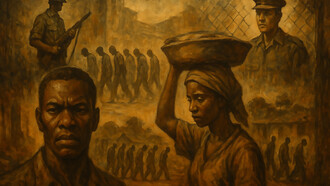
Jim Crow laws were most extensive and denied the humanity of African Americans from birth to death. These state and local statutes mandated racial segregation in public schools, transportation, waiting rooms, restrooms, restaurants, and even water fountains. African American voters were also disenfranchised.
Crimes against humanity
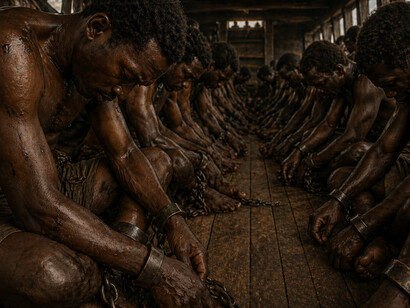
Article 7 of the International Criminal Court described sixteen crimes against humanity. Enslavement was, of course, listed; however, enslavement to some extent included every crime against humanity that was listed. The murder of the enslaved was an accepted practice, as the enslavedweres not considered to be human.
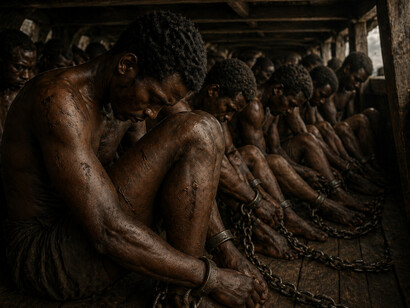
Extermination or genocide, especially for financial reasons,s was permitted, as wheslavesed were thrown overboard to meet insurance requirements, or when those who were not believed to be suitable for enslavement were killed. The forcible transfer of the enslaved from Africa or within the United States was customary. Severe deprivation of physical liberty occurred in special jails or holding cells for the enslaved. Brutal and savage torture commonplace. Torture was experienced by the enslaved as punishment, discipline, to increase productivity, or to teach a lesson to other slaves. Torture ranged from brutal whipping that caused disfigurement to putting salt brine, turpentine, or dripping hot wax on the wound. Restraints that included iron collars around the neck. The enslaved also experienced mutilation, such as the cutting off of ears and the horror of branding.
Sexual violence was suffered by both men and women. Men were violated and castrated. The lives of women, even young girls, were haunted by rape, forced breeding of children, and medical experiments. Families were separated by the auction block, never to see their children or relatives again. This forced separation was one of the most inhumane aspects of enslavement.
There can be no doubt that enslavement was the greatest crime against humanity, none since has included every aspect of dehumanization. Over 12.5 million Africans were shipped during the transatlantic slave trade, and it is estimated that over 2 million died during the Middle Passage. By the end of the Civil War, some 4 million people were enslaved in the United States.
The thought of reparations appears to be out of the question for the descendants of enslaved Africans and African Americans; however, President Reagan provided a formal apology for the incarceration of Japanese during the war, and the Civil Liberties Act of 1988 gave $20,000 to each surviving Japanese American incarcerated during WWII.
Currently, there are actions to hide the truth of slavery in the United States. This is a clear indication of knowledge of where enslavement stands on the hierarchy of inhumanity. The immorality of enslavement must be acknowledged and addressed before the United States can be the great nation devoted to freedom, justice, and equality that it claims to be.