English
 Español
 Français
 Deutsch
 Italiano
 Português
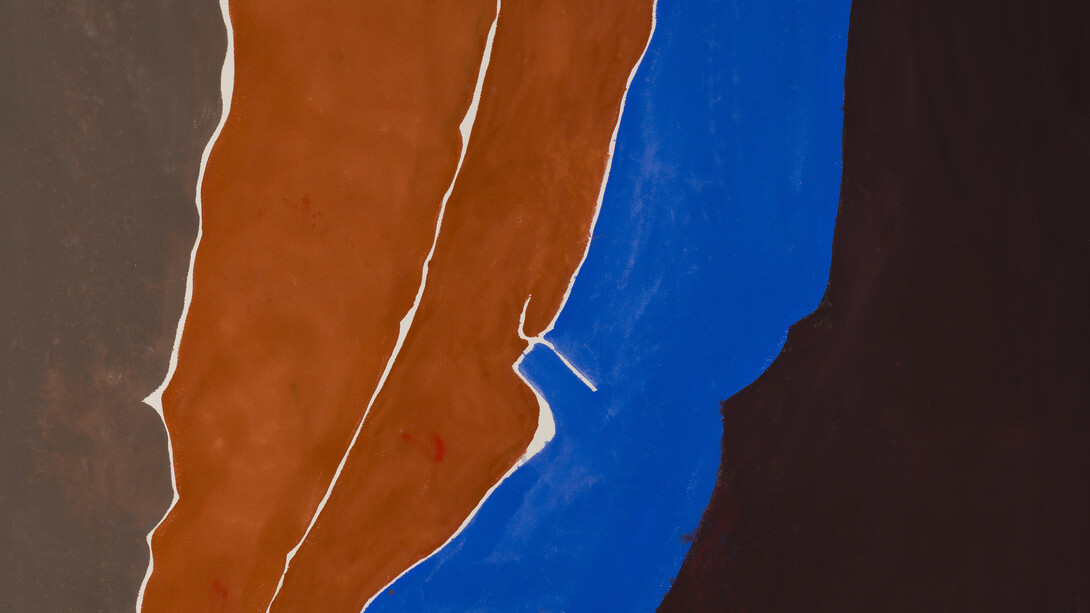
LewAllen Galleries is pleased to present Jack Roth: the vital diversity of black, an exhibition of museum quality paintings by acclaimed American abstract artist Jack Roth (1927–2004). On view from November 20, 2026, through January 2, 2027, the exhibition showcases Roth’s extraordinary synthesis of Color Field orchestration and rich fluency with Abstract Expressionist gesture and and a mathematician’s analytical rigor centered around a sustained investigation of black as an active, structural coordinate.
When Jack Roth entered the post-war American art scene in the late 1940s, studying at the California School of Fine Arts under Mark Rothko, Richard Diebenkorn, and Clyfford Still, Abstract Expressionist painting was largely defined by primal gesture and existential dribble and spill. Roth, however, brought a unique intellectual perspective to the unprimed canvas informed by his background in chemistry and mathematics. Viewing painting not merely as an emotional release but as a rigorous, ongoing search for structural truth and mathematical explanation, Roth approached the canvas as a coordinate structural system. Across his career, his work navigated a delicate balance between expansive, light-absorbing fields of color and sharp, vector-like linear interventions.
At the center of Roth’s artistic inquiry sits a monumental exploration of black at its most material and chromatic diversity. Synthesizing the material history of modern pigment with the logic of a mathematical proof, Roth stripped black of its historical burden as a narrative shadow or visual suggestion of darkness and death. Inspired in part by friend and mentor Clyfford Still’s view of black as “warm—and generative,” Roth deployed black as visual architecture—an optical baseline and relational anchor that forces adjacent raw colors, white passages, and exposed canvas to read with heightened luminosity. Rather than deadening space, black acts in Roth’s hands as an optical amplifier and geometric frame, allowing raw color fields to vibrate with intense clarity.
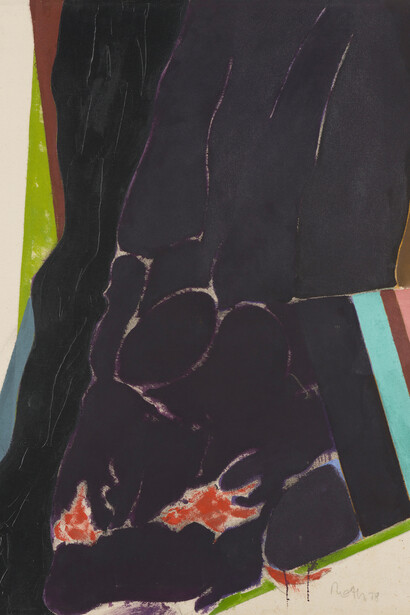
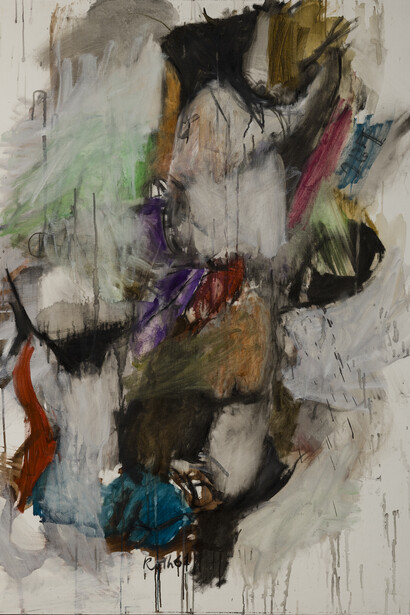
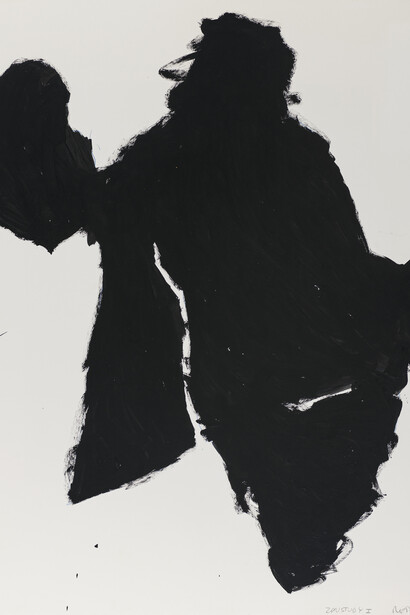
This exhibition features exemplary works spanning Roth’s evolved dynamic. Canvases such as Cornering #11 (1979) feature fine pale lines traversing vast fields of black, alongside subtle chromatic strokes, demonstrating Roth’s prowess for creating particular monochromatic silhouettes. Earlier compositions like Humpty dumpty (1961) illustrate his early integration of black fields with vibrant pigments, while later works such as Untitled #7706 (1978), New synthesis #27 (1981), and his 1986 Zen Studies demonstrate his mastery of line, geometric divides, and gestural immediacy.