English
 Español
 Français
 Deutsch
 Italiano
 Português
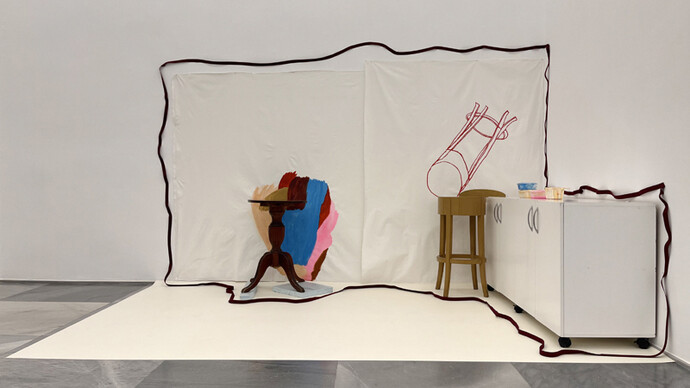
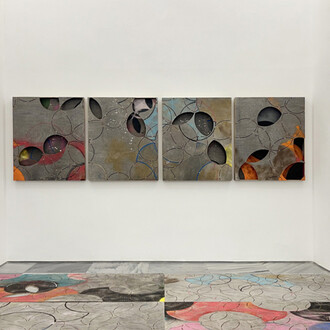
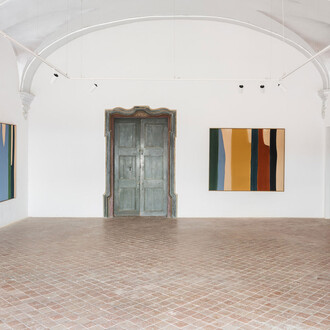
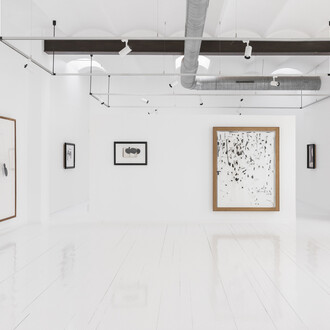
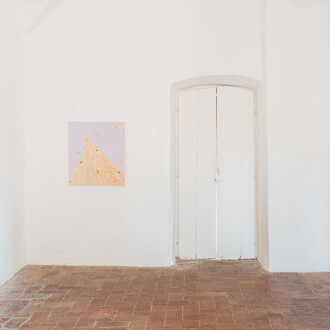
Espacio Mínimo presents the second solo exhibition by artist Elena Blasco at its gallery. Her artistic career—spanning from 1976, the year of her first exhibition—comprises a unique body of work characterized by formal freedom, featuring a wide range of techniques and textures, a brilliant and uninhibited use of color, and a disparate assemblage of elements where high and low culture merge through an intentionally ironic, childlike lens. Mix offers more than just a retrospective of her past works in conversation with new creations; beyond the formal and conceptual dialogue between pieces—some separated by a gap of over thirty years—it witness a staging that dissolves the boundaries of time and reveals an enduring aesthetic. Yet Mix is something more still, for the choice of materials and the act of "mixing" lie at the very genesis and essence of the artist's poetic vision. "Furniture and paintings. Two-dimensional and three-dimensional. What is it I want to bring together? I am always bringing things together. Can it be done? Is it possible? And why would I want to do it? What does it mean? Does it work? Is that what life is like? Does it work for me? It’s an experiment. Yes, it works."
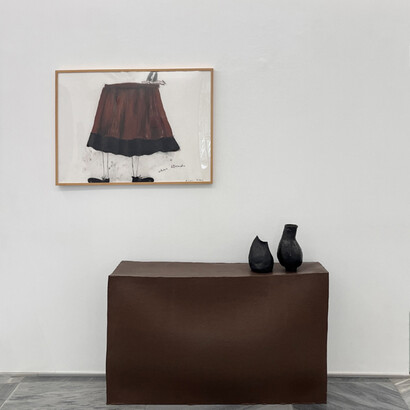
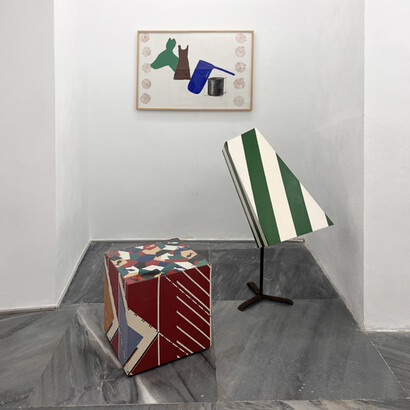
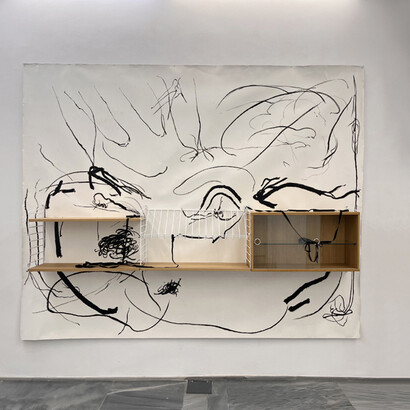
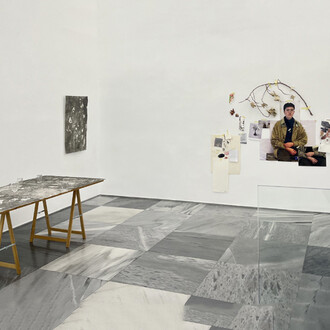
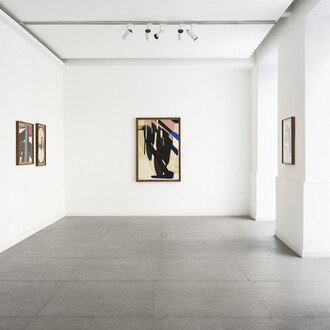
The exhibition comprises a selection of installations from the artist's early career alongside more recently created works that transform the gallery into something resembling a furniture showroom—a concatenation of petty-bourgeois representations revealing an obsessive interest in the domestic realm. As Carlos Jiménez noted in the catalog for the artist's 1991 exhibition at the Ángel Romero gallery: "The interior is an interior of resistance, a stronghold for the self waging battles against uniformity..."
Mix brings together a repertoire of large-scale works and diverse pieces that complement, reference, and amplify one another, forming a solid body of work that showcases her distinctive and highly personal imagery. Beneath a casual, irreverent air, Elena Blasco conceals the radical nature of the meanings she projects, challenging the clichés and canonical prejudices of contemporary society. These are domestic, a doll’s house-like interiors where the game proposed by the artist might well be a succession of slamming doors—echoing the act performed nearly 150 years ago by Nora Helmer, the heroine of Henrik Ibsen’s play of the same name, when she walked out on her home. It is an exercise in conceptual, thematic, and formal freedom—one she has cultivated since the start of her career—that establishes her as one of the most unique and unclassifiable figures in the contemporary art scene.