English
 Español
 Français
 Deutsch
 Italiano
 Português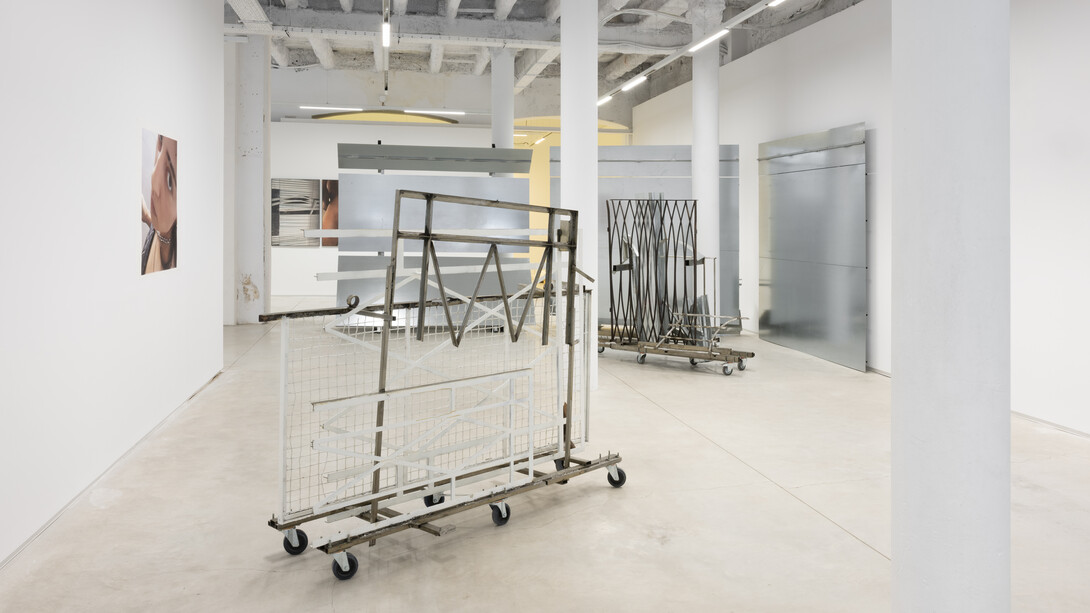
A memory of a translation: Arabic graffiti at a Syrian market in 2011, where a translation overlay read, you who have beautiful manners. For Lucía C. Pino, this strange address carried the possibility of warmth and community and became the title of their 2025 exhibition.
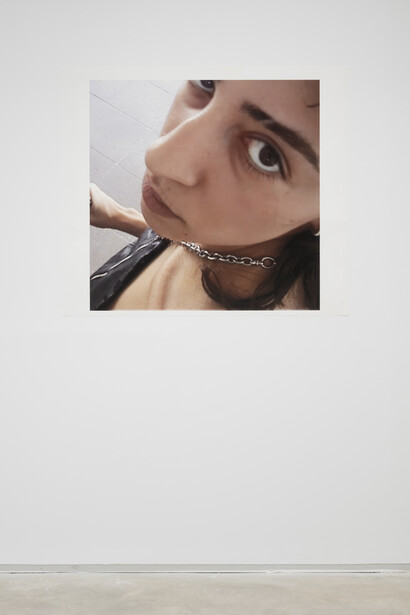
C. Pino’s work with “archives” has gone much like this, through memory and slippages in meaning. Visits to queer archives have fueled deeper questions around mediated inheritance and possible legacies. Some of these unfold in their book of autofiction Crines (2023), where Karim Rosa first appears as a central character, a play on the artist’s sister who works as a night nurse at a public hospital. The fluidity of materials and subjects found in these archives also informed their own approach to image-making. Friends and lovers became models for cellphone photographs, then enlarged, framed, and sequenced to produce a soft and tender mood rather than information or narrative.
Other inquiries undergird the work. For instance, the artist has been pressing on family histories and details that do not quite add up around a possible Arab heritage. Whether or not the suspected ancestry can be verified, the investigation opens onto documented exchanges between Spain and North Africa, as well as the ways such connections can disappear from or be obscured in family histories. These histories are flanked by present-day xenophobia within Spain on the one hand, and by nationalism surging across Europe on the other, amidst which resistance and protest also grow.
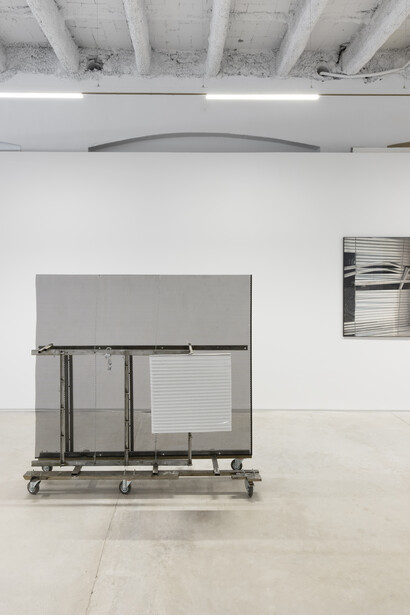
It’s a short detour, and quickly we find ourselves back at the work. Metal structures purchased at scrapyards and antique dealers, as well as rescued from the garbage are rewelded into armatures that become frames, supports, fences, or barricades, recalling the spatial constraints of protest, or the architecture of resistance. Not simply found objects, these works are the result of prolonged labor. For a year, the artist accumulated bars, railings, and steel and aluminum parts, then spent another six months cutting, polishing, brushing, and chemically altering them into new forms. In C. Pino’s You who have beautiful manners, viewers encountered these structures not just as visual references to fences and corridors but as forms that reorganized and obstructed their movement and attention. In Karim Rosa, these frames return to the gallery, forcing a new path through the space.
Scholar Julietta Singh offers a useful framework for considering C. Pino’s flexible way of relating to the proverbial archive. In No archive will restore you (2018), Singh describes the archive as an “enabling fiction,” or whatever you say you’re doing before you’re actually doing it, and before you fully understand what is at stake in the gathering and interpretation (23). Singh extends the metaphor further. Each of us is, in fact, an ongoing archive, incomplete, deteriorating, and marked by historical traces and trauma. Rather than recovering a fixed or stable history, the body is a site where histories accumulate unevenly, carrying both what is remembered and what cannot be fully known. The outside world, Singh writes, “constitutes, nourishes, and poisons us in turns.”
The border between “inside” and “outside” feels more porous by the day. At the very least, the rapidity with which they feed back into each other is difficult to overstate, especially under the constant barrage of mediated images and interfaces that we move through. In curator Sohrab Mohebbi’s Drifting in the atmospheric (2025), he describes a tendency in contemporary art away from discrete categories of installation, painting, or photography, toward “atmospheres” that dissolve distinctions between artwork, subject, and viewer. In turn, for viewers, posting an artwork online no longer simply says, “I was there,” but increasingly declares, “I identify with this,” or “I am this.”
Images of artworks are only one kind of atmosphere circulating through our feeds. In sharp contrast, yet within the same stream, images and livestreams of genocide and resistance across geographies proliferate. What happens to the body after repeatedly witnessing such violence through screens? If the body is an archive, it is one continually shaped by what we witness and what moves us to anger, as well as by the communities and solidarities that sustain us, an appeal to the “you” who have beautiful manners.
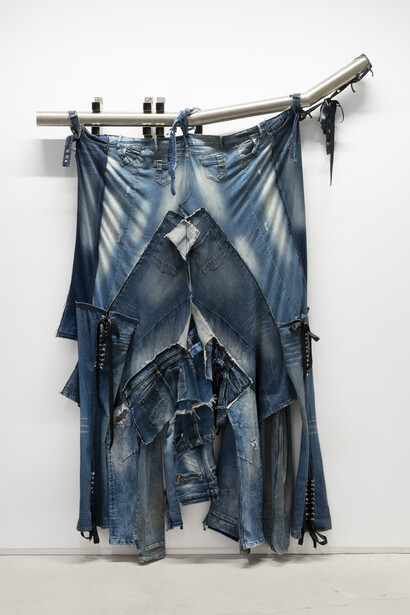
C. Pino’s works reconstitute references and materials drifting through this physical and virtual, interior and exterior, located and displaced atmosphere. Cadera Miamia (2025), an impaled steel table draped with denim patchwork vaguely resembling a ship or rocking horse, references the Global Sumud flotilla launched from Tunisia in 2025. Worn jeans, sutured and stretched over cold, sharp armatures, with the outlines of the legs still intact, bear the trace of a person who wore them. The body is treated as material; a leg, thigh, or rump becomes a discrete form like a cut of meat. Even though textile is a “soft” medium, denim and leather here are weighty and structured fabrics, and in their layering we feel the difficulty with which they take to manipulate. The body reappears in the work’s required force and physicality.
Although deteriorating and unrecoverable, Singh also writes that “the body archive is an attunement, a hopeful gathering, an act of love against the foreclosures of reason” (29). C. Pino’s exhibition is replete with physical foreclosures, traces and specters of violence, overt and implied. However, the same structures that barricade also enable sightlines to pass through, producing new relations between image and object, body and structure, tenderness and violence.
In philosopher Sylvia Wynter’s account, Christopher Columbus is said to have jotted down the phrase totum navigabile (“all seas are navigable”) in his notebook when he reached the Americas. For Wynter, the phrase helps articulate an epistemological rupture. No longer was there simply an “inside” and “outside” of the Christian world, or habitable and uninhabitable land. The encounter instead became foundational to a new ordering of the human and to the distinction between those who could be incorporated into that category and those who could be subjugated below it, thus producing another kind of enclosure. If I am to mistranslate or misread the phrase in this atmosphere, it would refer to the flotilla sailing for a free Palestine, or for the acts of love against the “foreclosures of reason.” In Karim Rosa, enabling fictions open new passages, or at least other possibilities of navigation.
![Aura Roig, The worms are starting to move [Los gusanos están empezando a moverse], vista de exhibición. Corteía de Prats Nogueras Blanchard](/attachments/f071f2e31535aca99858b1ef573d054464d3739a/store/fill/330/330/fe8dac1d242d24bf27f1e5fec7a9b71d3667a1476fdcc1a07fa9410a5e6b/Aura-Roig-The-worms-are-starting-to-move-Los-gusanos-estan-empezando-a-moverse-vista-de.jpg)