English
 Español
 Français
 Deutsch
 Italiano
 Português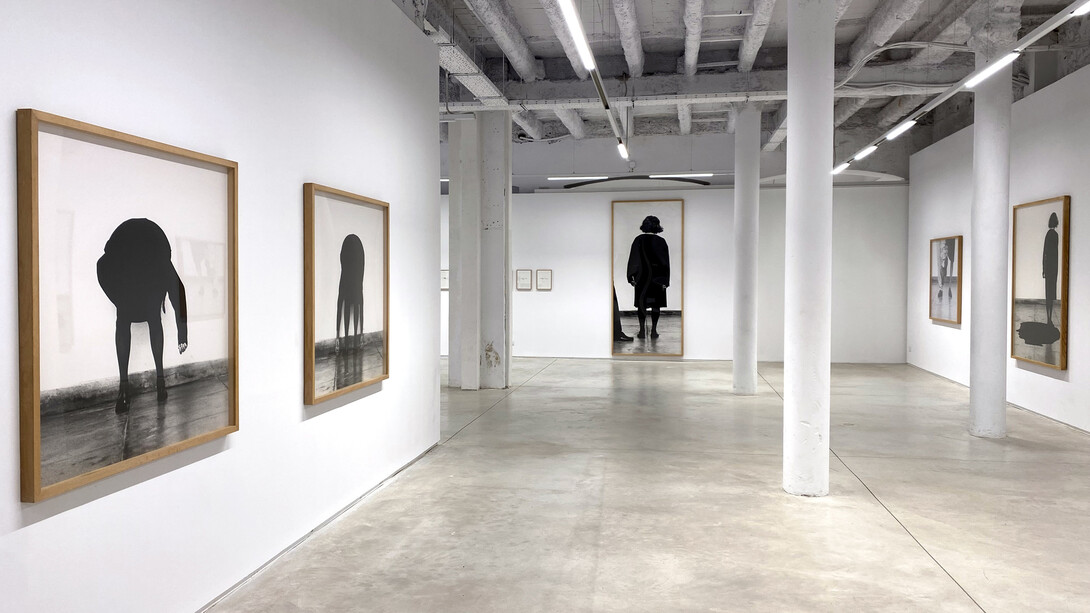
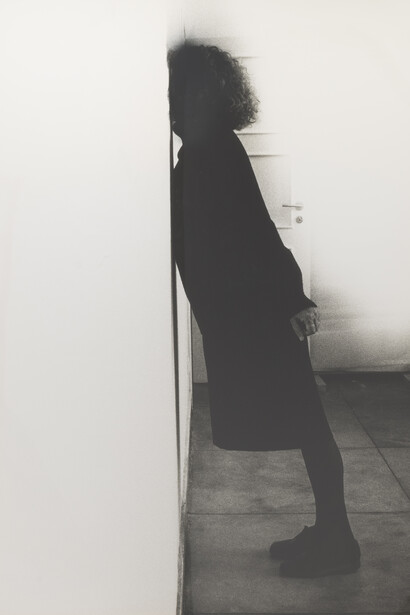
If it were a story, it could be told like this: a spacious house with large doors and windows, in which the interior and exterior exist as extensions of each other, was occupied by a woman in a black dress. As she wandered through the various rooms of the house, the woman inscribed shadows and lights, cut-outs and figures, a black and white body occasionally smudged with blue or red.1
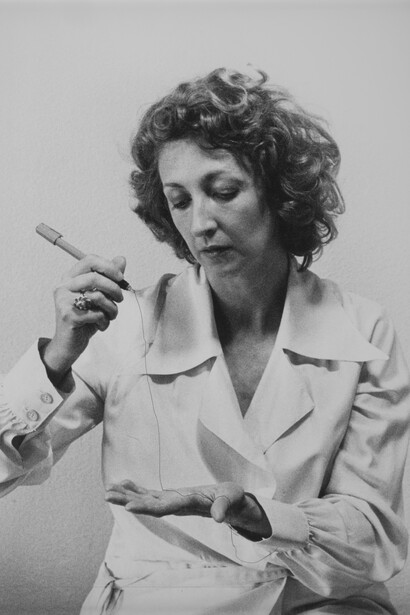
Prats Nogueras Blanchard is delighted to announce To hold the line with my fingers, our inaugural exhibition of the work of Helena Almeida (Lisbon, 1934 – Sintra, 2018) in our Barcelona gallery. Almeida was one of the most important artists in contemporary Portuguese art and a decisive figure in its transformation from the 1970s onward. Throughout her career, she moved between painting, photography, drawing and performance, constantly exploring their limits. In her work, the body—her own—becomes a tool, a material and a language: a space in which gesture, image, and presence converge.
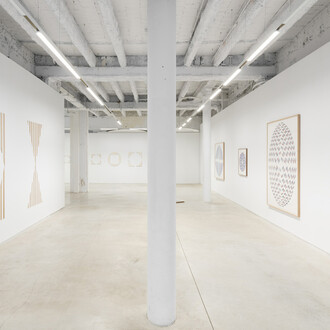
Following her early investigations into the rupture of the pictorial support in her late 1960s canvases, Helena Almeida deepened her exploration of the material conditions of the medium, producing a series of drawings made with horsehair thread on paper. Three works from this series open the exhibition. In these pieces, the line is not a stroke that describes, but rather an action that defines a place. It is an extension of the body—a way of inhabiting space. The line thus becomes a link between interior and exterior, between the pictorial plane and reality. Through this minimal and precise gesture, Almeida activates the space: the drawing opens up, the surface transforms into a stage, and the image ceases to be a representation and becomes a presence.
With early works such as Desenho habitado (1975), Almeida begins to foreground the body—her own—as both subject and medium, gradually transforming it from a mere narrative element to one of greater formal purity: “It was the horsehair drawings that led me to need to be photographed. I wanted to hold the line with my fingers, to show that the line had solidified on the paper, that it had been freed from the paper, that it could be felt by someone’s fingers, and enter through us”. Playing with real space and diegetic space, as well as questioning the viewer’s conception of dimension, would become a recurring concern in Almeida’s practice.
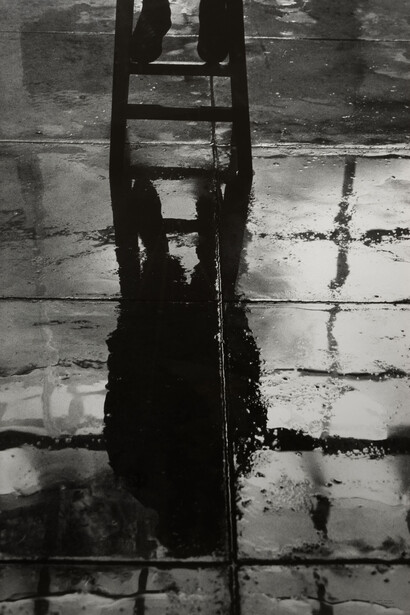
It is this dialogue between body and space – always that of her own studio – between gesture and imitation – always captured by her husband Artur Rosa – that Helena Almeida uses to construct a poetics of affirmation and disappearance. Her works trace a constant movement: entering and leaving the frame, occupying and liberating space. In this back-and-forth, the artist redefines the act of looking: The sequential structure of her photographic series reveals an almost cinematic mechanism. Almost, because “there is no before or after; these moments are only imagined by the viewer. Almeida formulates and makes visible various parts of a gesture without it actually occurring”2. In the exhibition, the sequence appears in the drawing series rodapé (1999): a form of writing, of cartography, that defines the body’s movement and its articulation in a space—a space which, in Almeida’s work, ceases to be a mere container of the body and becomes its extension.
Notes
1 Isabel Carlos, ‘Emociones en estado fotográfico’, in Helena Almeida tela rosa para vestir, Fundación Telefónica, 2008.
2 Filipa Oliveira, ‘The inside of the outside of the inside’, in Helena Almeida: inside me, Kettle’s Yard, 2009.
![Aura Roig, The worms are starting to move [Los gusanos están empezando a moverse], vista de exhibición. Corteía de Prats Nogueras Blanchard](/attachments/f071f2e31535aca99858b1ef573d054464d3739a/store/fill/330/330/fe8dac1d242d24bf27f1e5fec7a9b71d3667a1476fdcc1a07fa9410a5e6b/Aura-Roig-The-worms-are-starting-to-move-Los-gusanos-estan-empezando-a-moverse-vista-de.jpg)