English
 Español
 Français
 Deutsch
 Italiano
 Português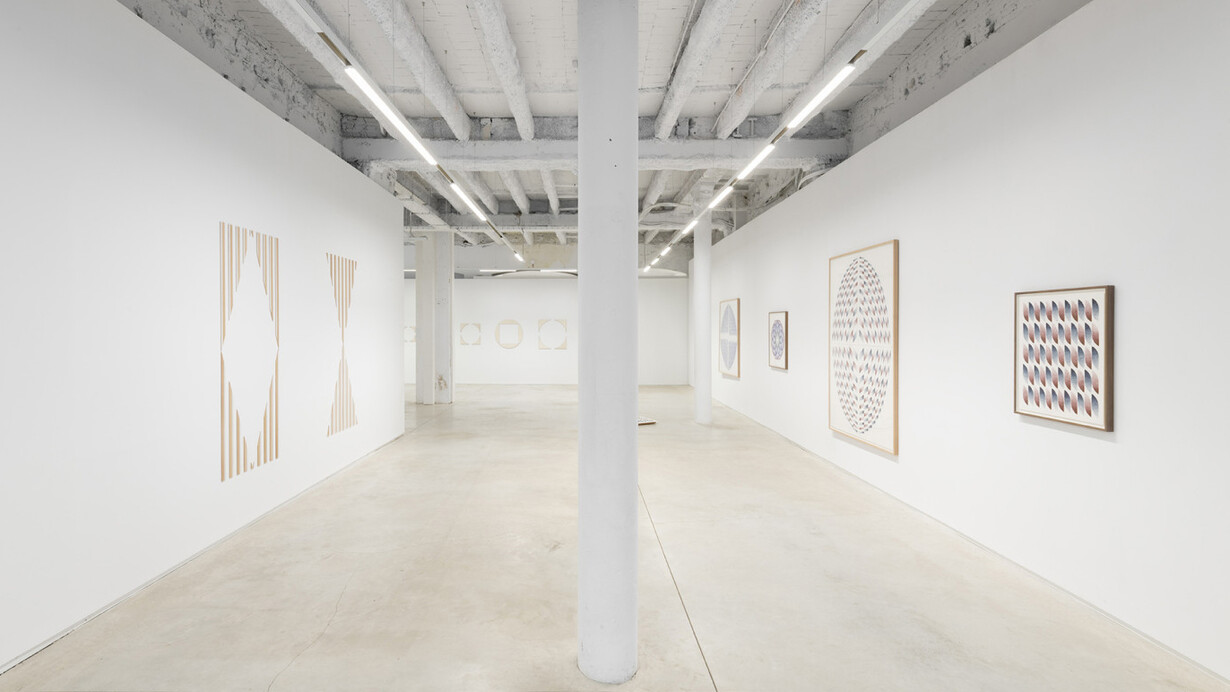
Prats Nogueras Blanchard is very pleased to announce Sequential systems, a new exhibition by Ignacio Uriarte (1972, Krefeld, Germany) at the gallery in Barcelona. Uriarte’s artistic practice unfolds as an architecture of resistance against the administration of time. His work is the result of a constant negotiation between the rigidity of bureaucratic structures and the sensitive dimension of the manual gesture. Through methodologies grounded in repetition, sequence, and order, the artist transforms elements of everyday administrative tasks into a precise and recognizable visual language.
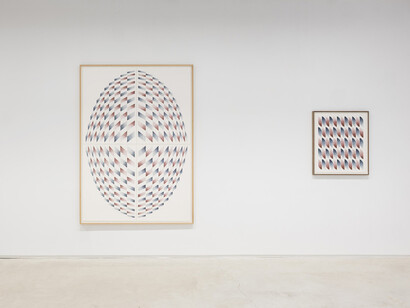
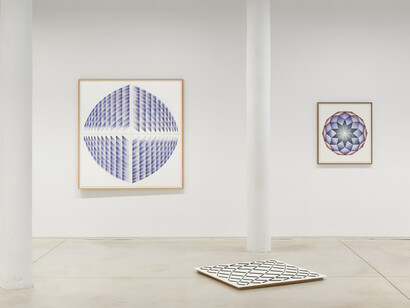
The drawings in this exhibition unfold through sequences: progressive expansions and contractions, angles that generate circular forms, shifts in intensity that produce quiet gradients. Each composition appears to follow a rigorous, almost constructive logic, yet at the same time inviting us to be carried along—to engage our gaze and follow the drawing’s internal rhythm. At times, the forms evoke logos or familiar graphic symbols; however, these references quickly dissolve in favor of greater complexity, marked by flow, repetition, and continuous development.
Drawing forms the structural core of Ignacio Uriarte’s practice, and doodling is one of its persistent foundations. Traditionally dismissed as a marginal or residual gesture, it is here transformed—elevated into method, language, and system. Through repetition and careful, the doodle becomes an instrument of subtle resistance, challenging the paradigms of efficiency and productivity that govern our society. In this exhibition, moreover, the colour palette extends beyond the usual codes of the office environment. Shades of blue prevail, accompanied by greys and maroon tones that gather and recede, lending the works a heightened sense of depth and visual complexity.
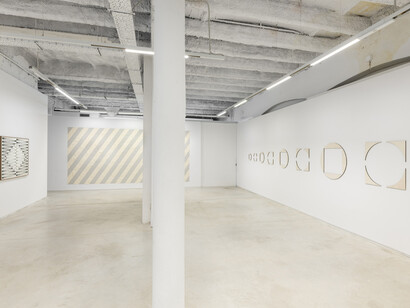
This exploration also extends into three-dimensional space through volumetric works which, although crafted from wood, retain a profoundly drawing-like quality. In pieces such as 100 pencils, geometry arises from the assembly of pencils sharpened at both ends, suggesting a contained tension and a duality in the direction of the line. Meanwhile, Rombos unfolds as a diptych of positive and negative space, composed of graduated rulers that transform the instrument of measurement into an object of formal abstraction. Through processes such as laser cutting, Uriarte further engages with elemental geometries, generating subtle optical effects that reveal the near-mathematical precision underlying his work.
Another central theme in Uriarte’s practice is his typewriter drawings, in which he uses symbols such as the slash (/), the equal sign (=) and the percentage sign (%) to create compositions built through the mechanical repetition of these characters. The works presented in this exhibition evoke both the patterns of Japanese shoji screens and the rhythmic verticality of a bamboo forest. Within them, densities gather and disperse; symbols accumulate, creating vibrant surfaces that shift perception and reinforce the almost physical dimension of the visual experience.
A constellation of dualities runs through the exhibition: warmth and cold, chaos and order, interior and exterior. Beneath the guise of a mechanically applied law, Uriarte’s works operate at the intersection between the everyday and geometric abstraction, triggering a perceptual experience in which repetition and monotony become tools of displacement. An exploration that uses monotony as a tool of subversion, reminding us that, even within the strictest system, there is always room for thought to set itself in motion.
![Aura Roig, The worms are starting to move [Los gusanos están empezando a moverse], vista de exhibición. Corteía de Prats Nogueras Blanchard](/attachments/f071f2e31535aca99858b1ef573d054464d3739a/store/fill/330/330/fe8dac1d242d24bf27f1e5fec7a9b71d3667a1476fdcc1a07fa9410a5e6b/Aura-Roig-The-worms-are-starting-to-move-Los-gusanos-estan-empezando-a-moverse-vista-de.jpg)