English
 Español
 Français
 Deutsch
 Italiano
 Português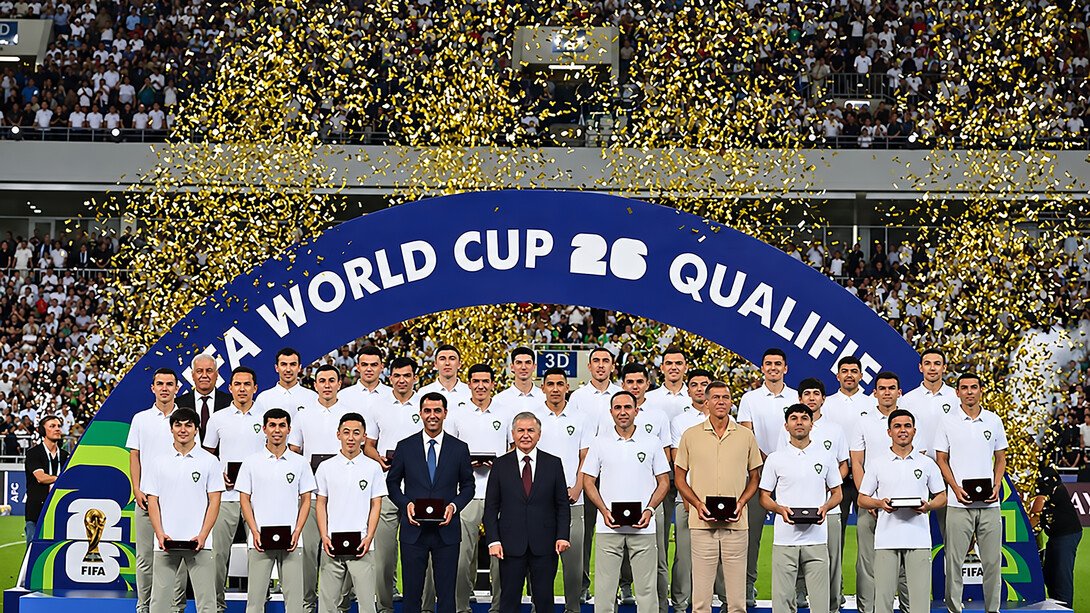
Akbar gets home late on a Thursday evening in June, worn down by the day but carried the last few streets by something loose and electric in the Tashkent air. The city has not changed its skyline or its traffic. The same battered sedans nose through the same intersections; the same fruit sellers call out from the same corners. What has changed is the way strangers glance at one another – quick, searching looks, as if checking that the other person has heard the news too.
Uzbekistan is going to the World Cup!
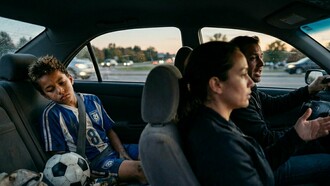
His wife meets him at the door before he has his shoes off. Dinner, she says, will be ready soon. He starts toward his room and stops at his son's half-open door. The boy is stretched across his bed, thumb flicking through a scroll of video clips: boys in a courtyard recreating a striker's goal celebration, a rooftop game of keepy-uppy filmed like a tribute, and someone's little sister dancing to footage of the final whistle.
He watches for a moment, laughs at something on the screen, and tells his son to come through when he's called. Then he walks on down the hallway, and the sound of that easy, unclouded laughter follows him back, for a moment, to another room, an older one, where the adults spoke about football in lowered voices, and where a boy first learned that the word "Pakhtakor" could make a table go quiet.
On 11 August 1979, a Soviet passenger jet carrying the Pakhtakor Tashkent football squad to a league match in Minsk collided in mid-air with another aircraft over the skies near Dniprodzerzhynsk, in what was then Soviet Ukraine. All 178 people aboard both planes were killed. Seventeen of them were players and staff of Pakhtakor.
News reached Tashkent slowly, filtered through official silence and word of mouth, and by the time the state press finally confirmed what had happened, a stunned crowd had already gathered outside the club's stadium, some of them staying through the night. Barely two weeks later, in the strange, unbending logic of Soviet sport, Pakhtakor fielded a scratch team of reserves and borrowed players and lost 3–1 to Yerevan's Ararat, because the season was expected to go on regardless. Streets were renamed for the dead. Schools took their names. For decades, fans in the stadium kept chanting the club's name the way people repeat a word so as not to forget it.
Akbar never lived through any of it. He inherited it instead, the way a country's grief becomes a household's, passed down at tables, in the pauses between sentences. Long before he understood the history, he understood the tone adults used when the subject came up, and by the time he did understand it, he already knew that football in Uzbekistan was never only about ninety minutes. It carried something heavier than that.
Independence came in 1991, and with it a new country looking for places to prove itself. Uzbekistan joined FIFA in 1994 and, that same year, won the men's football gold medal at the Asian Games, an early, genuine triumph that made the World Cup feel, for a while, like a natural next step.
It was not. Campaign after campaign, Uzbekistan reached the final stretch of Asian qualifying and stalled there, sometimes for reasons that had nothing to do with the players on the pitch.
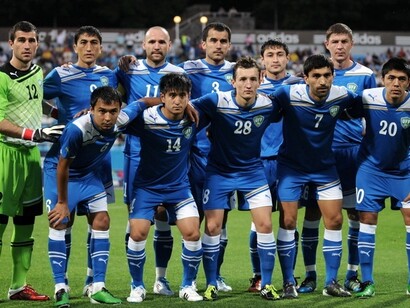
Akbar remembers the autumn of 2005 more vividly than almost anything else from his childhood, because it was the first time he watched a match beside his grandfather as something closer to an equal than a child being indulged. Uzbekistan had beaten Bahrain 1–0 in the first leg of a World Cup play-off in Tashkent and needed only to avoid disaster away from home to reach an intercontinental play-off. Then came a passage of play that still makes little sense two decades on; a legitimate Uzbek penalty was converted, then wrongly disallowed for encroachment, and instead of ordering the kick retaken, as the laws of the game required, the referee awarded Bahrain an indirect free kick. Uzbekistan protested to FIFA, expecting the mistake to be corrected in their favour. FIFA agreed the referee had erred and then, almost unprecedented in the sport's history, ordered not a retaken penalty but the entire match replayed. The replay in Tashkent finished 1–1. The second leg in Bahrain finished goalless. Bahrain advanced on away goals, a technicality that had nothing to do with the ninety seconds that had actually cost Uzbekistan the tie. Among the Uzbek players on the pitch for all three matches, two days short of his twenty-fourth birthday when the saga began, was a midfielder named Timur Kapadze. Nobody in the stadium that autumn had any reason to remember the name….
There is a kind of defeat that does not need shouting. Akbar remembers that his grandfather simply switched off the television and sat quietly for a long while, and the boy understood, without being told, that some losses could not be argued back into fairness.
The years that followed refused to offer a clean story of improvement. In January 2011, Uzbekistan reached the semi-finals of the Asian Cup for the first time, beating Jordan 2–1 in the quarter-final on two quickfire second-half goals from Ulugbek Bakaev, genuine proof that the team belonged among Asia's best. But for Uzbekistan, high points had a habit of curdling into something crueller further down the road.
In September 2013, Jordan and Uzbekistan met again, this time with a World Cup play-off spot at stake, and the return leg in Tashkent produced one of the strangest nights in the team's history. An early Uzbek goal, a Jordanian equaliser just before halftime, ninety scoreless minutes, and then, ten minutes into extra time, the floodlights at Pakhtakor Stadium failed outright, plunging the ground into darkness for eighteen minutes while players stretched under emergency lighting rigged up at the touchline. When the match finally reached penalties, it took twenty kicks to separate the sides. Jordan won it 9–8.
Two years later, another promising Asian Cup run ended in extra time against South Korea.
Then came the campaign for Russia 2018, which many in Uzbekistan still describe as the one that hurt most, because it came down to a single home match against South Korea that the team simply had to win. Days before it, visibly shaken after a defeat to China, Captain Odil Ahmedov told reporters his side had no room left for anything but victory, warning that failure would mean Uzbekistan should "end football in our country." Uzbekistan drew 0–0. South Korea went through instead. This time the wound had a face and a voice attached to it, and Akbar remembers exactly where he was when he heard Ahmedov say it.
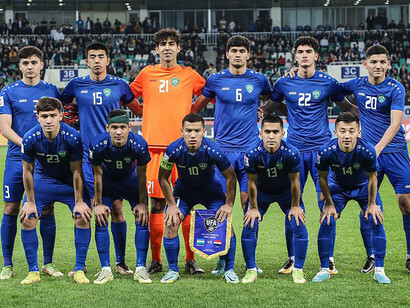
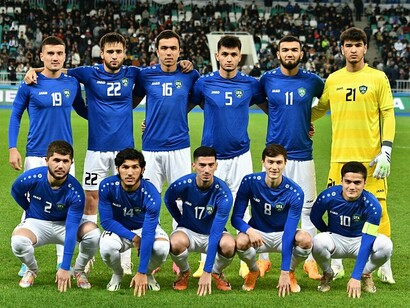
By January 2025, when the Uzbekistan Football Association turned, almost out of better options, to a familiar name to take over the national team on short notice, few people expected the appointment to change very much. The federation had just parted ways with its head coach because of illness, with crucial qualifiers only weeks away, and the man they turned to had spent the years since retiring as a player working quietly as an assistant, then as head coach of the country's under-23 side, which he had guided to its first-ever Olympic qualification. It was, in football terms, a safe choice rather than an inspired one. Few people stopped to remember that this same Timur Kapadze, the boy who had once been two days from his twenty-fourth birthday when Bahrain took his country's dream away on a technicality, had spent almost his entire playing career absorbing exactly this kind of disappointment on Uzbekistan's behalf.
What followed was not always beautiful. Uzbekistan ground out a 1–0 win over Kyrgyzstan in March, then scraped a 2–2 draw away to an already-qualified Iran. And then, on Thursday, 5 June 2025, in Abu Dhabi's Al Nahyan Stadium, they needed only a single point from the United Arab Emirates to secure, at last, a place at a first-ever World Cup.
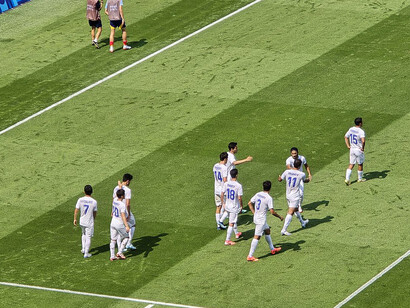
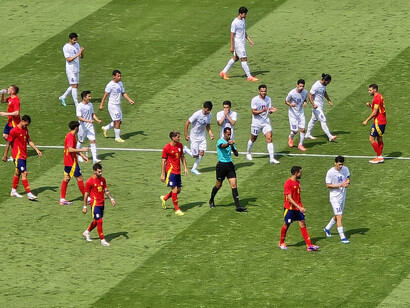
The match itself was not beautiful either. Abbosbek Fayzullaev struck the crossbar with a header in the second half; at the other end, goalkeeper Utkir Yusupov made a string of saves to keep the hosts out. The final whistle blew on a goalless draw, and for a country that had spent thirty-four years and eight qualifying campaigns teaching itself not to trust its own hope, that scoreline was enough. Uzbekistan had qualified, the first Central Asian nation since independence, to reach a men's World Cup.
Afterward, Kapadze spoke to the Uzbek outlet Zamin with the restraint of a man who understood, better than almost anyone else in the squad, what the result had actually cost to reach. He called it the product of "a long and difficult journey" and said it belonged not to him or his players alone, but to the entire country that had waited alongside them.
Four days later, Uzbekistan closed out its qualifying campaign at home to Qatar with nothing left to prove and every reason to enjoy it, winning 3–0 as fireworks lit the sky above Bunyodkor Stadium and the president watched from the stands. Two days after that, he presented the squad and its coaching staff with state honours.
Central Asia has long occupied an odd spot in the global imagination, a stretch of the map people struggle to locate, its countries frequently mistaken for one another, and its stories rarely travelling far beyond its own borders. A World Cup place does not undo that on its own. But for a few weeks that June, people who had never had reason to look toward Tashkent had one: a flag, a set of names, and a score to check. That is a small thing by the standards of geopolitics and a considerable one by the standards of a country that has spent decades trying to be seen.
Back in the present, Akbar can still hear his son narrating something from his phone in the next room, half to himself and half to nobody. He thinks about the distance between that easy, unclouded joy and everything that had to happen before it was possible: the plane over Dniprodzerzhynsk, the disallowed penalty in Tashkent, the floodlights failing at Pakhtakor Stadium, and a captain's warning that went unanswered. His son knows almost none of it, not really, and Akbar finds that he is glad. The boy was born into the ending of a story that began decades before him. He gets to keep the celebration without carrying the years that paid for it.
"Dadasi!" his wife calls from the kitchen. "Dinner is ready."
He starts down the hallway, past his son still talking about a summer that hasn't arrived yet, about matches he hasn't seen and players he is already certain he will remember. For forty-six years, Uzbek football had been waiting for a night like this one. Tonight, at least, the dinner can wait a little longer.