English
 Español
 Français
 Deutsch
 Italiano
 Português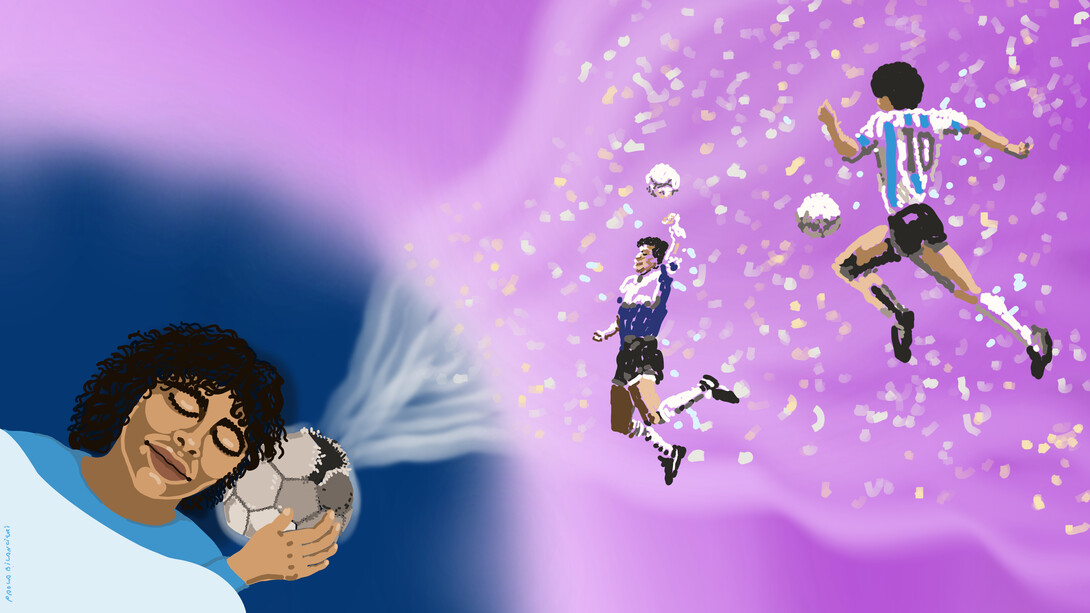
For years, medical appointments and work obligations sent me on hundreds of New York City taxi rides. In a city where most cabdrivers trace their roots to football‑loving nations, one detail about my background reliably sparks delight. The moment they learn I am from Argentina, many break into a grin and exclaim, “Maradona!”—a spontaneous homage to a player whose name still carries the force of revelation.
Few athletes have delivered joy on the scale Diego Armando Maradona once did. I owe him a debt myself. Years ago, while leaving Bangladesh—a country where football devotion runs deep—a customs officer berated me for lacking a required form. His anger rose, and so did my fear of spending the night in a Dhaka jail. Then he asked where I was from. “Argentina,” I whispered. His expression softened instantly. “Maradona’s country,” he said, waving me through.
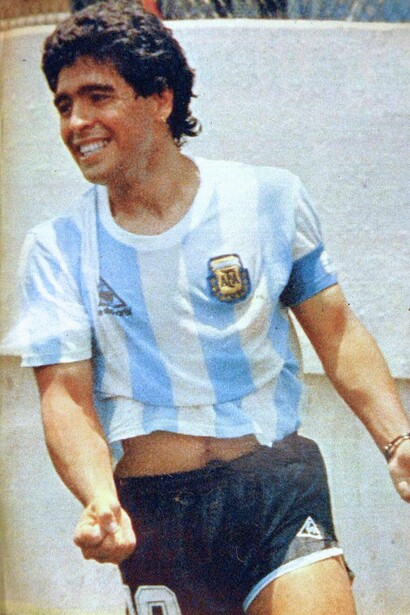
Maradona’s story began far from the global spotlight. Born in 1960 in Lanús, outside Buenos Aires, and raised in a shantytown, he joined Los Cebollitas at age 8 and helped the youth team compile an astonishing 141‑match unbeaten streak. He later starred for Argentinos Juniors and then Boca Juniors, where he delivered a league title.
His precocity was such that the Uruguayan writer Eduardo Galeano once observed, “By night he slept with his arms around a ball and by day he performed miracles with it.” And Francisco Cornejo, the youth coach who is credited with discovering Maradona, said, “When Diego came to Argentinos Juniors for trials, I was really struck by his talent and couldn’t believe he was only eight years old. In fact, we asked him for his ID card so we could check it, but he told us he didn’t have it on him. We were sure he was having us on because, although he had the physique of a child, he played like an adult. When we discovered he’d been telling us the truth, we decided to devote ourselves purely to him.”
Europe soon came calling. Barcelona paid a world‑record fee for him, and he rewarded the club with two trophies —both won against Real Madrid. But it was in Naples, to where he was transferred by a world record fee of $10.48 million, with a struggling Napoli team, that Maradona reshaped a city’s identity. Under his leadership, Napoli won its first Serie A title in 1986‑87, followed by the Coppa Italia. More silverware followed: another league championship in 1989‑90 and the Italian Super Cup. A Vietnamese fan once described him as “a one‑man orchestra,” adding that Maradona “could play with a team of corpses and still make them champions.”
His time in Naples, however, also revealed the darker contours of his life. Addiction, tabloid scandals and alleged ties to the Camorra crime syndicate eroded his standing. He left the city in 1992 under a cloud of controversy. His time playing for Napoli, however, was unforgettable. On December 4, 2020, nine days after Maradona’s death, Napoli’s home stadium was renamed Stadio Diego Armando Maradona.
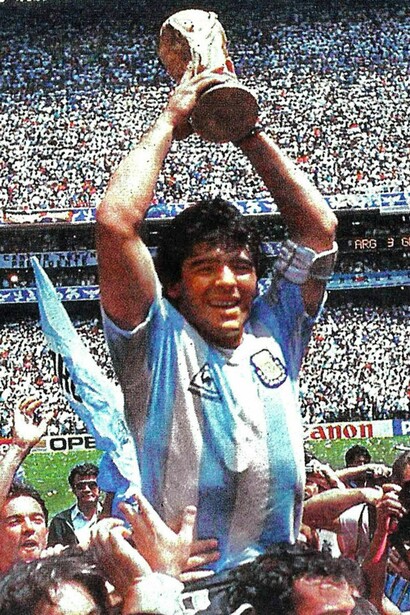
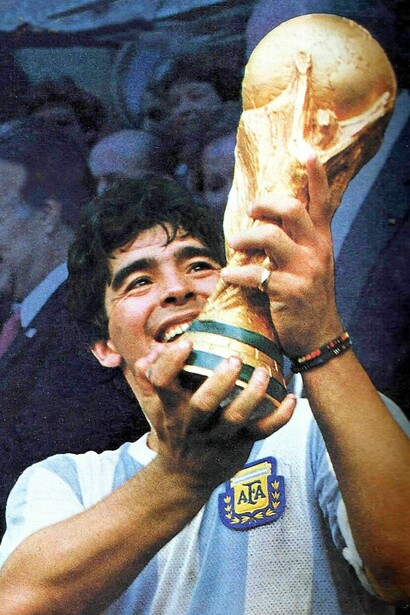
Nothing, though, defined Maradona more than the 1986 World Cup in Mexico, where he delivered two of the most famous goals in the sport’s history—within four minutes of each other. The first, scored with his hand pressed to his head, became known as the “Hand of God.” The second was pure genius: an 11‑touch sprint past five English players, capped with a feint that left goalkeeper Peter Shilton helpless. FIFA later named it the “Goal of the Century,” and a statue of the moment now stands outside Estadio Azteca. The French sports daily L’Équipe summarized him as “half angel, half devil.”
As teammates rushed to embrace him after that second goal, one held back. Jorge Valdano later explained, “When I saw that goal, I realized I would never again witness something so magnificent, and I wanted to savor every moment of it.” England striker Gary Lineker admitted, “When Diego scored the second goal against us, I felt like applauding. It was impossible to score such a beautiful goal. He’s the greatest player of all time, by a long way.” In 2022, Maradona’s jersey was sold for $9.28 million, the highest for a piece of sports memorabilia.
For Argentines, the 1986 victory over England carried an emotional weight that far exceeded the match itself. It came four years after Argentina’s defeat in the Falklands/Malvinas War. Maradona later acknowledged, “Against England, it wasn’t just another match…We knew a lot of kids had died there. We couldn’t say it loud, but we felt it.” Of the Hand of God goal, he added, “It was like stealing from a thief.” For many Argentinians, defeating England offered no revenge, but a profound sense of restored pride.
Maradona’s upbringing in a shantytown shaped his man‑of‑the‑people persona. He displayed that bluntness during a 1987 meeting with Pope John Paul II at the Vatican. After seeing the ornate ceilings, he bristled at the Church’s stated concern for poor children. “Sell your ceiling then, amigo,” he said. “Do something.” Lionel Messi, often cast as Maradona’s heir, once said, “Even if I played a million years, I’d never come close to Maradona. Not that I’d want to, anyway. He is the greatest there’s ever been.” After Maradona’s death on Nov. 25, 2020, Pelé wrote, “I have lost a great friend and the world has lost a legend. One day, I hope we can play together in heaven.”
The debate over football’s greatest player inevitably includes Maradona, Pelé, Cristiano Ronaldo and Messi. It is an impossible task; they played in different eras and under different rules. Each offered a distinct interpretation of excellence: Pelé’s elegance, Ronaldo’s athleticism, Messi’s cerebral artistry, and Ronaldinho's playfulness. But Maradona contributed something harder to quantify and impossible to imitate. He brought magic.