English
 Español
 Français
 Deutsch
 Italiano
 Português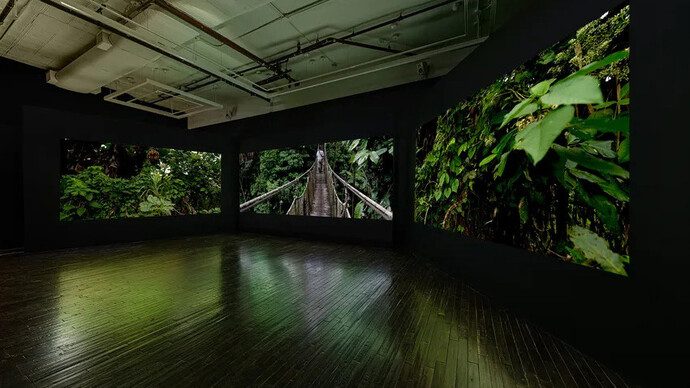
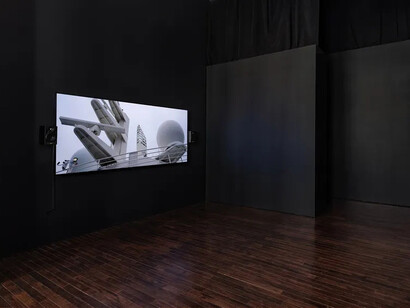
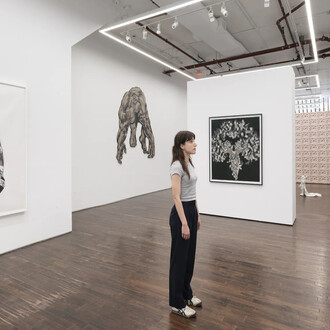
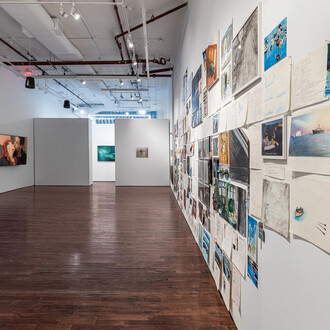
Cristin Tierney Gallery is pleased to present Path of totality, a solo exhibition of new and recent video installations by Janet Biggs. This is the artist's third solo show with the gallery. The exhibition opens Wednesday, September 9th and will be on view through Saturday, October 24th.
For decades, Biggs has traveled to extreme environments, using the journey as a framework to explore how physical landscapes mirror the psychological and emotional terrain of human life. Path of totality extends this inquiry by bringing together two video installations set in vastly different environments: Eclipse (Antarctica, December 4, 2021), 2022–24, and Eclipse (Amazon, September 7, 1858), 2025. Through the juxtaposition of contemporary footage with historical writings, navigational accounts, and inherited memory, Biggs collapses geographical and temporal distance. The solar eclipse becomes both an astronomical event and a metaphor for human psychology: a moment when light is blocked, orientation is disrupted, and familiar conditions are temporarily transformed.
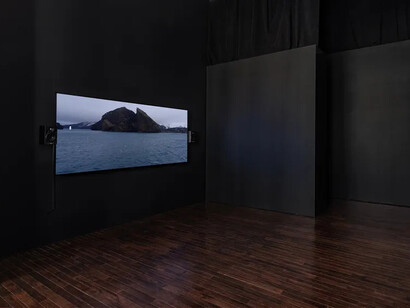
In Eclipse (Antarctica, December 4, 2021), 2022-24, Biggs travels to the Chilean coast of Antarctica to witness a rare total solar eclipse. Dense fog obscures the event, subverting the purpose of the voyage and shifting the work away from spectacle toward unpredictability. In place of direct observation, she interweaves footage from the expedition with navigational histories, psychological studies of extreme isolation, and poetic texts, including Yakut accounts from Eastern Siberia and the writings of nineteenth-century astronomer Lt. James Melville Gilliss. What emerges is less a record of an eclipse than an inquiry into what it means to locate oneself when visibility fails.
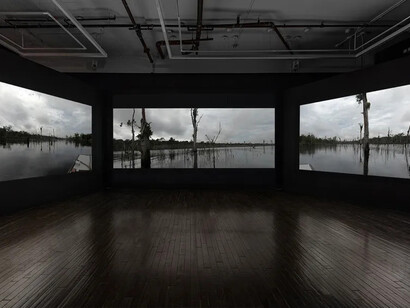
Biggs expands her engagement with Gilliss in eclipse (Amazon, September 7, 1858), 2025, tracing his 1858 expedition through the rainforest of the Amazon. Echoing the disorientation that shapes Eclipse (Antarctica, December 4, 2021), the work brings the uncertainties of the rainforest into dialogue with the artist's mother's experience of sundowner’s syndrome, connecting the cosmic reversal of an eclipse to more intimate forms of disorientation. Personal narrative, environmental precarity, and colonial records converge in a meditation on how memory is shaped by what can and cannot be seen.
Across both installations, Biggs treats the eclipse not simply as a celestial phenomenon, but as a condition of altered perception—a threshold between science and mythology, observation and imagination, the personal and the planetary. As darkness interrupts the expected order of things and the body loses its bearings, the works ask not only what disappears, but also what becomes newly perceptible in moments of obscurity. Moving through remote landscapes while remaining deeply intimate, Path of totality suggests that the search for orientation is also a search for relation: to the histories that shape us, and to the instabilities that we increasingly share with the natural world.