English
 Español
 Français
 Deutsch
 Italiano
 Português
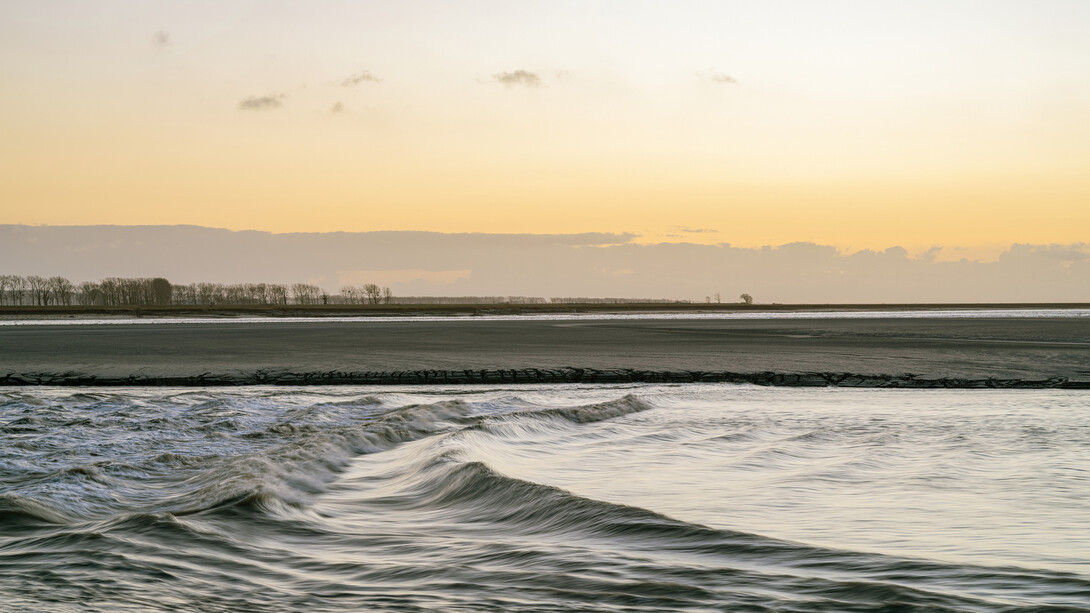
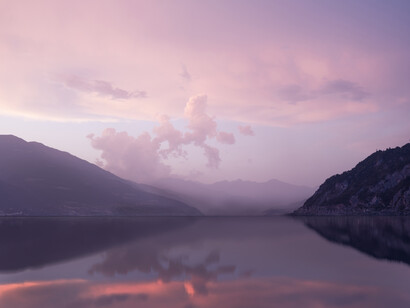
Bruce Silverstein Gallery is pleased to present Elger Esser: Where the sea thinks of land, the gallery’s second solo exhibition of work by the German photographer Elger Esser (b. 1967) and the first in its new space. Bringing together thirteen photographs made between 2012 and 2025, this exhibition follows Esser along the waterways and coastlines that have occupied his thoughts for three decades. Where his work has often been celebrated for the pastoral glow of the French countryside, this selection is more spare and meditative, reduced to sky, water and the last trace of land, recalling the contemplative calm of Abstract Expressionism and Color Field painting. The show takes on a particular relevance in New York, a city, in Esser’s words, “born of water” where the sea has never been a distant view but a source of migration and wealth. Esser’s photographs answer that restless history with a slower measure of time.
The exhibition’s title offers a key to Esser’s art, which is built on a dialectic of seeming contradictions: present and memory, stillness and motion and, above all, land and water; each intrinsic to the other. Coasts, he writes, “are not mere edges. They are places of thought. The sea thinks of land because there it encounters its limit; the land thinks of the sea because there it recognizes its own impermanence.” Between these contradictions lies a moment of reflection, in both senses of the word. The moment is ephemeral; gone as soon as the tide turns or the light shifts. In his most reduced pictures, a band of distant shore thins as it recedes and finally disappears into the haze, so that the eye searches for that boundary and never quite finds it. Turner arrived at something similar in his late seascapes, and Esser’s photographs belong to that lineage of powerful yet serene landscape. Without the landmarks that would tie them to a map, these views cease to describe a particular coast and become what Esser, in his text for the exhibition, calls “places where the world holds its breath for a moment — before the tide returns.”
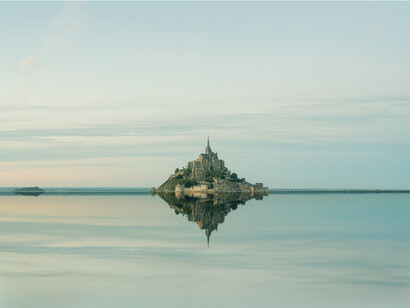
In Esser’s own account, “the sea is never merely the sea. It is memory, surface, mirror, archive.” Mont-Saint-Michel inspires such poetry: the sea dictates passage to the storied French island, to which Esser has often returned, including for residencies in the abbey in 2022 and 2023. It is the subject of five of the thirteen works in the exhibition, including Mont Saint Michel X (2025), a photograph more than seven feet wide. Here, the abbey rests on pale green water beneath a pearl sky, mirrored so exactly that the rock seems to belong to neither element. In his statement, Esser expresses his admiration of Courbet’s waves, Turner’s storms and Johann Wilhelm Schirmer’s cliffs at Étretat, only to leave their violence behind and settle into a lasting calm.
Just as his explorations embrace contradiction, this selection includes Beaugency III (2014), in which the pale gold, celadon and ocher tones that marked his early career suffuse an arched bridge on the Loire, doubled in its own reflection. Its long upper edge takes over the role of the horizon, while the far bank shows through its arches. Face-mounted in Diasec, a method of glazing that fuses the print to acrylic and was embraced by the Düsseldorf School for making prints at monumental scale, the large photographs feel grounded and seem lit from within, radiating stillness.
Alongside these serene and still Diasecs are photographs printed on copper and silver plates. The plates are less settled as the light reflects off the metal surface and back through the image, giving the surface a shimmering effect that makes the otherwise still water dance. This push-pull tension runs through the exhibition, as works that hold the viewer still answer to works that keep the viewer moving.
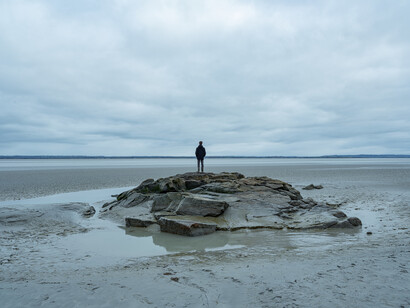
A single, solitary figure exists in the exhibition. This rare presence in Esser’s work, distinguishes Mont Saint Michel - Young man by the sea (2023), while emphasizing his enduring concerns with time and impermanence. The scene recalls the spiritual longing and existential uncertainty of German Romantic landscape painting, particularly Fried rich’s solitary figures confronting the immensity of the natural world, giving form to the encounter between the self and the infinite. The young man, cut by the horizon yet held fast by the rock beneath him, stands on what Esser calls the “uncertain margin” where humankind has lived for millennia, “waiting, fearing, finding,” on ground the sea has only lent.