English
 Español
 Français
 Deutsch
 Italiano
 Português
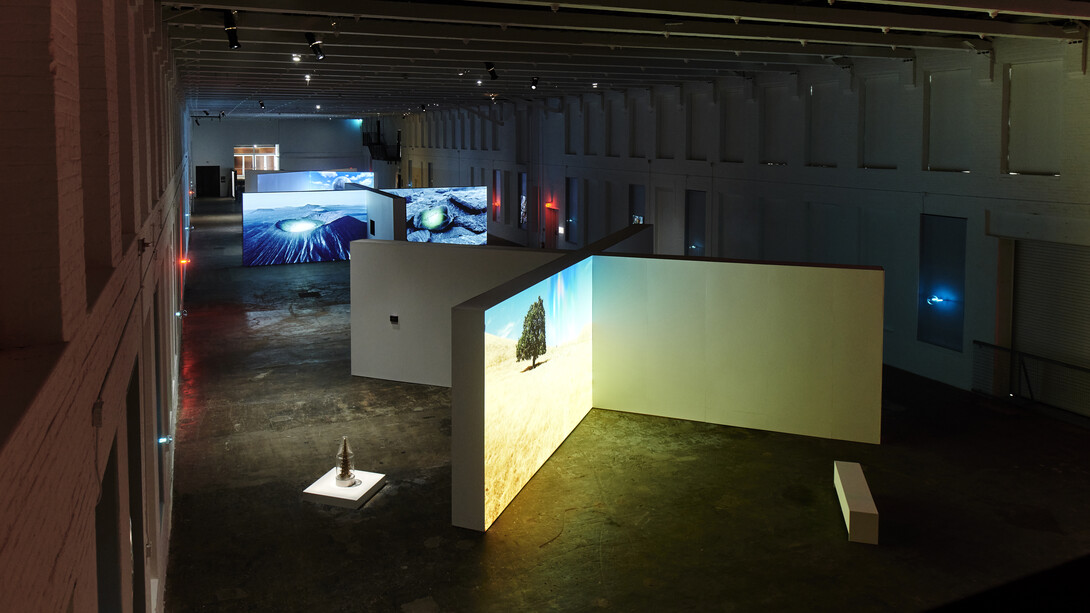
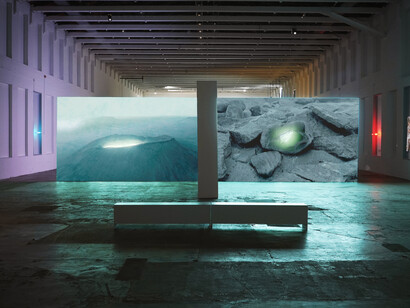
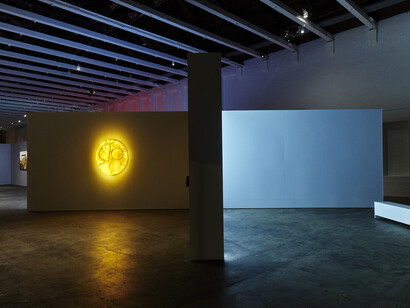
Metaphysical maze is the largest exhibition to date in the United States devoted to French conceptual artist Laurent Grasso. Installed in the museum’s iconic Building 5, Metaphysical maze takes the form of an immersive installation bringing together, for the first time, the artist’s most emblematic films, along with Cosmic Drive (2026), produced during his research residency at the SETI Institute in Mountain View, California.
Conceived as a journey, the exhibition immerses visitors in a contemplative state that expands the perception of time. The installation extends beyond the realm of film to include new works — paintings, sculptures, and architectural interventions — forming a whole. In Grasso’s universe, all lines are blurred: artworks are presented without specific titles, dates, or identifying labels. Within the exhibition time appears suspended, unfolding a carefully orchestrated environment. “Entering my exhibition,” says the artist, “is like walking into a forest — an imaginary landscape where you wander without trying to identify every species of tree.”
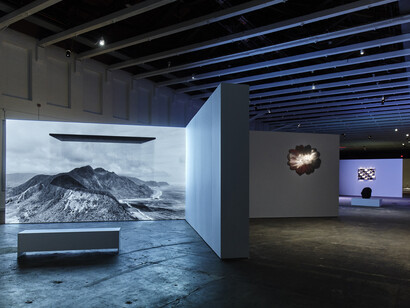
Using three X-shaped structures specially designed to span the length of the former industrial space, Grasso turns the gallery into an immersive machine of vision. Each section holds videos and artworks all of which upend traditional depictions of time. These structures also draw inspiration from Sol LeWitt’s geometric works which are on view in his A wall drawing retrospective installed in MASS MoCA’s adjacent gallery and establish a dialogue between the two exhibitions. Each architectural element is positioned at a 45-degree angle to the next, creating shifting sightlines that encourage visitors to move around and between the structures. As visitors navigate the space, their changing perspectives create a sense of continuous movement, reinforcing the impression of being inside a living mechanism, evoking time travel, a theme Grasso has explored throughout his career.
The focal point of Grasso’s practice are his films. Metaphysical maze unites five works which look at shifting perceptions, invisible forces, and the resonance of landscape: OttO (2018), Anima (2022), Orchid island (2023), Geophonia (2024), and Cosmic drive (2026).
The most recent of these, Cosmic drive, was shot on location at and around the SETI Institute, a non-profit research organization that studies the emergence of life in extreme environments and beyond Earth. It was inspired by the result of Grasso’s residency at SETI and his conversations with astrobiologist and Director of the Carl Sagan Center for Research Nathalie Cabrol’s quest to understand the origins of life in the universe.
Grasso punctuates the exhibition with works across various media that evoke strange phenomena, many of which appear in his films. These include his ongoing series Studies into the past, a deliberately undated series that references historical painting, while introducing singularities that immediately unsettle their interpretation. This merger of past, present, and future is intended to produce a sense of confusion in the viewer when it comes to time, as well as a false historical memory.
New works related to Cosmic drive include Cosmic mirrors (2026), a series of hammered stainless-steel panels installed in the gallery windows with subtle painted interventions that evoke the optical phenomena produced by gravitational lenses. Other works include Future herbarium (2026), a large white-bronze sculpture related to the film Orchid island, which imagines the possible mutations of a post-disaster herbarium and Solar wind (2026), an LED screen version of Grasso’s 2016 permanent light installation in Paris. Throughout MASS MoCA, Grasso has placed a series of neon signs (2024-6) which reference flame and cloud motifs seen in the film Anima. The neons move from the exterior facade of the museum through the galleries leading the way to Metaphysical maze.