English
 Español
 Français
 Deutsch
 Italiano
 Português
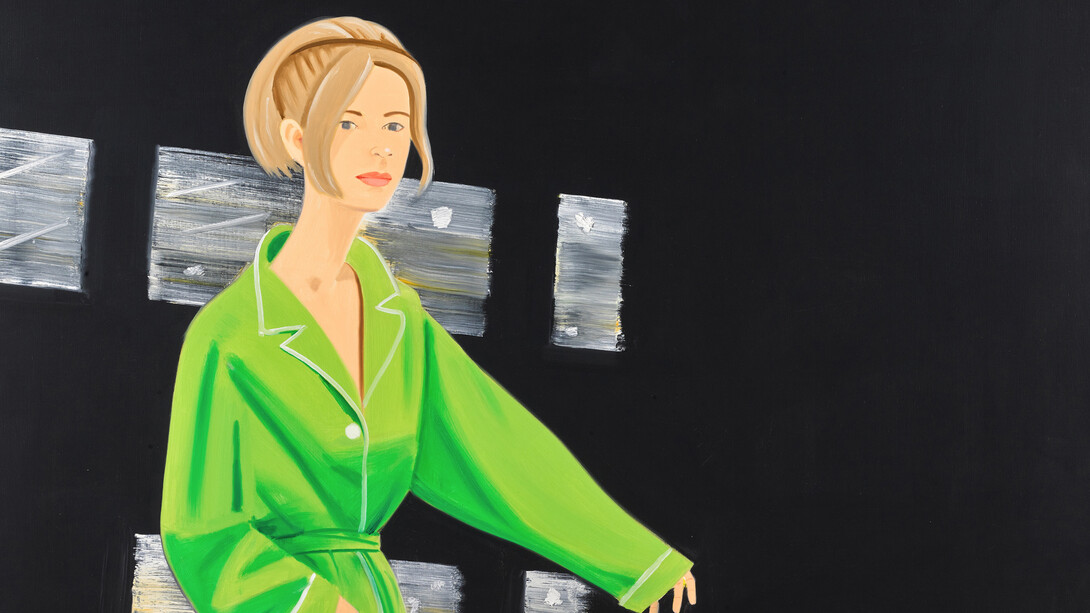
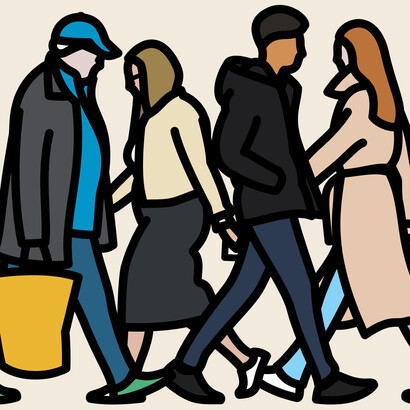
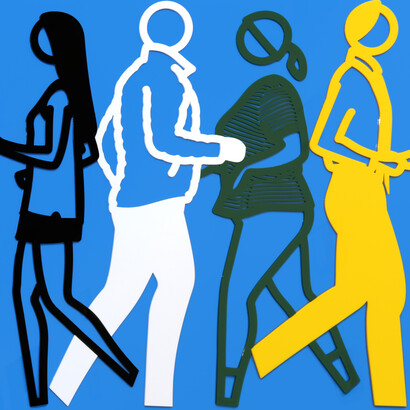
Although their visual languages differ, both artists pare back descriptive detail to focus on the elements that make a figure legible—a face, a gesture, a posture or the outline of a body. Their approaches diverge, however, in what remains: Katz retains the individuality of his subjects, while Opie pushes the figure towards a more universal visual language.
Alex Katz came of age in the New York art world when Abstract Expressionism dominated, yet remained committed to figuration throughout his career. Taking inspiration from film close-ups, fashion, advertising, his paintings are defined by flattened space, crisp contours and an economy of detail. His images appear direct, but their simplicity is carefully constructed: his subjects feel closely observed, while the flattened compositions make clear the artifice of the image. In Nikki II (2006), a tight crop draws the viewer into the sitter’s gaze, while Yvonne in green (1995) isolates the figure against a dark ground, letting color, expression and posture carry the image. In both works, the reduction of detail brings the individuality of his subjects into sharper focus.
In contrast, Julian Opie approaches the figure through a visual language shaped by graphic design, public signage, digital imagery and animation. Associated with the Young British Artists (YBA) movement of the 1990s, he has developed a distinctive vocabulary of simplified lines, blocks of color and repeated forms. His figures are stripped of descriptive detail but remain immediately recognizable. In Angel couple 9 (2026), two bodies are distilled into clean, graphic forms, while The angel 8 (2025) uses repetition and implied movement to suggest the rhythm of a passing figure.
“We’re thrilled to host ‘Face to face’ during this year’s Miami Art Week,” said Dan Benchetrit, Director of Opera Gallery Miami. “Presented side by side, Alex Katz and Julian Opie offer two very different approaches to the figure: Katz through the particularity of the sitter, and Opie through a visual language shaped by simplified, graphic forms. Bringing them together allows us to look closely at how observation and graphic representation can shape our understanding of the human form.”