English
 Español
 Français
 Deutsch
 Italiano
 Português
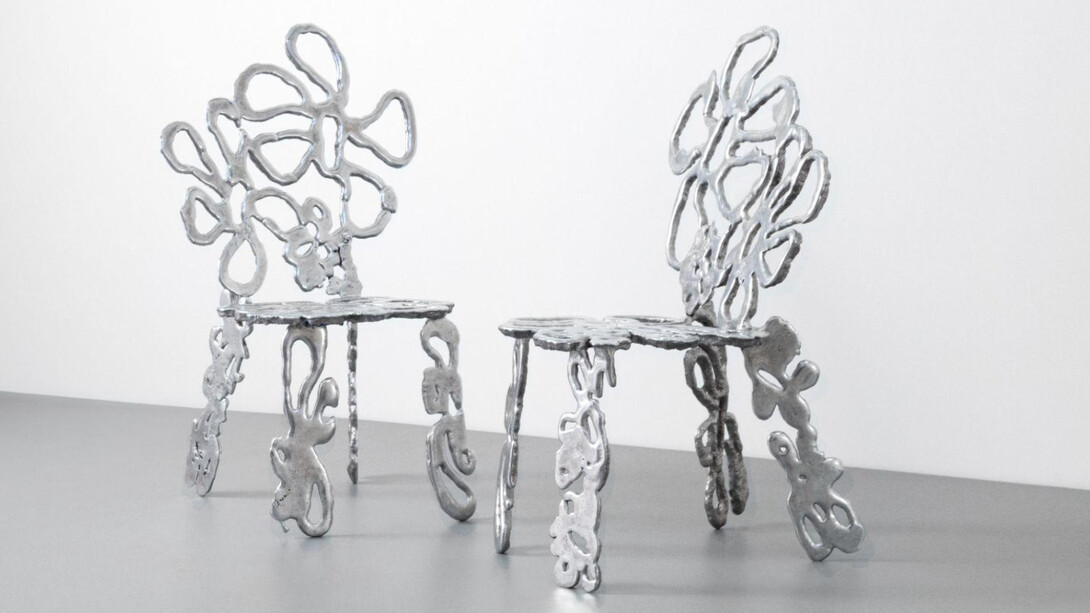
R & Company announces Fly trap, an exhibition of new work by Katie Stout, on view November 19, 2026, through January 23, 2027, at the gallery’s 82 Franklin Street location in Tribeca. Bringing together furniture, lighting, clocks, mirrors, and sculptural objects, the exhibition builds on Stout’s irreverent approach to design, exploring the tension between function, ornament, and form. Through a varied vocabulary of materials and motifs, Fly trap considers the passage of time as both a conceptual framework and a force that shapes how objects are made, experienced, and understood.
Rather than approaching time as a linear or measurable progression, Stout considers its subtler manifestations: the accumulation of age, the cycles of growth and decay, and the shifting relationship between permanence and change. Clocks, mirrors, and lighting evoke its passage through movement, reflection, and illumination, while unruly brushwork and plant-like forms suggest the gradual transformations that occur as things grow, weather, and deteriorate. Together, these elements serve as points of departure, allowing time to emerge as an underlying presence across the exhibition.
“Katie Stout’s infectious personality, style, and wit transmute into three-dimensional objects that celebrate growth and decay in a beautiful and mischievous way,” said Evan Snyder, co-founder of R & Company. “With her fourth solo exhibition at R & Company, we are thrilled to be a part of her journey as she continues to lead her generation of design artists into uncharted waters.”
Living and working in upstate New York has sharpened Stout’s attention to the rhythms of growth and upkeep, particularly to the vegetation that emerges at the edges of cultivated spaces. This sensibility informs compositions that resist fixed or pristine states. Stout does not seek an idealized finish; instead, she continually revisits and reworks her pieces until their forms and material relationships achieve conceptual resolution. Imperfection, in this context, is not an aesthetic shorthand but a means of discovery, allowing unexpected associations to emerge through the process of making.
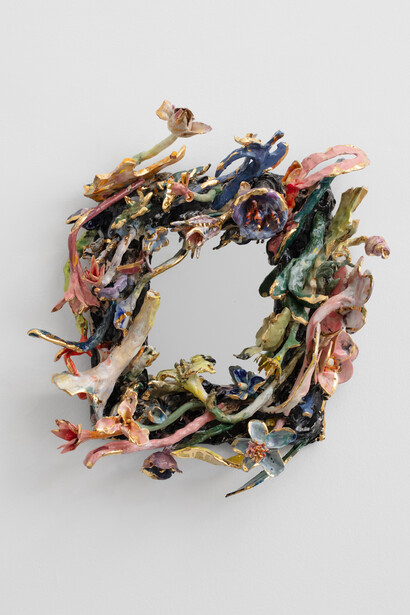
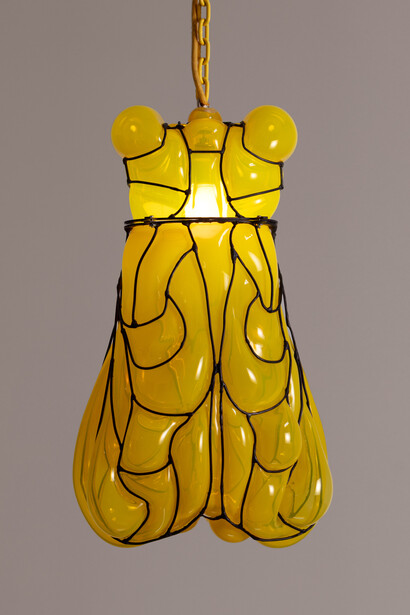
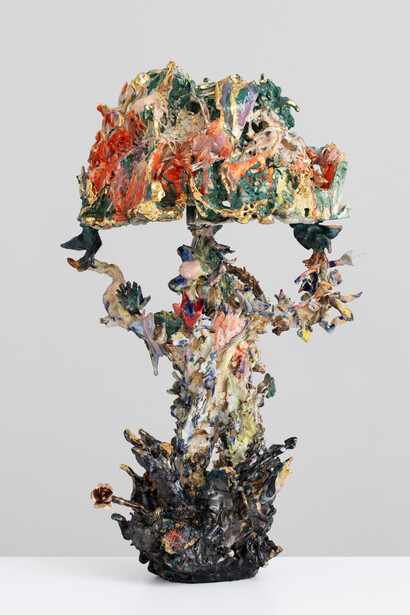
Newer materials, including aluminum and glass, appear alongside the bronze and ceramic that have long informed Stout’s practice. Interlocking, patterned sections of aluminum form recognizable chair and lighting silhouettes, while cutouts and carefully positioned light sources cast shadows that extend the works beyond their physical boundaries. Elsewhere, a jewelry box is enveloped in dense, bramble-like metalwork, its ring of appendages alternately concealing and revealing the object within. Ceramic flowers, a recurring motif in Stout’s work, introduce another layer of reference, connecting these new pieces to her sustained exploration of decorative form and its expressive potential.
With Fly trap, Stout advances the visual language of her earlier work while reconsidering its material and conceptual concerns. The objects suggest contrasting states—growth and stillness, preservation and deterioration, attraction and entanglement—without resolving them into a singular narrative. Resisting definitive readings, they reveal new relationships through sustained observation. What emerges is a meditation on change that is neither nostalgic nor prescriptive, but attentive to the resonance that arises in the tension between permanence and transformation.