English
 Español
 Français
 Deutsch
 Italiano
 Português
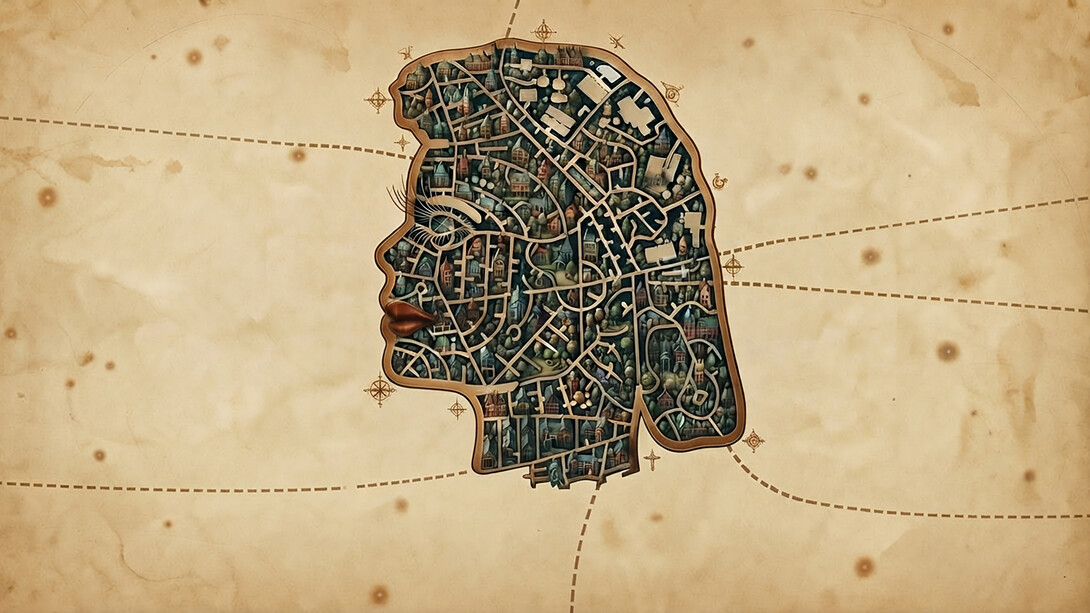
There is a version of the loneliness problem that sounds almost too abstract to matter until you have actually lived inside it, which is the fear that you might not exist, not fully, outside the words other people use to describe you. This is roughly the fear that haunts Lenore Beadsman, the protagonist of David Foster Wallace’s first novel, The Broom of the System, a book Wallace himself once described, only half joking, as a conversation between Wittgenstein and Derrida. Lenore worries, with an intensity that keeps tipping from comic into genuinely distressing, that she has no identity apart from the language others impose on her, that she is less a person than a linguistic construction assembled by everyone around her, and that if the words stopped, she might simply stop with them. It is a strange fear to build a novel around, and yet it turns out to be one of the more precise descriptions available of what it feels like to suspect that language might be a prison rather than a bridge.
Wallace inherited this fear, quite explicitly, from the early Wittgenstein, from the Wittgenstein of the Tractatus Logico-Philosophicus, who wrote, in one of the more quietly devastating sentences in twentieth-century philosophy, that the limits of my language mean the limits of my world. Read generously, this is simply an observation about the boundaries of what can be articulated. Read the way a young, anxious, philosophically trained novelist might read it at three in the morning; it becomes something closer to a trapdoor: if I cannot say something, does it exist for anyone else? Can I exist, myself, beyond what I manage to put into words, or am I confined, permanently, to whatever fraction of my interior life happens to survive translation into language? The early Wittgenstein offers no particularly comforting answer to this, because the Tractatus treats language as fundamentally a private, logical mirror of the world, each person building their own picture from the inside, with no guaranteed bridge to anyone else’s picture at all.
What makes Wallace’s engagement with Wittgenstein so much more than a young writer borrowing a fashionable reference is that he was equally, perhaps more deeply, invested in the later Wittgenstein, the Wittgenstein of the Philosophical Investigations, who effectively demolished his own earlier picture and replaced it with something considerably less isolating. In the Investigations, language stops being a private logical structure I build alone in my head and becomes, instead, something that only exists at all because it is used, shared, practised among people, and embedded in what Wittgenstein calls forms of life. A language that only one person could ever understand, a genuinely private language, is not a difficult achievement in this later picture; it is, strictly speaking, incoherent, because meaning itself is constituted by shared use, by the fact that other people can, in principle, follow the rule I am following.
Wallace called the Investigations, in his interview with Larry McCaffery, the most articulate and beautiful argument against solipsism that he knew, and it is worth sitting with why that mattered so much to him specifically. If language can only exist between people, then the very act of speaking is already, structurally, an attempt to leave the sealed room of one’s own head. You cannot use language at all, even to despair privately about your own isolation, without already having conceded that isolation is not absolute, that some part of you is already reaching, successfully, into a space that belongs to no one alone.
This is the movement that makes the two Wittgensteins, read together, feel less like a contradiction and more like a diagnosis followed by something resembling treatment. The Tractatus names the terror precisely: the possibility that I am sealed inside my own linguistic limits, unreachable and unable to reach. The Investigations does not dissolve that terror so much as relocate it, insisting that whatever we mean by a self was never a private, pre-linguistic thing waiting to be perfectly expressed in the first place; it was already partly constituted by the shared, imperfect, endlessly negotiated language we use to build it. The prison, it turns out, was never entirely private, because the walls themselves were built out of something we hold in common.
This is where the line back to Lacan becomes useful rather than merely decorative. Lacan shows that language divides the subject, that the moment experience enters the symbolic order, it is already split from itself, already speaking through a system that predates it and exceeds its control, so that something is lost in every act of putting a feeling into words. Wittgenstein, in his later work, does not dispute this fracture so much as reframe what it means. Yes, language divides me from my own raw experience, translates it, distorts it, and never quite delivers it whole. But that same language, precisely because it is not mine alone, exists only in the shared space between me and another person, which means the division Lacan describes is simultaneously the only mechanism by which any bridge to another consciousness becomes possible at all. The fracture and the connection turn out to be made of the same material.
Wallace took this tension and did something with it that neither Lacan nor either Wittgenstein was especially interested in doing, which was to turn it into an ethical demand rather than leaving it as a description. If communication is structurally imperfect, if something will always be lost in the translation from private experience into shared words, the available response is not to stop trying, and it is certainly not to retreat into the kind of ironic detachment that so much of Wallace’s own literary generation had perfected, the safe, unfalsifiable posture of never quite meaning what you say so that you can never quite be caught meaning it.
Wallace’s fiction argues, over and over, often through characters who are suffering in ways they cannot adequately articulate even to themselves, that the imperfection of language is not an excuse for giving up on reaching another person. It is the exact condition under which reaching for them becomes necessary, even urgent, precisely because nothing else is available. This is why Wallace could describe the purpose of fiction, in terms that have by now become almost too quoted to feel weighty, as making the reader feel less alone inside. Not less alone because the writer has finally solved the problem of transmitting experience whole. Less alone because the attempt itself, however incomplete, however much gets inevitably lost between one interior life and another, is already a form of company.
Ocean Vuong belongs in this same lineage, working from poetry rather than philosophy but arriving at something very close to the same conclusion. On Earth We’re Briefly Gorgeous is built, after all, on an impossible act of communication, a letter from a son to a mother who cannot read it, and the novel’s entire emotional force depends on the fact that Vuong does not treat this impossibility as a reason to abandon the letter. He writes anyway. The love in that book lives specifically inside the incompleteness of the gesture, inside a communication that both writer and reader know will never fully arrive, and that turns out to be exactly where its intimacy comes from rather than despite it.
Taken together, these four thinkers describe something like a single arc. Lacan shows that language divides the speaking subject from itself, that no word delivers experience whole. Wittgenstein, in the movement from the Tractatus to the Investigations, shows that this same imperfect language exists nowhere except in the uncertain, shared space between people, which means the limitation and the connection are the same fact seen from two directions. Wallace turns this into something closer to an ethics, insisting that the incompleteness of communication is not a reason to stop attempting it but the very condition that makes the attempt matter. And Vuong shows what that attempt looks like when it is followed all the way through, love addressed to someone who may never fully receive it, written anyway, because the writing itself was never really about guaranteed arrival.
Perhaps communication is not the successful transfer of an inner truth but the decision to keep reaching towards another person despite knowing that something will always be lost. For Wallace, as for the later Wittgenstein, language is imperfect precisely because it belongs neither to me nor to you, but to the uncertain space between us.