English
 Español
 Français
 Deutsch
 Italiano
 Português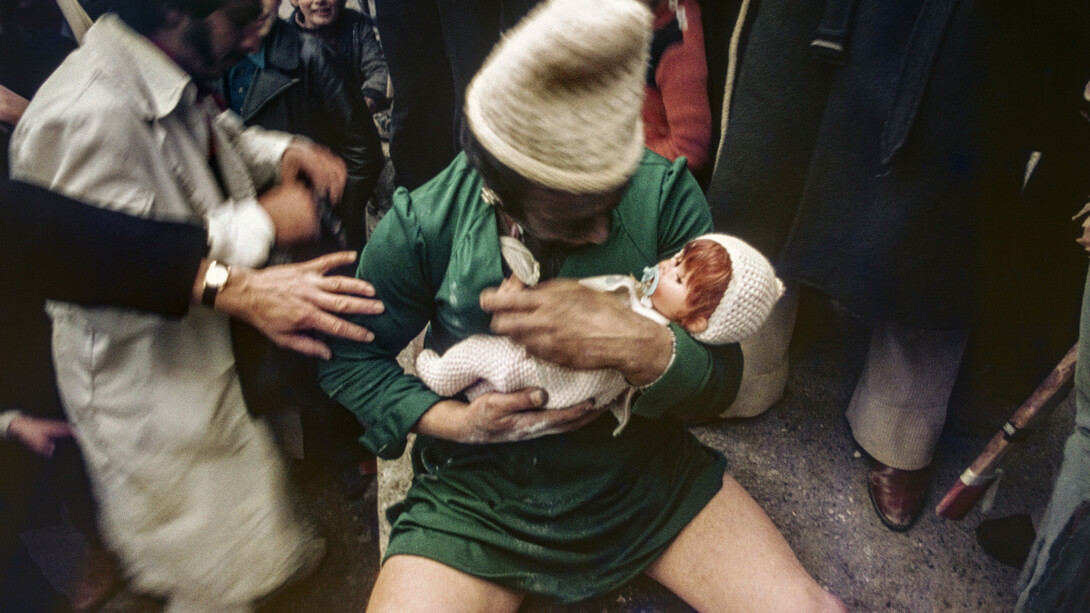
Sguardo rovescio, curated by Cristiana Perrella and Elena Magini, is the first major exhibition dedicated by an Italian museum to Marialba Russo. Born in Giugliano (Naples) in 1947, Russo is among the artists who, from the late 1960s onwards, helped redefine the language of photography in Italy, bringing together artistic practice, visual anthropology and an observation of society.
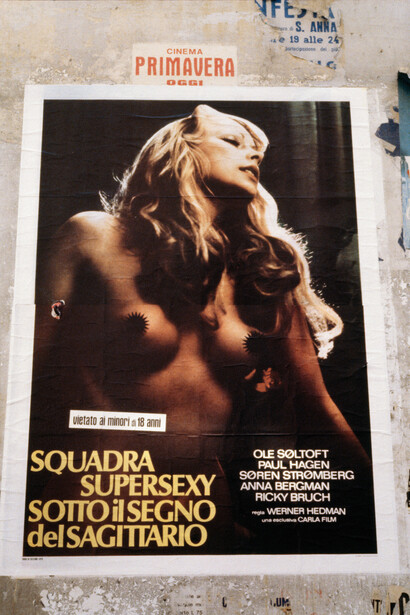
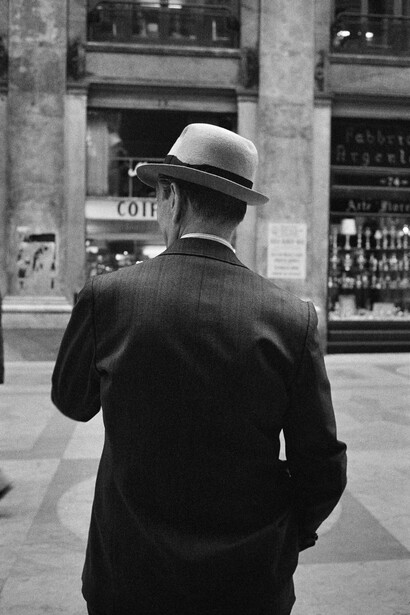
The exhibition brings together seven key bodies of work from her practice: Al ristorante, il 29 settembre 1974 (1974); Travestimento (1975–80); Il passaggio – l’incanata (1979); Il parto (1978); Della serie delle centotrenta figure di spalle (1981); Cult fiction (1978–80); and L’espulsione del male (1974). Together, they reveal the complexity of a practice that anticipated themes now central to contemporary debate, including the body, gender, ritual and the cultural construction of identity.
The title Sguardo rovescio refers to the reversal operated by Marialba Russo in relation to the canonical viewpoint of an Italy that was still deeply patriarchal: “another experience of looking”, in Russo’s own words, which unsettles the conventions of photography at the time, questioning the representation of masculinity from a woman artist’s perspective and offering an alternative, autonomous and original vision of a reality largely narrated through the male gaze.
This reversal naturally engages with the notion of the male gaze developed by feminist film critic Laura Mulvey, generally used to describe the ways in which men have objectified the female body through the camera, simply reversing its direction: here, a female eye scrutinises, isolates and captures masculinity in a single frame as a multifaceted cultural construct, rather than as a natural given.
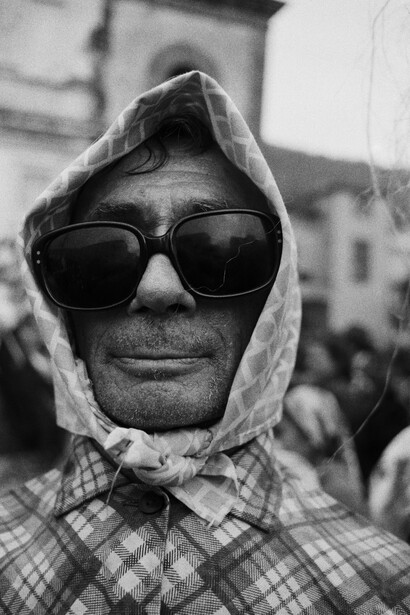
The male figures represented by Marialba Russo challenge the stereotype of virility by portraying men who surrender themselves to the event, relinquishing control or restraint; figures in disguise, subversive figures, or figures stripped of their individualism.
The photographs in the exhibition reveal two distinct approaches to the represented subject. On the one hand, there is a taxonomic and repetitive, descriptive mode that recalls at times the conventions of street photography and at others those of portraiture. On the other, there is a narrative mode that instead constructs a sequence, a visual account capable of capturing eccentric moments of extraordinary vitality.
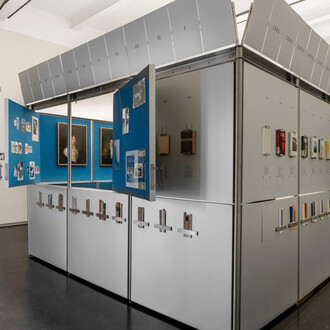
The project at MACRO, which also includes an installation from the artist’s Personal Archive, unfolds in dialogue with a second venue for the exhibition at MUCIV – Museo delle Civiltà.
Titled Immagini della madonna dell’arco (After) and curated by Cristiana Perrella, Elena Magini, Andrea Viliani and Francesca Romana Uccella, the exhibition at MUCIV focuses on the fieldwork Russo carried out in 1971, which led to a collaboration between 1972 and 1977 with the then Museo Nazionale delle Arti e Tradizioni Popolari, as part of research campaigns on Italian popular and subaltern cultures coordinated by anthropologist Annabella Rossi.