English
 Español
 Français
 Deutsch
 Italiano
 Português
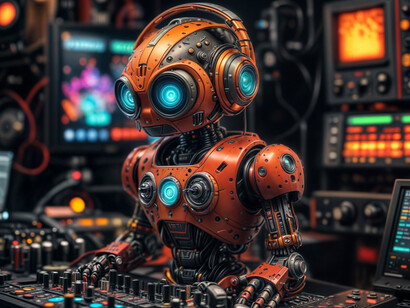
You’ve seen it: the eight-fingered Jesus painting, the recipe for "glue pizza", and the LinkedIn article that drones on like a zombie in a business suit. Welcome to the age of "AI slop". But beneath the tide of digital garbage lurks a far more provocative question—one that philosophers, neuroscientists, and cynical Twitter users are fighting over in real time. Can a machine made of math and cold silicon ever be truly creative? Or is it just the world’s fastest mimic?
The debate is ancient in spirit but urgent in practice. On one side stand the sceptics, who argue that without a heartbeat, a childhood scar, or the ability to suffer, an AI cannot create—it can only calculate. On the other side are the pragmatists and futurists, who say that if the output is novel and beautiful, who cares what’s inside the black box? Both sides have data. Neither side is backing down.
The sceptic's case: no suffering, no sonnet
Let’s start with the gut punch. For many philosophers, true creativity requires consciousness. It requires intention, emotion, and what old-school thinkers called a "soul". A large language model has never been heartbroken. It has never felt the terror of a blank page at 2 a.m. It has no personal identity, no cultural intuition, and no lived meaning. As psychologist Mark Runco puts it bluntly, "I believe intentionality plays an important role in human creativity." Without the desire to create—without the spark of “I want to say something”—what an AI produces is technically impressive but existentially hollow.
This is the heart of the Lovelace Objection, named after computing pioneer Ada Lovelace. The argument goes: an AI can only generate what it has been trained on. It is an elaborate remix machine, not an originator. Even when it surprises us, that surprise is an illusion—a statistical leap, not a creative will. Selmer Bringsjord, a computer science professor at Rensselaer Polytechnic Institute, takes this further.
He helped design the Lovelace Test in 2001, long before ChatGPT was a twinkle in OpenAI’s eye. For an AI to be truly creative, he argued, it would have to produce something its own engineers could not explain. And while today’s neural networks are famously inscrutable, Bringsjord remains unmoved: their outputs are still a "matter of analogy"—clever rearrangements of existing human art, not genuine breakthroughs.
The pro-AI counterpunch: but look at the output
Then again, maybe we’re defining creativity wrong. If creativity is simply about producing something new and high-quality, then AI has already walked through the door. AI-generated art has fooled gallery-goers. AI music has passed blind listening tests. And in at least one major study, human judges could not reliably tell AI art from human-made works—rating them as aesthetically comparable.
Even more striking is the divergent association task (DAT), a test designed by University of Toronto psychologist Jay Olson. It measures creative thinking by asking people to generate wildly different words from a given prompt. When researchers pitted 100,000 humans against leading AI models, the results were seismic. "GPT-4 surpassed human-level creativity when taking the mean performance across a large sample of humans," said Karim Jerbi, director of the UNIQUE Quebec Neuro-AI research center. The AI beat the average human. Only the top 10 per cent of human creatives still outran the machines.
The neuroscience of the spark
But wait—creativity isn’t just a test score. It’s a process that lives in the physical brain. Cognitive neuroscientists like Indre Viskontas, a psychologist at the University of San Francisco, point to a four-stage model first proposed in 1926 by researcher Graham Wallas. Stage one is preparation, driven by the brain’s executive control network. Stage two is incubation, where the mind wanders and the default mode network takes over—the same network that fuels daydreaming. Stage three is the famous "aha!" moment, tied to the parietal cortex. And stage four is verification, when an idea is wrestled into reality.
Here’s the kicker: neuroimaging shows that highly creative people are exceptionally good at switching between these networks. It’s a kind of mental ballet. AI has nothing like this. It does not prepare, wander, gasp at insight, or struggle to verify. It simply computes.
So… true creativity or clever mimicry?
The most honest answer is a frustrating one: it depends on your definition. If you define creativity by the product—by novelty and quality—then yes, AI can be creative, especially as a collaborator. Humans prompt, select, and refine; the machine generates possibilities. That fusion might be the most exciting creative partnership of the century.
But if you define creativity by the process—by lived experience, intention, and the mysterious spark of consciousness—then AI is still a beautiful parrot. It lacks suffering, joy, curiosity, and risk. As Runco warns, "I'm afraid we're not going to make the right decisions" about how to protect human creativity. The rise of AI-generated content threatens the livelihoods of the next generation of artists, forcing them to compete with something that works for free, forever, at the speed of light.
So next time you see an AI painting that moves you, ask yourself: are you moved by the image or by the ghost of the humanity it imitates? The machine has no answer. But you do.