English
 Español
 Français
 Deutsch
 Italiano
 Português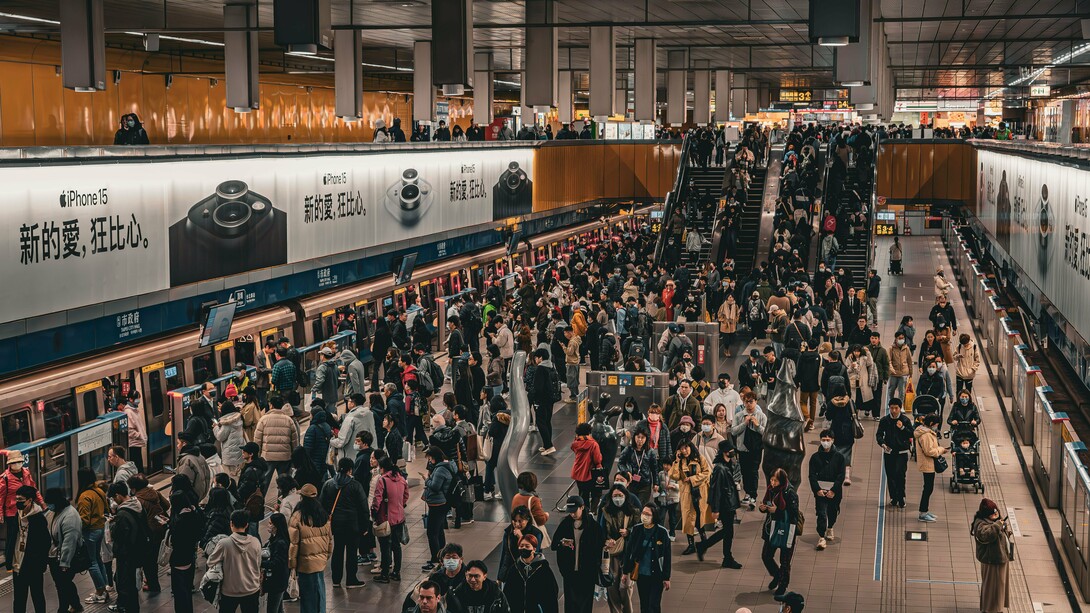
This is about ensuring human rights, human dignity for everyone. This is about fighting inequality.
(Amitabh Behar – Oxfam)
The areas where we could leave the decision process to markets, limiting public policies to correcting critical deformations, are shrinking. Asset management giants, global social media platforms, the expanding weight of health and education services, the control of information, and the appropriation of natural resources and infrastructure all demand updated forms of management for the common good. Rescuing efficient governance has become a key challenge.
The war for social planetary justice is coming.
(Jean Ziegler – L’empire de la honte)
Who is running the show? We certainly do have elected governments, but they are increasingly caught in a greasy web of global interests, and in fact, the elections themselves are deeply influenced by the social media. In the US, with the Citizens United transformations in 2010, the election itself has become a money competition. With big money, big media, and behavioral political marketing, political representativity of the populations’ needs has dominantly become a farce. This is not a pessimistic view but rather down-to-earth.
The global platforms do not function as “markets”, competing to better serve the population, as in the 1776 Adam Smith bakery example. Even having to mention this, because so many still believe that the invisible hand is working, is humiliating. We are in the times of global platform corporations, overall control allowed by the power of algorithms, intangible money, global connectivity, and AI already on a big scale.
Studies like Peter Phillips’ Titans of Capital, detailing the financial power of the 10 major asset management platforms, managing the equivalent of 50% of world GDP, give us a kind of mental reset on how the system works. It is not about “markets”, and it is curious that when we mention markets nowadays, we are not thinking of producers but of Wall Street, big banks, and global platforms.
And they are indeed organized in parallel governing structures. The managers of each have seats in different corporations, which in turn are solidarized through cross-shareholding. And they do have global presential meetings, much beyond the Davos shows of goodwill and ESG. “The website leak has exposed participants in the secretive, Peter Thiel-founded Dialog retreats, which includes top politicians from across the American divide, officials from foreign countries, other titans of the tech industry world and prominent media figures.
The annual Dialog retreats, which have been compared to other quasi-secret elite conferences like the Bilderberg Group1 and Bohemian Grove2 since they began in 2006, have had some participants revealed in previous media reports.” The little we know on these meetings is inspiring; someone is in charge, after all.3 In charge of maximizing profits and political clout, obviously, whatever the social and environmental costs.
But it is interesting to bring our minds back from secret global conspiracies to what we effectively need, which was what we thought our businesses and elected governments were about. The figure below presents the long-term projected transformations on what sectors of our economies will shrink or expand. It covers three centuries, from 1800 to 2100, which may seem exaggerated, but it does help in thinking about structural long-term change. If your kids were born in 2000, they will probably live to around 2080: the long term is about our lives, our families. This is the kind of time horizon we must include in our speculations on the future.4
The key transformation we already face is the rapid shift from material to immaterial sectors. We do have hard data on the expansion of the leisure/culture activities, doubling between the 1980s and 2026, from 13% to 26%. The major structural transformation concerns education and health, which have already expanded strongly, from 8% to 11%, but will probably expand radically with longer lives and knowledge becoming the central transformation force of society. The traditional hardware sectors, like transport, energy, manufacturing, housing-construction, and particularly food production, have already shrunk in the last decades and will have their participation still more reduced with robots and AI in general.
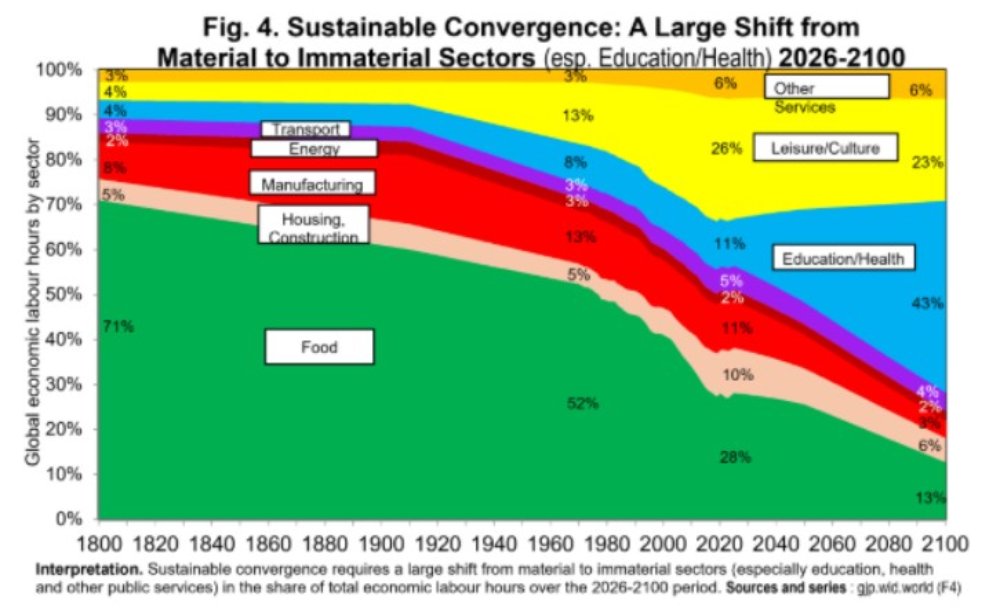
Source: WID – The Global Justice Report.
This overall structural change implies a transition from material to immaterial sectors, and it means that our labor hours share will be transformed. But what is of particular interest here is that the shift is also towards public services, activities that are linked to overall social interest. This means, precisely, a shift from market delivered goods and services to activities that are better served as universal free access public services.
Health services give a particularly strong message: in the US, the cost has reached $13,500 a year per person; it represents 20% of GDP, but the country is in the 40th place in terms of quality of the population health, while the best quality is reached in countries like Canada, where the costs are around $5,000. Health services work best where they are public, free, and with universal access.
It allows for preventive health measures and systemic organization like water quality, ultra-processed food control, and the like. Market mechanisms do not work when the information on what is necessary is radically unequal. It is not about ideological global alignments; it is about looking at how health services are organized and where they work best. The irony is that the high costs of health services in the US raise their GDP and are presented as “growth”.
This also concerns education. The best experiences, like Finland or China, are based on public, free, universal access, considering it represents an investment both in quality of life and in overall productivity of the country. Making access more difficult through privatization tends to deepen inequality, with high-cost private elite schools or universities, instead of spreading scientific and cultural capacity throughout the country, with more generalized higher productivity. We are in the middle of the digital revolution, and knowledge has become the main factor of production. Restricting access to quality education to make more money with the elite is plain stupid. Just compare the results.
Another key issue is about the control of the social media. The giants like Alphabet, Meta, Amazon, and Microsoft, in turn exerting control on DeepMind, Anthropic, OpenAI, and similar expanding AI platforms, represent an oligopoly we cannot escape: we have to use what others use, characterizing a demand monopoly, and are based on invasive private information appropriation. Services that are used by everyone are cheaper and more efficient when organized as free public access infrastructure.
I use the image of the web of streets and avenues in our cities: privatizing them would increase costs for everyone. And the fact that we can use them freely makes it more profitable for private services, shops or markets, being built along them. The invasive advertising, presently called the attention industry, is a cost included in the products we buy and generates costly fragmentation of attention at every step. For kids it has become a nightmare, as presented in Jonathan Haidt’s The Anxious Generation.5
Another key area that has to escape the narrow private-interest strangleholds is knowledge itself. Elinor Ostrom and Charlotte Hess present the issue in Understanding Knowledge as a Commons. Freely communicating new ideas is just more productive: the overall transformation in this new knowledge society, advancing at an accelerated pace, is in great part based on everyone copying everyone else, even as they have to cope with the absurd patent and copyright jungles.
I put all my books free of charge on my website, and they keep selling. Open access is just more productive, since in the digital age ideas may reach (and enrich) everyone on the global web. Free reproduction limited to 70 years after an author’s death is ridiculous. Universities can become overall social knowledge-spreading institutions, much beyond the individual climbing the social ladder through a diploma. Zero Marginal Cost Society is how Jeremy Rifkin called it.
Getting back control over our money is another challenge. Brazil presently has 182 community development banks. Although very small as compared to the traditional private and public banking systems, it does allow for a much more productive money: the community knows best what is needed, and it does not transform money into a money-making commodity. It is a means, not the objective. Thus the overall transformation we need is rescuing the social and economic usefulness of money, presently just information on computers.
Market competition could ensure it in the times of numerous small local banks, but not with the present dominant financial platforms, which is what they have become. Examples abound, from the local public banks in China to the Sparkassen in Germany, Yunus’ Grameen Bank, and present also in Brazil, with the numerous cooperative banks. Instead of presenting their profits, banks should be evaluated by their contribution to social productivity. After all, they are just intermediaries. What are we paying them for?
Money is not gold anymore; it is just information on computers and should be managed in different subsystems according to its use: big national infrastructures demand long-term investment in high volume and are best funded by national development banks, while the diverse small-scale needs in communities should be locally managed. But the basic issue is that financial control has been taken over by speculation giants, draining the money needed for public policies, for productive investment and for family consumption: it has become an overall counterproductive structure. Calling them “markets” is plain wrong; they are a draining oligopoly.
The exploitation of natural resources is another area where private interests collide with what we need. Oil, iron ore, fertile land, forests, and similar resources are a capital belonging to nations. When Vale, one of the major world-scale mining companies, was privatized, the money earned on exports became a drain through dividends instead of providing the State with money to fund social policies and infrastructures. Privatization, in the present commercial structure, means de-nationalization. Trump’s kidnapping of Venezuela’s president and demanding oil is not about markets; it is about the use of brute force for economic advantages. We are not far from colonial times. Free competition? Liberalism?
Infrastructure is another area where private control leads to deep deformations. Streetcars and the corresponding rails were eliminated in São Paulo, decades ago, in order to sell more cars. We presently have only 104 kilometers of underground, compared to around 1,000 km each in Shanghai and Beijing. With a dense underground network, you reach any place rapidly and in comfort. And it is a low-cost option after you cover the investment. This kind of infrastructures, and it also concerns communications, energy and water, work best when they are planned by governments to optimize efficiency.
In São Paulo, where I live, the lack of public transportation leads to more people buying cars, which presently travel at under 20 km per hour. Paralyzing a huge, modern, and rich city by excess of transportation means draws a clear picture of how the sum of private interests simply does not lead to overall advantages. The time lost on transportation is also a huge value; it is the time of our lives, an average of three hours a day. Of course, cursing in your car can be mind-liberating.
I am not lamenting our social and economic stupidity here; listing overall absurdities humanity is able to perform would be tiring. More specifically, I aim to shed light on the systemic changes that are occurring, in that in the age of small-scale activities through innumerous businesses, they did effectively have to compete, bringing better and cheaper products and services to the “markets”, places where you bought and sold comparable items, while with present technologies and the scale of corporate giants, markets simply do not generate equilibrium; they generate economic, social, and environmental dramas. I could also mention the political mess. Did you notice who was with Trump as his inauguration?
What we are facing are giant financial and political power struggles, not “markets”. And in particular, with the deep change in the inter-sector composition of economic activities, we are not speaking of bakeries anymore or small farms, but of the transition to activities where public management is simply more effective. In fact, bakeries should certainly continue as private businesses, but not railways or health services, and much less the present information and communication infrastructure control. We are too complex a society to solve our dramas with ideological simplifications.
China, using an innovative mix of public planning and private companies and radical decentralization of the economic decision process, has become an example. They are not stranded by simplifications; they are managing a process of structural change and adapting.
The best ideology, presently, consists in looking at what works best, where, and in what areas of activity. This is the real innovation. It demands open minds, which apparently is the rare-earth equivalent. Free markets? Come down to earth!
Notes
1 Charlie Skelton. Secretive Bilderberg group just met – but who knows what global elite said?. The Guardian. April 2026.
2 Michael Sainato. Workers sue secretive elite club Bohemian Grove for wage theft. The Guardian. June 2023.
3 Jason Wilson. Key Trump allies and Musk on leaked list for secretive Peter Thiel retreat.The Guardian, June 2026.
4 WID – The Global Justice Report. May 2026.
5 Jonathan Haidt. The Anxious Generation. Penguin Press, 2024.