English
 Español
 Français
 Deutsch
 Italiano
 Português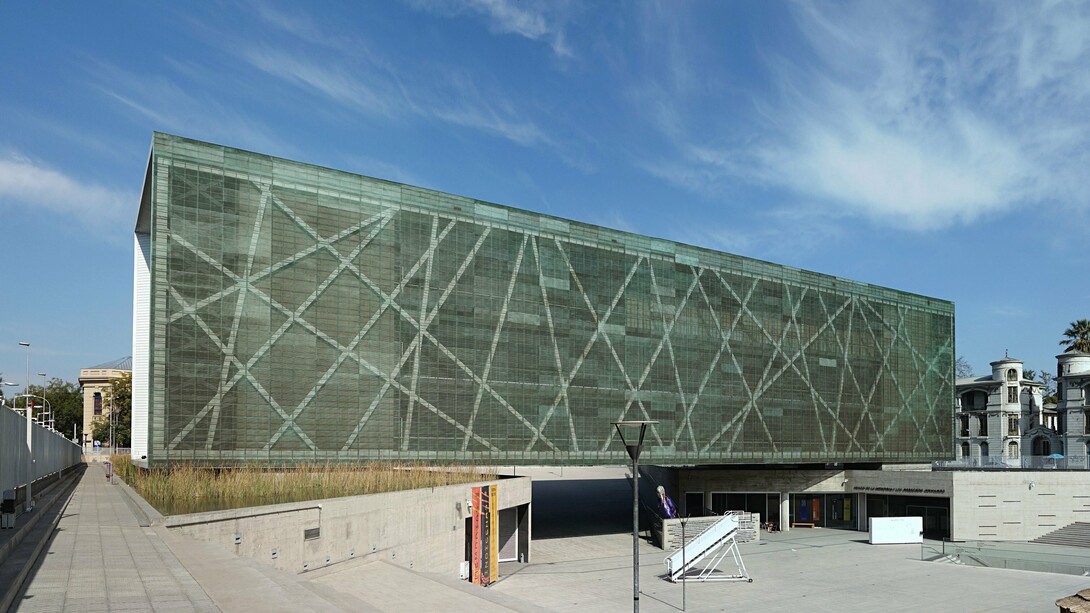
I think we tend to forget that socialism was once real—and that it came to power through elections in Chile. This milestone in Latin American political history took place on September 4, 1970, when Salvador Allende was elected president. Its spectacularly violent ending, with the September 11, 1973 coup d'état led by Augusto Pinochet, tends to make us forget everything that came before.
Chile's last dictatorship was a long one. Pinochet left office in 1990 but remained Commander-in-Chief of the Army, and in 1998 he became a senator for life, a position that granted him the immunity necessary to avoid prosecution. The dictator finally died in 2006 without ever facing justice. But this article is not about him.
Four years after his death, socialist president Michelle Bachelet inaugurated the Museum of Memory and Human Rights. I teach this subject at university, and, having visited sites of memory in Argentina, Uruguay, and Chile, I believe Chile has the most interesting museum of the three.
Located opposite Quinta Normal Park, the museum is architecturally imposing. It was designed by a São Paulo-based team of architects—Mario Figueroa, Lucas Fehr and Carlos Dias. The building is a glass rectangle that cuts across the city block. The Universal Declaration of Human Rights is engraved on the esplanade outside. It is an open museum: glass and concrete give it an austere, solemn quality.
Just a few meters from the entrance, there is a work that immediately sets the tone: an aircraft boarding staircase, the kind used to board planes on the tarmac, bearing the words "asylum—exile." The staircase leads nowhere, symbolizing the leap into the void that leaving one’s country in haste and fear can entail—often with no resources, driven by nothing but the instinct to survive.
Like every site of memory, it offers a chronology of Chile's most recent dictatorship, placing particular emphasis on a meticulous reconstruction of the day of the coup. Its holdings consist of archival material and donations from survivors and ordinary citizens. The permanent collection portrays everyday life under the dictatorship, the experience of exile, childhood, and the international repercussions of the regime's crimes.
This last point is particularly relevant because Pinochet carried out torture and executions in large, open-air public spaces, most famously at the National Stadium. As sociologist Emilio Crenzel has pointed out, the Argentine dictatorship that began in 1976 carried out its campaign of extermination clandestinely, in part to avoid the international condemnation that Pinochet's regime had faced from the outset.
I have visited the museum twice, and two things in particular have stayed with me.
The first is the reconstruction of a torture room, part of the permanent collection. Whether museums should deliberately shock their visitors is a legitimate debate. On the one hand, a space with the objectives of this museum has an obligation to convey the truth. What cannot be seen is difficult to imagine and, consequently, easier to forget. As Georges Didi-Huberman argues, if it was possible for the perpetrator to conceive of something and carry it out, we cannot excuse ourselves by calling it unimaginable.
On the other hand, human empathy can paralyze us in the face of images of horror. It is almost inevitable to move quickly past them or look away, and I am not convinced that education is effective when approached from that perspective. Because the lesson we should draw from dictatorships is not simply to fear the return of torture—which, in fact, never really went away—but to understand where authoritarianism, the absence of dialogue, and the inability to find common ground can lead us.
The other highlight is the museum's collection of arpilleras, which is beautiful.
Arpilleras are a form of textile art in which a scene is designed and constructed out of fabric, usually on a piece of burlap—a cheap and often discarded material. It is an art form produced primarily by working-class women. Although examples predate the dictatorship—Violeta Parra herself made them—the best-known works are those produced by women connected to the disappeared: mothers, wives and other relatives.
The aesthetic is close to folk or naïve art, requiring the kind of skill associated with craft, while at the same time depicting extraordinary brutality. In 2012, the Lo Hermida Arpilleristas collective was declared a Living Human Treasure by UNESCO.
I have no intention of describing the museum in detail. Anyone can find material on its website and through Google that will be far more interesting than a textual transcription could ever be. What I do want to do, first of all, is celebrate its existence and make it known to those who have never heard of it so that they might include it in their travel itineraries if they have the opportunity.
There is something deeply moving about taking an hour or two, walking through the museum without rushing, and listening to Isabel Parra's Ni toda la tierra entera in front of the map of Chilean exiles.
Pinochet remained part of Chilean political life until his death. Today, twenty years later, the current president, José Antonio Kast Rist, is an avowed Pinochet supporter who has echoed the dictatorship's old narrative: that it came to “save” Chile from socialist collapse. He has even said that, if Pinochet were alive, he would vote for him (Bordel, 2015). His government has also imposed a 10 percent cut on culture and the arts. So, is the Museum of Memory safe?
In 2018, Kast paid a public visit to the museum. Although he praised the installation and the documentation behind the project, he also pointed to what he considered its “original problem”:
For this Museum of Memory, Chile begins at nine in the morning on September 11, 1973, and that makes me think that, rather than a museum, I would call it a memorial. It is an impressive memorial, but one that has a problem at its origin.
(Quoted in Jofré Cañipa, 2018)
For as long as I can remember, Chile has been associated with impunity and with an impulse to forget what happened. The fact that political crises continue to erupt cyclically, together with the inability to adopt a new constitution, reflects a deep political polarization. The current constitution is not, strictly speaking, identical to the one adopted under the dictatorship in 1980—it was substantially amended in 2005—but no constituent assembly has successfully replaced it during the democratic period.
Chile is also seen by some as a model, with its consumer possibilities and its close ties to the United States. From this side of the Andes, I can say that I would genuinely rather have free public universities than every last American brand to hit the market. But in this new era of right-wing politics unfolding across parts of Latin America, we need to remain vigilant. Spaces that have been built and fought for—museums, memorials, and institutions dedicated to human rights—cannot simply be allowed to be overwhelmed, even if Kast or Milei do not particularly like what they have to say.
Because museums of memory have an inconvenient habit: they remember. And sometimes that is precisely what a country needs most.
References
Bordel, J. (2025, December 12). «Pinochet votaría por mí»: ¿Quién es José Antonio Kast, el nuevo presidente de Chile? [“Pinochet would vote for me”: Who is José Antonio Kast, Chile’s new president?]. El Grand Continent.
Crenzel, E. (2008). La historia política del Nunca Más: La memoria de las desapariciones en la Argentina [The political history of Nunca Más: The memory of disappearances in Argentina]. Siglo XXI Editores.
Didi-Huberman, G. (2004). Imágenes pese a todo: Memoria visual del Holocausto [Images in spite of everything: Holocaust visual memory]. Paidós.
Jofré Cañipa, C. (2018, August 24). Kast sobre el Museo de la Memoria: “La gente de izquierda no quiere contexto” [Kast on the Museum of Memory: “The left does not want context”]. La Izquierda Diario.
Museo de la Memoria y los Derechos Humanos. (n.d.). Museo de la Memoria y los Derechos Humanos Museum of Memory and Human Rights.
UNESCO. (2012). Arpilleristas de Lo Hermida. UNESCO.