English
 Español
 Français
 Deutsch
 Italiano
 Português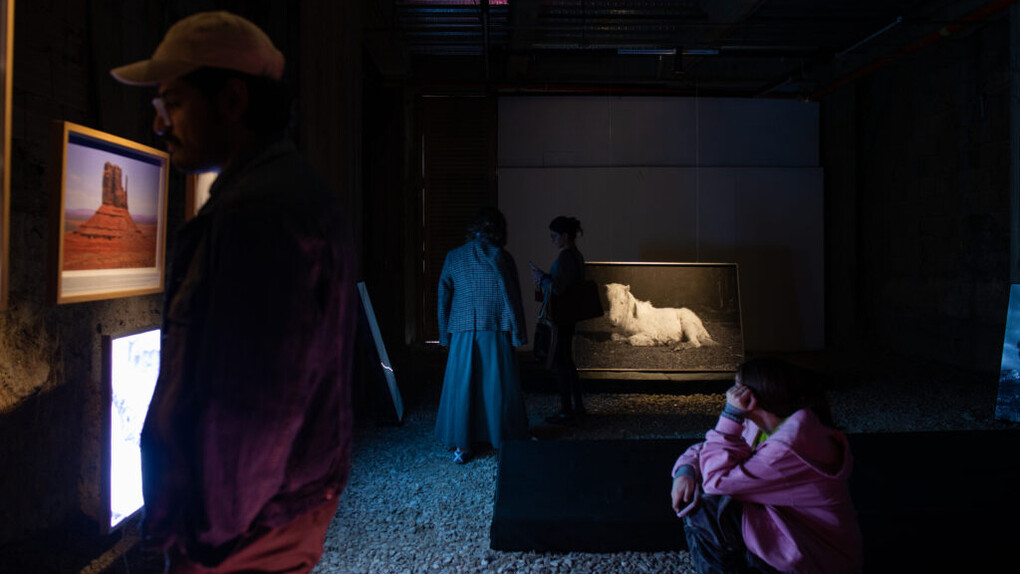
It feels like the end of the world every time you open a window;
every time you hear the pressure cooker reaching boiling point,
given the scarcity of water and the unchecked exploitation of resources.
But also with the imminent noise of violence
—the kind that has stigmatized the Colombian landscape
and shaped us in terms of survival.
However, this sense of impending catastrophe
sometimes arises in the smallest of events:
in the face of loss, a fall, or the abandonment of love.
Everything coexists here on the same plane,
where the world seems to end again and again.(Francisca Jiménez)
The end of the world that Francisca Jiménez explores in this group of works is not a future event; it is a daily feeling that has accompanied her throughout her life. This experience only gained meaning two years ago thanks to a clinical diagnosis of Borderline Personality Disorder (BPD), which allowed her to name this anguish and begin treatment. This condition pushes perception to oscillate between extremes and to experience catastrophe as a permanent, aesthetic, symbolic, and enduring sensation.
Francisca is the daughter of a former soldier and grew up surrounded by military bases in a country where the imminence of war has trained the body for constant vigilance. Her previous works already explored how this context shaped her understanding of the landscape, her family history, and that of the country. This anguish, now expressed on a clinical level, is the mark of a collective trauma: a generational wound.
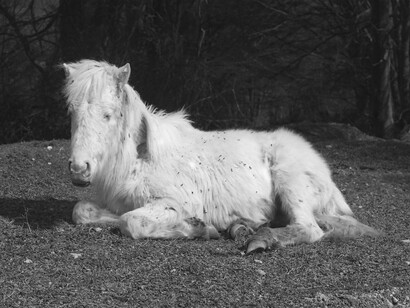
This is how Francisca immerses herself in the landscape as part of her therapy, a confrontation with nature and with geographies where emotional boundaries are challenged by the geographical limits she explores. Therefore, the milestone of this quest began in Tierra del Fuego, the place they call "the end of the world" for being the southernmost inhabited settlement on the planet. There she didn't find a resolution, but rather a direct confrontation with an indifferent and calm landscape. She walked. She planted a gray flag at the last point she reached, parodying the rituals of conquest. She found a white horse facing the precipice, like the counterpoint to the hegemonic image of the horsemen of the apocalypse who foretell the end in Judeo-Christian theology; instead, only a patient animal gazing at the horizon.
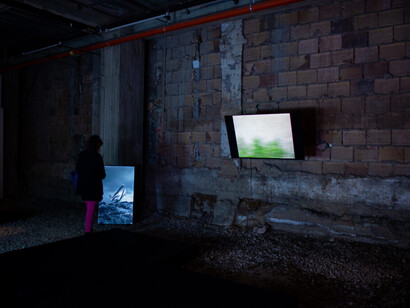
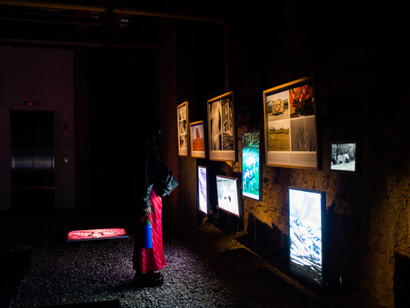
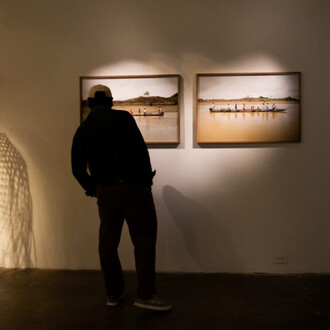
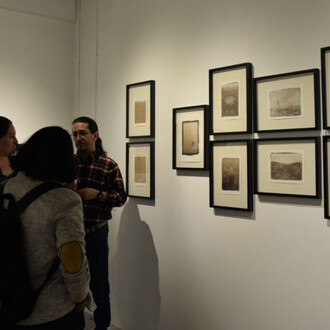
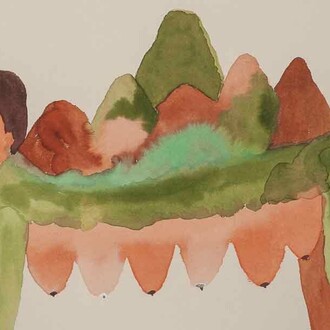
Abismo functions as an archaeology of an imaginary landscape composed of various fragments. The exhibition brings together material recorded in Patagonia, Bogotá, and the Colorado Plateau. A meteorite falling on Bogotá buildings. Images that construct an extraterrestrial landscape. Light boxes that assemble the false historiography of a territory that only exists in the images that name it. It is not the record of a specific place: it is the excavation of a nonexistent cartography surrounded by a tangible affectivity.
What Francisca found upon reaching the edge was a problem of scale: nature is not governed by human urgency. The disaster we perceive as absolute is, for the landscape, barely an instant. This doesn't dissolve the anguish, but it repositions it. Perhaps the end of the world is like the blue of the mountains: something recognizable, but which only exists while viewed from a distance.