English
 Español
 Français
 Deutsch
 Italiano
 Português
The word that forced a different reading
A doctrine does not return to history because the past repeats itself. It returns because an old question finds a new way of becoming unavoidable.
When I read the 2025 National Security Strategy of the United States, as many of us who follow matters of security and defense closely did, my attention was immediately drawn to the reference to the “Trump Corollary” to the Monroe Doctrine. It did not seem to me like a decorative phrase. Nor like a way of dressing a regional policy in solemn historical language. There was something more demanding there: the name appeared within an architecture of priority, means, and execution, precisely at the point where the document began to define what the United States should want, what instruments it could mobilize to achieve it, and what spaces had to be treated as vital to its security, its continuity, and its power. In that reading, the Western Hemisphere ceased to be just another region. It again occupied the place of a strategic condition.
That detail matters because doctrinal words are rarely innocent. When a strategic document speaks of reaffirming and enforcing a doctrine, it is not merely recalling a principle or invoking a memory useful for organizing political discourse. It indicates that the principle must recover ordering capacity, that it must once again separate the admissible from the inadmissible, the tolerable from what can no longer be treated as a simple deterioration of the surrounding environment. A historical memory may be evoked. A doctrine, by contrast, must organize conduct.
The question, then, is not whether Monroe has returned. That question is too small. Monroe never disappeared entirely; it changed vocabulary, object, intensity, and justification. The real question is different: what does it mean to enforce a hemispheric perimeter in an age in which power no longer needs colonies in order to capture strategic spaces?
The Trump Corollary must be read from there. It is not a matter of imperial nostalgia, nor of repeating Monroe under another name, nor of imagining that the twenty-first century can be administered with the same categories through which European recolonization was understood in the nineteenth century. The point is more uncomfortable: the object of the doctrine changed, and when the object changes, the way of recognizing the threat also changes, as does the way of defining the threshold and deciding when a regional condition ceases to be an external problem and becomes a direct question of national security.
First, there was a line. Later, that line acquired a mechanism. Now the old hemispheric inadmissibility is translated into an age of capture, nodes, critical chains, transnational crime, mass migration, strategic infrastructure, and extra-hemispheric presence.
The doctrine returns because the object changed.
Monroe’s line
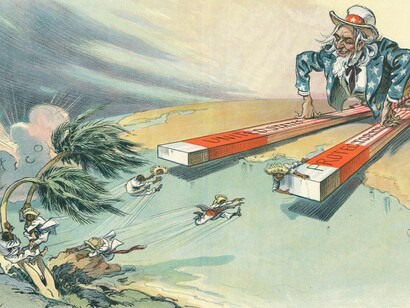
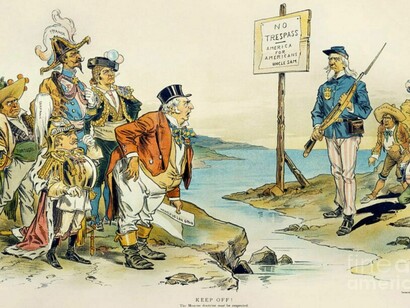
The Monroe Doctrine, named after President James Monroe and set forth in his annual message to Congress in 1823, was born in a world where danger could still be drawn with relative clarity. Europe could return. The imperial powers could attempt to restore their influence over the new American republics. The threat appeared under recognizable forms: colonization, intervention, monarchical restoration, imperial tutelage, or formal political presence.
Monroe established, then, a hemispheric line.
That line said, in essence, that the American space should not again become a political extension of the European powers. It was not yet an architecture of regional governance. It was not a coordinated system of economic, military, financial, technological, and diplomatic instruments. It was a declaration of inadmissibility. A way of saying that the hemisphere had a distinct condition and that the reinstatement of the old European imperial system would be treated as a threat.
Doctrines are not always born with all the means necessary for their execution. Sometimes they appear as orientation before the machinery capable of sustaining them exists. Monroe fixed a historical direction before the United States could fully administer its consequences. There lies part of its importance: it was not only a policy of its time, but a phrase that opened a tradition of interpretation.
The object of that first doctrine was territory understood as political space. The threat was visible. An external power could occupy, recolonize, intervene, or impose its system upon the new republics. Power arrived with flag, squadron, imperial diplomacy, and formal presence. The doctrinal response was a line: this hemisphere should not again become an object of European recolonization.
With Monroe begins the modern history of the hemispheric perimeter, but not yet its full administration.
Roosevelt and the internal risk
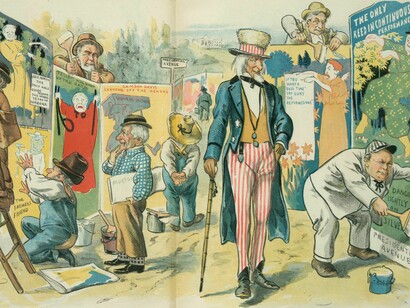
Roosevelt changed the nature of that line. He did not abandon it. He made it executive.
The Spanish-American War of 1898 had already shown the transition between Monroe and Roosevelt. The United States was ceasing to be merely the power that named a perimeter and was becoming the power capable of enforcing it. Cuba and Puerto Rico were removed from Spanish control, although they followed different political destinies, and the Caribbean ceased to appear as a distant frontier and became an immediate strategic space.
Shortly afterward, the naval blockade of Venezuela in 1902-1903, carried out by European powers to force the collection of debts, made the problem still more evident. The danger was not only that Europe might attempt to enter the hemisphere again. The danger could also lie in the internal conditions that made that entry possible. Insolvency, disorder, institutional weakness, violence, state incapacity, or collapse of authority could become a pretext for an external power to claim intervention, creditor protection, temporary occupation, or political tutelage.
That turn was decisive. Since Roosevelt, the hemisphere has not been protected only by looking outward. It was also necessary to look inward. The question was not only who wanted to enter, but what regional conditions could open the door.
There the Monroe Doctrine ceased to be a warning addressed to Europe and began to acquire the form of a mechanism. The line was no longer enough. It had to be administered. And administering it meant deciding when the internal disorder of an American country ceased to be merely a national problem and became a hemispheric risk.
That point connects Roosevelt to the present, even though today’s world is radically different from his. The problem is not to repeat his repertoire of intervention. The problem is to understand the logic he left installed: the security of the United States could be affected by the internal condition of the hemisphere. A formally sovereign state could become, through disorder, fragility, or capture, an entry point for external forces or a producer of pressures that ultimately crossed borders.
Formal sovereignty is not always enough. A country may preserve its flag, anthem, ministries, embassies, nominal elections, and seat in international organizations, while losing real control over the mechanisms that order its collective life. It may continue to appear as a state, while functioning as a platform for other powers.
That, in time, would become the central problem of the twenty-first century.
The ISM lens
From the perspective of the Integrated Security Model, or ISM, which I have discussed in other articles, security cannot be read as a sum of separate files. Migration, transnational crime, cartels, ports, supply chains, energy, telecommunications, minerals, maritime routes, debt, infrastructure, institutional corruption, external presence, and access to strategic positions are not isolated matters. They are patterns of interaction.
What matters is not to accumulate threats in a list. What matters is to understand how one condition becomes another. Disorder can become migration. Crime can become a territorial power. Debt can become a dependency. A port concession can become pressure capacity. Civilian infrastructure can acquire strategic value. A criminal network can degrade the authority of a state. And the institutional capture of one country can produce internal effects in another.
Security, read through ISM, is an integrated condition. A national community is secure when it can sustain cohesion, satisfy essential needs, preserve institutional control, protect the routes of its material life, and prevent external or transnational actors from deforming the conditions under which that community decides its future.
This allows the 2025 NSS to be read differently. The document does not treat migration, organized crime, strategic assets, non-hemispheric competitors, critical chains, and geographic access as disconnected pieces. It articulates them as conditions of a single operating environment: the Western Hemisphere. If that environment deteriorates, the effect does not remain outside. It enters. It is internalized. It crosses through the border, through the economy, through trafficking, through migratory pressure, through the vulnerability of chains, through the control of nodes, and through the erosion of state capacities.
The superficial reading sees issues. The strategic reading sees conversions.
That is the function of ISM in this article: to show that the Trump Corollary does not appear as an isolated reaction to an isolated problem. It appears as a response to an integrated condition of the hemisphere. A condition in which the internal deterioration of certain states, the action of criminal networks, the presence of external competitors, and the capture of strategic assets form part of the same pattern of pressure.
The age of capture
Monroe’s world was the world of the colony. Roosevelt’s was the world of intervention. Ours is the world of capture.
Capture does not always arrive in the form of invasion. It may enter through a seemingly technical contract, through a concession presented as investment, through a debt that at first appears manageable, through a submarine cable, a technological network, an energy infrastructure, a port, a mine, or a logistics corridor. It may also advance without noise, through military advising, opaque financing, parties that subordinate institutions, cartels that administer territory, illicit flows that integrate into the formal economy, or technological dependencies that, when the moment arrives, prevent a country from deciding without permission.
Power learned to enter without appearing as an invasion.
This does not mean that force has disappeared. It means that force has ceased to be the first face of power. In the age of capture, domination can install itself before the uniform appears. It can accumulate in silence, without spectacular deployment, until the affected country preserves its sovereign form but no longer controls the architecture through which its destiny passes.
A state can keep the map and lose the nodes. It can preserve the capital and lose the corridors. It can preserve the discourse of independence and depend on whoever controls energy, debt, communications, intelligence, ports, criminal routes, or financing. The old language of occupation falls short before that reality.
For that reason, the Trump Corollary cannot be read as a simple return to Monroe, nor as a mechanical repetition of Roosevelt, even though it needs both in order to be understood. Monroe spoke of colonies, of visible imperial presence, of the possibility that Europe might attempt to reinstall its political system over the new American republics; Roosevelt, by contrast, understood that internal disorder, insolvency, or institutional fragility could open the door to that same presence through less direct means. The Trump Corollary appears on another plane: in a hemisphere where the threat may take the form of systemic capture, that is, of material, criminal, institutional, and strategic controls that do not always suppress the formal sovereignty of a country, but do hollow it out from within until they turn it into a source of internal pressure and external vulnerability.
When the 2025 NSS speaks of non-hemispheric competitors, strategic assets, access to key locations, critical chains, and regional stability, it is using the vocabulary of that age. It does not look only at territory. It looks at the points through which territory can be conditioned.
January 3, 2026
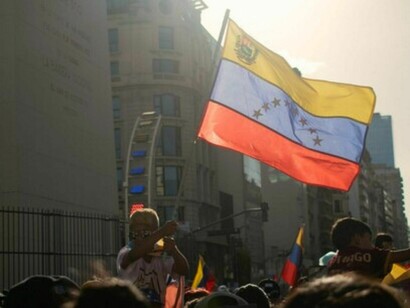
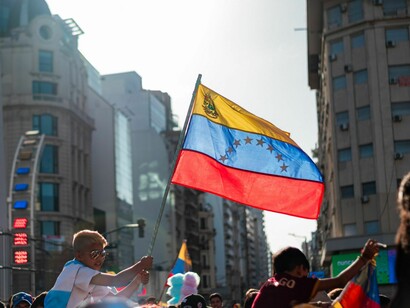
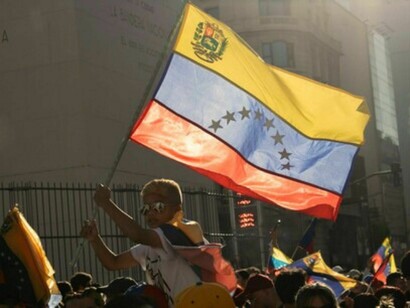
The events in Venezuela on January 3, 2026, cannot be left outside this reading. Nor should they be presented as an accusation or as a legal debate. Their meaning, within this sequence, is doctrinal. That day, with the capture and extraction of dictator Nicolás Maduro under Operation Absolute Resolve, the Trump Corollary ceased to be a formula that some could read as rhetorical excess and came to be understood as a doctrine with a real possibility of execution.
It was not the birth of the Trump Corollary. It was its moment of continental legibility.
The distinction matters. Strategic doctrines do not begin on the day an operation is executed. They begin earlier: in the diagnosis, in the hierarchy of interests, in the definition of the perimeter, in the selection of means, in the construction of capabilities, and in the will to order the environment. The operational fact does not create the doctrine. It reveals it.
The capture and extraction of Maduro had that function. It showed that the formulation of the NSS was not an ornamental piece or a historical evocation destined for domestic applause. There was a line connecting diagnosis, priority, means, and execution. That line is what turns a policy into a doctrine.
Venezuela occupied a singular place in that architecture. Not only because of the dictatorship. Also, because of the convergence of layers that, over many years, accumulated until they formed a hemispheric condition: institutional collapse, transnational crime, migratory pressure, extra-hemispheric presence, energy resources, illicit networks, structural corruption, and direct effects on the United States. Venezuela had ceased to be merely a Venezuelan problem.
That is the meaning of the point of torsion. January 3 should not be read as an isolated act against a person. The person mattered, of course: Nicolás Maduro embodied the continuity of the regime and of its system of control. But the operation had a larger reading. It marked the threshold at which a systemic capture could be treated as an inadmissible condition within the new strategic hemispheric perimeter.
From that moment on, the continent read the expression “Trump Corollary” differently. Governments read it differently. External actors read it differently. Criminal networks, regional armed forces, and economic and political elites read it differently. A doctrine can exist in a text, but it becomes fully real for others only when it demonstrates that it can produce consequences.
Doctrine, not gesture
The temptation to interpret every act of force as improvisation is strong. It is also comfortable. It allows what occurred to be reduced to temperament, opportunity, or spectacle. But that reading is not enough to explain the Trump Corollary.
A conscious strategic doctrine is recognized by its consistency. First, it defines a problem. Then it fixes a hierarchy. After that, it identifies means. Finally, when conditions require it, it executes. Its scope, convenience, or risks may be debated. But it cannot be understood as an isolated gesture when it fits within an architecture previously formulated.
The 2025 NSS had placed the Western Hemisphere at the center of a priority. It had associated regional stability, migration, transnational crime, strategic assets, critical chains, and access to key locations with American security. It had signaled the need to deny non-hemispheric competitors the possibility of controlling assets or positioning threatening capabilities. It had used a direct formulation: to reaffirm and enforce the hemispheric perimeter under a Trump Corollary.
Operation Absolute Resolve did not replace that architecture. It made it visible.
This does not mean that every future situation will be resolved in the same way. A serious doctrine is not an automatic repetition. It does not convert every problem into the same type of response. Its function is to establish criteria: what becomes inadmissible, what threshold activates priority attention, what conditions connect the external environment with internal security, and what instruments may be combined before, during, or after direct action.
In that sense, the Trump Corollary is not only a doctrine of force. It is a doctrine of conditions. Its natural field is not only the visible operational moment, but everything that happens before and after: regional alignment, reconstruction of capacities, security cooperation, intelligence, control of routes, financial instruments, energy, supply chains, maritime presence, infrastructure, nearshoring, conditionality, and the competition for strategic partnerships.
The formula Enlist and Expand must be understood from there. Enlist: align, incorporate, stabilize and make governments and regional actors participate in the production of a functional hemisphere. Expand: broaden presence, association, influence capacity, and the denial of capture by extra-hemispheric actors. Both dimensions are necessary. Stability without denial of capture remains vulnerable. Denial of capture without stability produces a vacuum. The Trump Corollary attempts to join both.
That is why the capture of Maduro was so significant. It did not exhaust the doctrine. It illuminated it. It showed that the new perimeter was not merely conceptual, that the age of capture had not eliminated the possibility of direct execution, and that hemispheric preeminence, when defined as vital, cannot remain in language.
After January 3
After January 3, the American hemisphere could no longer be read in the same way. That is the importance of the point of torsion. Not because everything changed immediately, nor because one operation resolved by itself the structural problems of the region. No operation does that. Something deeper changed: the framework of expectations.
Regional actors understood that certain levels of capture would no longer be treated as tolerable deterioration of the environment. The link between dictatorship, transnational crime, migratory pressure, extra-hemispheric presence, and strategic assets could reach a doctrinal category. The hemisphere was again being read as vital space, not merely as a diplomatic neighborhood.
That change does not cancel the dilemmas. On the contrary, it makes them more serious. A doctrine of this nature must avoid two dangers. The first is to become pure language, incapable of ordering facts. The second is to become an automatic reflex, incapable of distinguishing thresholds. Strategic consistency demands something more difficult: recognizing when a regional condition has ceased to be merely local and has begun to affect the hemispheric system.
Venezuela was that point. Not by accident, but by accumulation. For years, the country concentrated dimensions that ISM allows us to read as integrated: institutional destruction, illicit economy, human displacement, transnational criminality, political control, external alliances, energy resources, degradation of real sovereignty, and regional pressure. When those dimensions accumulate, the problem changes scale. It is no longer only an internal conflict. It is a hemispheric condition.
The Trump Corollary must be understood from that transformation. Monroe belonged to the age of visible empires. Roosevelt belonged to an age in which internal disorder could open the way to external intervention. The Trump Corollary belongs to the age of capture, where a country may preserve its sovereign symbols while losing the real mechanisms of decision, and where that loss may become direct pressure on the security of others.
The age of capture did not abolish force. It changed the threshold at which force reappears.
That is the strategic lesson of Venezuela. When capture becomes sufficiently dense, when crime, state, external actors, migration, energy, institutions, and strategic vulnerability form a single condition, doctrine ceases to be historical memory. It becomes action.
The hemisphere is no longer lost only when a foreign flag is raised over a capital. It can be lost when its ports, cables, corridors, minerals, institutions, criminal routes, and strategic flows begin to respond to another logic. It can be lost when formal sovereignty remains, but the material conditions of decision have shifted. It can be lost when a state no longer functions as an autonomous political community, but as a platform of capture.
For that reason, the Trump Corollary should not be read as a nostalgic return to Monroe, nor as a mechanical repetition of Roosevelt, nor as a theatrical gesture of power. It is a conscious and consistent strategic doctrine for an age in which hemispheric security depends less on preventing colonies and more on preventing captures.
Here, however, another test begins. The 2025 NSS gave the Corollary its language. Venezuela gave it continental legibility. But the Venezuelan transition will tell whether that doctrine can produce more than a point of torsion: whether it can also open a sequence of reconstruction.
The transition as a test
There is, for that reason, a final note I must leave stated. Venezuela has been, for much of its contemporary life, an ally, an energy partner, a point of democratic convergence, and a strategic reference for the United States within the Western Hemisphere. That memory matters because it prevents the Venezuelan case from being read as a simple relation of hostility. What deteriorated was not an inevitable national vocation, but a captured political structure that turned a country historically associated with the West into a platform of disorder, migratory pressure, transnational criminality, institutional degradation, and extra-hemispheric presence.
After the capture and extraction of Nicolás Maduro, the true challenge does not end with the removal of the dictator. It begins there. The levers of power that sustained the Venezuelan apparatus do not automatically disappear when its principal figure falls. They can adapt, mimic, simulate collaboration, speak the language of transition, and present themselves as useful instruments to avoid a vacuum. That is one of the most difficult forms of capture: not open resistance, but continuity disguised as cooperation.
The risk is clear. Part of the network that controlled Venezuela may try to survive under a pseudo-collaborationist appearance, presenting itself as a bridge, a guarantee of stability, or a lesser evil, while silently preserving the oppressive and ignominious apparatus that made the institutional destruction of the country possible. Its calculation would be temporal: resist, administer the surface, reduce external pressure, wait for the end of President Donald Trump’s mandate and, once that milestone has passed, reactivate the old anti-imperialist discourse against what has in fact been a historical constant of the hemisphere: the structural primacy of the United States as a world power and as the ordering axis of continental security.
There appears a dialectic that demands prospective reading. The Trump Corollary cannot limit itself to preventing extra-hemispheric captures, dismantling criminal networks, or removing dictatorial figures. If its meaning is to restore conditions of hemispheric security, then it must distinguish between true stability and the mere conservation of the captured apparatus. Not all continuity is order. Sometimes continuity is precisely the way disorder protects itself.
Venezuela, moreover, is not an exhausted society. It has been an example of resistance, persistence, and resurgence. The social majority of the country does not expect a cosmetic substitution of command, but a real and effective route toward democratic transition. That expectation is not secondary. It forms part of the strategic condition. Because if the Trump Corollary is oriented against institutional collapse, transnational crime, state degradation, and structural corruption because of their effects on regional order and on the United States, then it cannot be indifferent to the political destiny of Venezuelan society after the capture of Maduro.
A popular revolt in Venezuela, a probable scenario if the regime attempts to remain under another form, would have effects beyond national borders. It would very probably produce a political tide capable of radically altering the conditions of governability across much of Latin America. It would not be merely a Venezuelan crisis. It would be a hemispheric wave. And that scenario, by its own nature, would test the limits of the Trump Corollary: a doctrine designed to contain capture, crime, migration, state degradation, and external presence would also have to face the moment when a society decides to break, from within, the structure that produced those conditions.
For that reason, democratic transition is not a later detail or a secondary consequence that can be left to the ordinary administration of events. It is the practical test of the Corollary, because there it will become known whether the doctrine was capable of removing a figure without altering the system that made that figure possible, or whether, on the contrary, it can open the political space necessary to dismantle the structure of capture that turned Venezuela into a hemispheric problem. If the tyrannical apparatus manages to survive, even with another face, and simply waits for the exhaustion of the political cycle in Washington, it will have turned time into refuge. To outlast President Trump’s mandate while keeping intact the structure of capture would be, in itself, a negation of the Corollary and the beginning of its failure: it would have demonstrated capacity for action, but not capacity for transformation.
By contrast, if democratic transition begins to become a real, verifiable, and effective route, then the deeper meaning of this hemispheric vision acquires temporal projection. The Trump Corollary will not have been only the name of an operation or the rhetorical updating of Monroe. It will have functioned as strategic doctrine: not only to punish capture, but to open the space in which a nation historically allied with the United States can recover its republican condition, rebuild its institutions, and return to its natural place within the Western Hemisphere.
That is the final measure. January 3 made visible that the Corollary was in force. The Venezuelan transition will tell whether it can also endure.