English
 Español
 Français
 Deutsch
 Italiano
 Português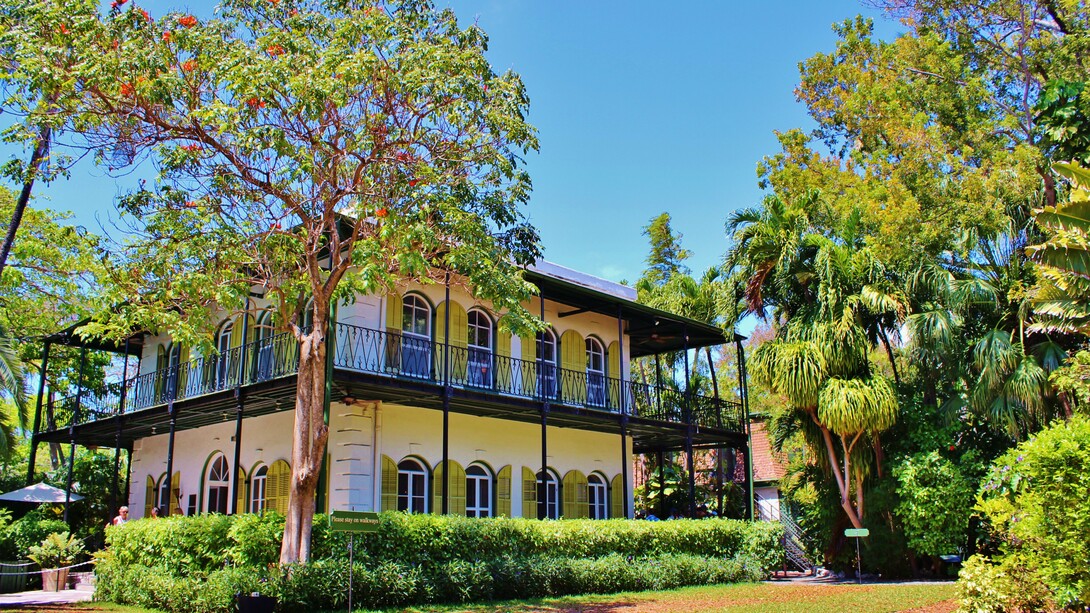
Returning from Spain, where he had covered the Spanish Civil War along with Martha Gellhorn, a young blonde he had met at Sloppy Joe’s, his favorite bar, Ernest Hemingway discovered his wife Pauline had spent an extraordinary amount of money to build a pool in their backyard, the first one on the island of Key West.
“You might as well take my last cent,” he yelled, throwing a penny to the ground.
It was all drama and no reality, as it was Pauline who paid for the pool just as her wealthy uncle, Gustavus Pfeiffer, had paid for the French Colonial-style house at 907 Whitehead Street where they lived. Hemingway had been in Spain.
Pauline, with a touch of class and whimsical humor, embedded the penny in the concrete by the pool and that’s where I’m standing as the docent at the Ernest Hemingway Home & Museum tells us the story of Ernest Hemingway’s life on the island.
But let’s go back to how Pauline and Ernest met in Paris when she was visiting there with her younger sister, Virginia, and he lived in the city with his wife, Hadley. The four were all part of the same social circle and soon Hemingway, finding himself in love with both Pauline and Hadley, had to make a choice. He chose Pauline despite Hadley being the mother of his son.
Don’t feel sorry for Hadley, though; she soon met the man she would remain married to for the rest of her life and also secured the rights and royalties in perpetuity to her soon-to-be ex-husband’s first major bestseller, “The Sun Also Rises.” As the book became more successful, the royalties increased and, in the 1930s, were worth about $30,000 a year, equivalent to $640,000 a year in today’s money. A new love and lots of money can cure a broken heart pretty quickly.
The urinal
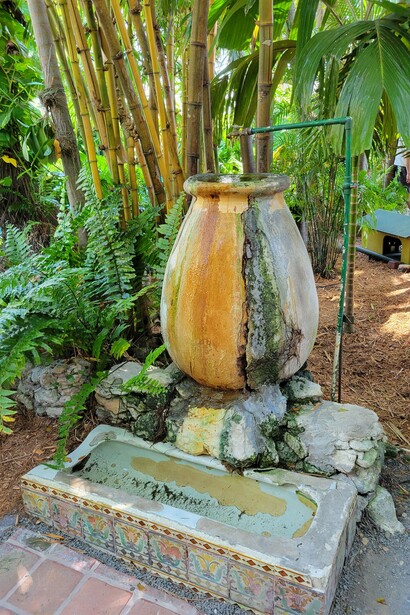
Nearby, nestled into the lush foliage of the gardens at Hemingway’s home, is the urinal the writer took from Sloppy Joe’s, his favorite bar, when the owner was changing locations. His reasoning was that since he’d “pissed away enough money” at Sloppy Joe’s, he deserved the urinal. Pauline, with her usual aplomb, decorated it with tiles, turning it into a drinking fountain for all their polydactyl or six-toed cats.
Extra toes and lots of cats
Which brings us to the cats. The Hemingways had a six-toed cat named Snow White who obviously was into reproduction big time because currently there are an estimated 60 cats, many of them with extra toes, living on the 1.5-acre estate.
It is the only museum I’ve ever visited with live cats sprawled all over the place. But then this is Key West, a place known for its independent spirit and vibe. That reputation was why I was surprised to find that beyond the liveliness of the docks, beaches, and trendy neighborhoods like Duval, much of the island resembles Charleston or Savannah, its streets lined with perfectly preserved historic homes surrounded by immaculate gardens.
The home styles are varied. Cozy shotgun cottages, so called because a bullet shot through the front door would travel down the central hallway and out the back without hitting a thing, are accented with gingerbread trim and, like many of the homes here no matter their size, shuttered windows and doors. The larger Bahamian manses feature wraparound verandas and second-story balconies, and elaborate Queen Anne homes are notable for their architectural flamboyancy of multiple gables, turrets, peaked roofs, and bay windows.
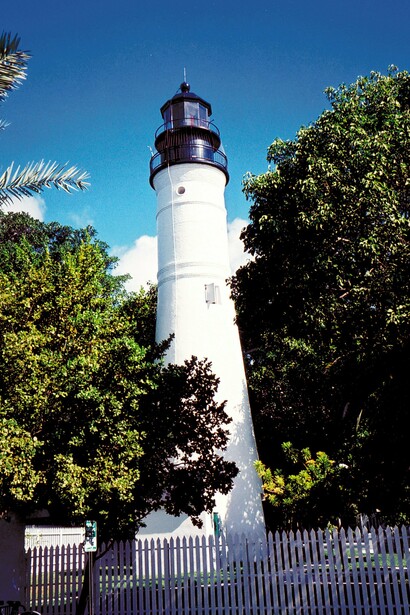
Less common is the French-Colonial style of the Hemingway house, which is situated on the second highest site on the island, a 16-foot rise across the way from the Key West Lighthouse. Built in 1851, it had been a showpiece in its time but had long stood abandoned when Pauline convinced her Uncle Gus to shell out $8,000, or about $186,000 in today’s money, and then had it restored.
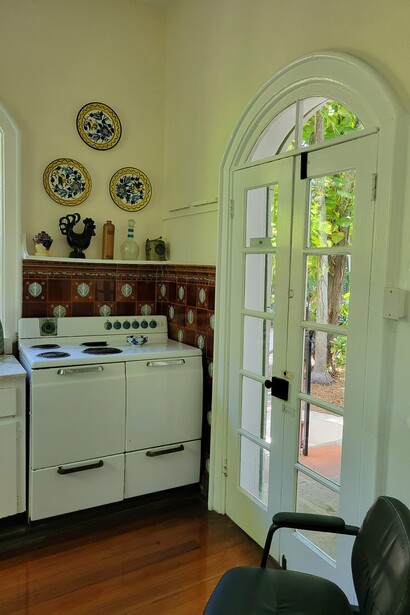
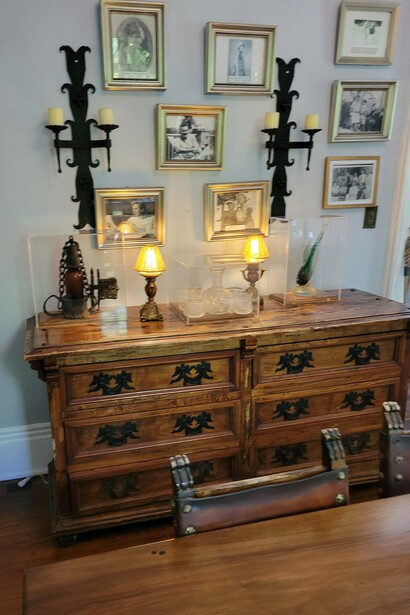
Decorated by Pauline, Ernest added his hunting trophies to his second-floor office above the carriage house in the back. The ambience of the home is gentle and serene, a little different than it was when the Hemingway family lived there and seemingly perfect for writing bestselling novels.
Hemingway’s hangouts
But Hemingway, being Hemingway, spent a lot of time at Sloppy Joe’s Bar at 201 Duval Street, just a 15-minute walk from his home. It’s where he met Martha Gelhorn, a pretty ambitious blonde who was 11 years younger and in town on a family vacation.
The sprawling bar hasn’t changed much over the years, though I don’t know if they had live entertainment back in Hemingway’s day and they wouldn’t have had pizza, which is on the menu now, because pizza mostly didn’t exist in the U.S. in the 1930s. They did, as one would expect, have daiquiris (the drink Hemingway made famous) and Papa Doble daiquiris—a concoction of rum and maraschino cherry liqueur mixed with lime and grapefruit juice. It’s served in a double-sized cocktail glass.
I also visit Captain Tony's Saloon, where Sloppy Joe’s Bar was originally located. It was here that Hemingway first met Sloppy Joe’s owner, Josie Russell, who cashed a $1000 check for him after the bank refused to do so. But its history is interesting beyond the Hemingway connection. Built in 1851, the original building served both as a morgue and an icehouse, which makes sense in a macabre way. As an aside, Captain Tony’s is where Jimmy Buffet got his start.
Island cuisine
Instead of steak, said to be Hemingway’s favorite dish, I opt for the conch fritters at Sunset Pier with its views of the water, the Spicy Cajun Jambalaya at Caroline’s Café, located in a quiet neighborhood off of Duval, and a slice of pie at Kermit’s Key Lime Pie Shop on Elizabeth Street. You can get it with meringue or without—I went for the meringue.
On Duval Street, I stop at Fat Tuesday on Duval for a frozen daiquiri to go and then make my way to Mallory Square, where there’s a sunset celebration every night. It’s a crowd scene with vendors and artists selling their goods, live music, and street performers. But beyond that, it’s a spectacular place to watch the setting sun painting the sky rainbow colors and highlighting the sails of boats passing by and I imagine that Hemingway took his boat along the shore here in his search for marlins almost a century ago. In his search for marlins, he met a man who had fished for these giant fish for 40 years and crafted a story around him called “The Old Man and the Sea.”
But Hemingway’s time on the island was getting shorter. Divorcing Pauline in 1940 and marrying Martha a few weeks later, the couple moved to Cuba. That marriage lasted only five years and shortly after he remarried for the fourth and final time, his life ending with a shotgun blast in 1961 in Ketchum, Idaho.
Pauline continued to live on Key West with their two sons until her untimely death in 1951.
But the house and the places where Hemingway loved to drink and the sea where he fished remain and tell the story of a place he loved, if only for a short time.